THE CLASSIC COLLECTION✦The Shield of LoveCLASSIC FREE BOOKS
The Shield of Love
B. L. (Benjamin Leopold) Farjeon
THE CLASSIC COLLECTION · 1903
"The House of the White Shadows" by B. L. Farjeon is a novel written in the early 20th century. The story revolves around a murder trial that captivates the city of Geneva, centering on Gautran, a woodman accused of murdering a flower-girl named Madeline. As the trial unfolds, themes of love, jealousy, and class struggle emerge, particularly through the character of the renowned Advocate who takes on Gautran's defense. The opening of the novel sets a tense atmosphere, highlighting the excitement in Geneva over the impending trial of Gautran, the brutal suspicion that surrounds him, and the tragic fate of Madeline. We are introduced to the dynamics of their relationship, revealing Gautran’s possessiveness and jealousy, and the societal backdrop that complicates these themes. The narrative hints at deeper secrets involving Madeline’s past and her protector, Pauline, creating an intricate web of intrigue. In parallel, the arrival of the Advocate and his wife at the enigmatic House of White Shadows sets the stage for a story that will intertwine their lives with the criminal case, suggesting a journey into the mysteries and moral dilemmas surrounding justice and personal redemption.
Introduction adapted from the source catalogue; source summaries may be automatically generated.
Free to read · English · 132,640 words · No account needed
MAKE TIME FOR A GOOD BOOK
On by default. Untick to stop anonymous reading totals. Each page counts after 10 seconds in view. How this works.
Anonymous counting is on unless you have switched it off.
"You said you must see Madeline. The Widow Joseph went into the house, and returned with the message that Madeline would not see you. Upon that you tried to force your way into the house, and struck the woman because she prevented you. Madeline came down, alarmed at the sounds of the struggle, and begged you to go away, and you said you would, now that you had seen her, as you had made up your mind to. What have you to say to this?"
"A batch of lies. Twenty women could not have prevented me getting
into the house."
"You think yourself a match for twenty women?"
"Aye."
"And for as many men?"
"For one man, whoever he may be. Give me the chance of proving it."
"Do you know Heinrich Heitz?"
"No."
"He is, like yourself, a woodcutter."
"There are thousands of woodcutters."
"Did you and he not work together as partners?"
"We did not."
"Were you not continually quarrelling, and did he not wish to break
the partnership?"
"No."
"In consequence of this, did you not threaten to murder him?"
"No."
"Did you not strike him with a weapon, and cut his forehead open?"
"No."
"How many women have you loved?"
"One."
"Her name?"
"Madeline."
"You never loved another?"
"Never."
"Have you been married?"
"No."
"Have you ever lived with a woman who should have been your wife?"
"Never."
"Did you not continually beat this poor woman until her life became a burden to her, and she was compelled to fly from you to another part of the country?"
"No."
"Do you expect to be believed in the answers you have given?"
"No."
"It is said that you possess great strength."
"It has served me in good stead."
"That you are a man of violent passions."
"I have my feelings. I would never submit to be trampled on."
"You were always kind to Madeline?"
"Always."
"On the night of her murder?"
"Yes."
"Witnesses will prove that you were heard to say, 'I will kill you! I will kill you!' Do you deny saying so?"
"No."
"How does that cruel threat accord with a mild and affectionate
nature?"
"I was asking her whether she had another lover, and I said if she had, and encouraged him, that I would kill her."
"The handkerchief found round her neck was yours."
"I gave it to her as a love-gift."
"A terrible love-gift. It was not wound loosely round her neck; it was tight, almost to strangulation."
"She must have made it so in her struggles, or----"
"Or?"
"The man who killed her must have attempted to strangle her with it."
"That is your explanation?"
"Yes."
Your reading position is saved on this browser. Take it to another device with a library code. Reading pages adapt to text, rather than matching a printed edition.
B. L. (Benjamin Leopold) Farjeon
B. L. (Benjamin Leopold) Farjeon
B. L. (Benjamin Leopold) Farjeon
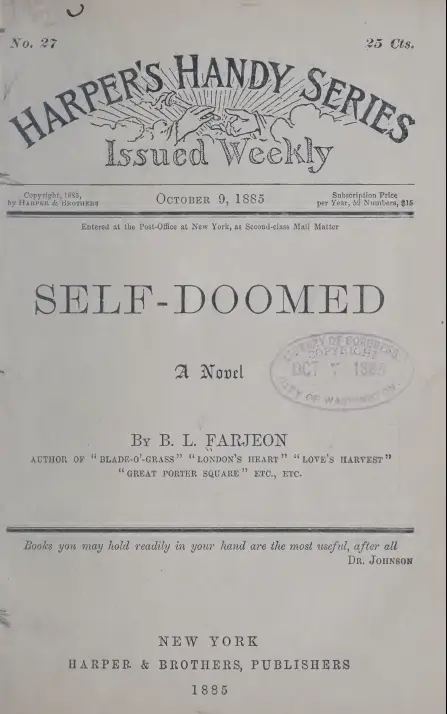
B. L. (Benjamin Leopold) Farjeon
BEHIND THE BOOK
This eBook is for the use of anyone anywhere in the United States and most other parts of the world at no cost and with almost no restrictions whatsoever. You may copy it, give it away or re-use it under the terms of the Project Gutenberg License included with this eBook or online at www.gutenberg.org. If you are not located in the United States, you will have to check the laws of the country where you are located before using this eBook. Read the source licence.
The original source file, including credits and licence, is retained by this library. Request an original-format copy at no charge. Please include the book title and Project Gutenberg identifier #42973.
KEEP YOUR CURIOSITY GOING
Coulson Kernahan

Maurice Baring
Frances Wright
Cécile Tormay

Frederic Jesup Stimson

W. H. P. (William Henry Pope) Jarvis