THE CLASSIC COLLECTION✦The Shield of LoveCLASSIC FREE BOOKS
The Shield of Love
B. L. (Benjamin Leopold) Farjeon
THE CLASSIC COLLECTION · 1903
"The House of the White Shadows" by B. L. Farjeon is a novel written in the early 20th century. The story revolves around a murder trial that captivates the city of Geneva, centering on Gautran, a woodman accused of murdering a flower-girl named Madeline. As the trial unfolds, themes of love, jealousy, and class struggle emerge, particularly through the character of the renowned Advocate who takes on Gautran's defense. The opening of the novel sets a tense atmosphere, highlighting the excitement in Geneva over the impending trial of Gautran, the brutal suspicion that surrounds him, and the tragic fate of Madeline. We are introduced to the dynamics of their relationship, revealing Gautran’s possessiveness and jealousy, and the societal backdrop that complicates these themes. The narrative hints at deeper secrets involving Madeline’s past and her protector, Pauline, creating an intricate web of intrigue. In parallel, the arrival of the Advocate and his wife at the enigmatic House of White Shadows sets the stage for a story that will intertwine their lives with the criminal case, suggesting a journey into the mysteries and moral dilemmas surrounding justice and personal redemption.
Introduction adapted from the source catalogue; source summaries may be automatically generated.
Free to read · English · 132,640 words · No account needed
MAKE TIME FOR A GOOD BOOK
On by default. Untick to stop anonymous reading totals. Each page counts after 10 seconds in view. How this works.
Anonymous counting is on unless you have switched it off.
"My Own,--My husband is uneasy about you, and has imposed a task upon me. You shall judge for yourself whether it is a disagreeable one. I am to write to you immediately, to insist upon your coming to us without an hour's delay. You have not the option of refusal. The Advocate insists upon it, and I also insist upon it. You must come. Upon the receipt of this letter you will pack up your portmanteau, and travel hither in the swiftest possible way, by the shortest possible route. Be sure that you do not disobey me. You are to come instantly, without an hour's--nay, without a moment's delay. If you fail I will not answer for the consequences, and upon you will rest the responsibility of all that follows. For what reason, do you suppose, did I accept the offer of your villa in this strangely quiet valley, unless it was in the hope and the belief that we should be near each other? And now that I am here, pledged to remain, unable to leave without an exhibition of the most dreadful vacillation--which would not matter were I to have my own way, and were everything to be exactly as I wish it--you are bound to fly swiftly to the side of one who entertains for you the very sincerest affection. Do not be angry with me for my disregard of your caution to be careful in my manner of writing to you. I cannot help it. I think of you continually, and if you wish me not to write what you fear other eyes than ours might see, you must come and talk to me. I shall count the minutes till you are here. The Advocate is uneasy about you, and is, indeed and indeed, most anxious that you should be with us. He seems to have an idea that you have some cause for melancholy, and that you are brooding over it. Could anything be more absurd? Cause for melancholy! Just as if you were alone in the world! You do not need to be told that there is one being who will care for you till she is an old, old woman. Think of me as I shall be then. An old woman, with white hair, walking with a crutch-stick, as they do on the stage. If you are sad, it is a just punishment upon you. There was nothing in the world to prevent your travelling with us. What do you think a friend of yours, a banker in Geneva, suggested to the Advocate? He said that it was probable that you had experienced a disappointment in love. Now, this sets me thinking. Why have you chosen to hide yourself in the mountains, a hundred and a hundred miles away? Have you been there before? Is there some pretty girl to attract you, from whom you find it impossible to tear yourself? If it is so, let her beware of me. You have no idea of what I should be capable if you gave me cause for jealousy. What is her disposition--pensive or gay? She is younger than I am, I suppose--though I am not so old, sir!--with hands---- Ah, I am easier in my mind; her hands must be coarse, for she is a peasant. I am almost reconciled; you could never fall in love with a peasant. They may be pretty and fresh for a month or two, but they cannot help being coarse, and I know how anything coarse grates upon you. But a peasant-girl might fall in love with you--there are more unlikely things than that. Shall I tell you what the Advocate said of you this evening? It will make you vain, but never mind. 'I have never in my life known a man more likely to inspire love in a woman's heart than Christian Almer.' There, sir, his very words. How true they are! Ah, how cruel was the chance that separated us from each other, and brought us together again when I was another man's wife! Oh, if I had only known! If some kind fairy had told me that the man who, when I was a child, enthralled me with his beautiful fancies, and won my heart, and who then, as it seemed, passed out of my life--if I had suspected that, after many years, he would return home from his wanderings with the resolve to seek out the child and make her his wife, do you for one moment suppose I would not have waited for him? Do you think it possible I could ever have accepted the hand of another man? No, it could not have been, for even as a child I used to dream of you, and held you in my heart above all other human beings. But you were gone--I never thought of seeing you again--and I was so young that I could have had no foreshadowing of what was to come.
Your reading position is saved on this browser. Take it to another device with a library code. Reading pages adapt to text, rather than matching a printed edition.
B. L. (Benjamin Leopold) Farjeon
B. L. (Benjamin Leopold) Farjeon
B. L. (Benjamin Leopold) Farjeon
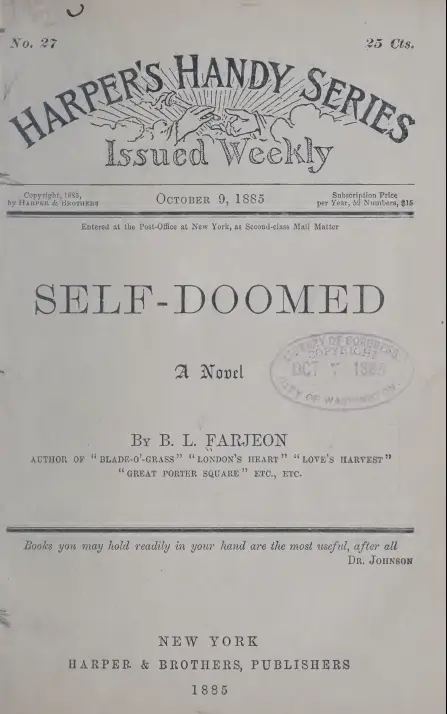
B. L. (Benjamin Leopold) Farjeon
BEHIND THE BOOK
This eBook is for the use of anyone anywhere in the United States and most other parts of the world at no cost and with almost no restrictions whatsoever. You may copy it, give it away or re-use it under the terms of the Project Gutenberg License included with this eBook or online at www.gutenberg.org. If you are not located in the United States, you will have to check the laws of the country where you are located before using this eBook. Read the source licence.
The original source file, including credits and licence, is retained by this library. Request an original-format copy at no charge. Please include the book title and Project Gutenberg identifier #42973.
KEEP YOUR CURIOSITY GOING
Coulson Kernahan

Maurice Baring
Frances Wright
Cécile Tormay

Frederic Jesup Stimson

W. H. P. (William Henry Pope) Jarvis