THE CLASSIC COLLECTION✦The Shield of LoveCLASSIC FREE BOOKS
The Shield of Love
B. L. (Benjamin Leopold) Farjeon
THE CLASSIC COLLECTION · 1903
"The House of the White Shadows" by B. L. Farjeon is a novel written in the early 20th century. The story revolves around a murder trial that captivates the city of Geneva, centering on Gautran, a woodman accused of murdering a flower-girl named Madeline. As the trial unfolds, themes of love, jealousy, and class struggle emerge, particularly through the character of the renowned Advocate who takes on Gautran's defense. The opening of the novel sets a tense atmosphere, highlighting the excitement in Geneva over the impending trial of Gautran, the brutal suspicion that surrounds him, and the tragic fate of Madeline. We are introduced to the dynamics of their relationship, revealing Gautran’s possessiveness and jealousy, and the societal backdrop that complicates these themes. The narrative hints at deeper secrets involving Madeline’s past and her protector, Pauline, creating an intricate web of intrigue. In parallel, the arrival of the Advocate and his wife at the enigmatic House of White Shadows sets the stage for a story that will intertwine their lives with the criminal case, suggesting a journey into the mysteries and moral dilemmas surrounding justice and personal redemption.
Introduction adapted from the source catalogue; source summaries may be automatically generated.
Free to read · English · 132,640 words · No account needed
MAKE TIME FOR A GOOD BOOK
On by default. Untick to stop anonymous reading totals. Each page counts after 10 seconds in view. How this works.
Anonymous counting is on unless you have switched it off.
"Most likely. Master, you go deeper than I do."
"What relationship existed between Pauline and Madeline?"
"Some said they were sisters, but there was a big difference in their ages. Others said that Pauline was her mother, but I don't believe it, for they never spoke together in that way. Master, I don't know what to say about it; it used to puzzle me; but it was no business of mine."
"Did you never hear Pauline address Madeline as her child?"
"Never."
"They addressed each other by their Christian names?"
"Yes."
"Did they resemble each other in feature?"
"There was something of a likeness between them."
"Why did Pauline leave the girl?"
"No one knew."
"That is all you can tell me?"
"That is all."
Then after a slight pause, the Advocate asked:
"Do you value your liberty?"
"Yes, master," replied Gautran excitedly.
"Let no person know what has passed between us, and do not repeat one
word I have said to you."
"I understand; you may depend upon me. But master, will you not tell me something more? Am I to be set free or not?"
"You are to be tried; what is brought against you at your trial will establish either your innocence or your guilt."
He knocked at the door of the prison cell, and the gaoler opened it
for him and let him out.
"Well, Gautran?" said the gaoler, but Gautran, wrapped in contemplation of the door through which the Advocate had taken his departure, paid no attention to him. "Do you hear me?" cried the gaoler, shaking his prisoner with no gentle hand.
"What now?"
"Is the great lawyer going to defend you?"
"You want to know too much," said Gautran, and refused to speak
another word on the subject.
During the whole of the day there were but two figures in his mind--those of the Advocate and the murdered girl. The latter presented itself in various accusing aspects, and he vainly strove to rid himself of the spectre. Its hair hung in wild disorder over neck and bosom, its white lips moved, its mournful eyes struck terror to his soul. The figure of the Advocate presented itself in far different aspects; it was always terrible, Satanic, and damning in its suggestions.
"What matter," muttered Gautran, "if he gets me off? I can do as I
please then."
In the evening, when the small window in his cell was dark, the gaoler heard him crying out loudly. He entered, and demanded what ailed the wretch.
"Light--light!" implored Gautran; "give me light!"
"Beast in human shape," said the gaoler; "you have light enough. You'll get no more. Stop your howling, or I'll stop it for you!"
Your reading position is saved on this browser. Take it to another device with a library code. Reading pages adapt to text, rather than matching a printed edition.
B. L. (Benjamin Leopold) Farjeon
B. L. (Benjamin Leopold) Farjeon
B. L. (Benjamin Leopold) Farjeon
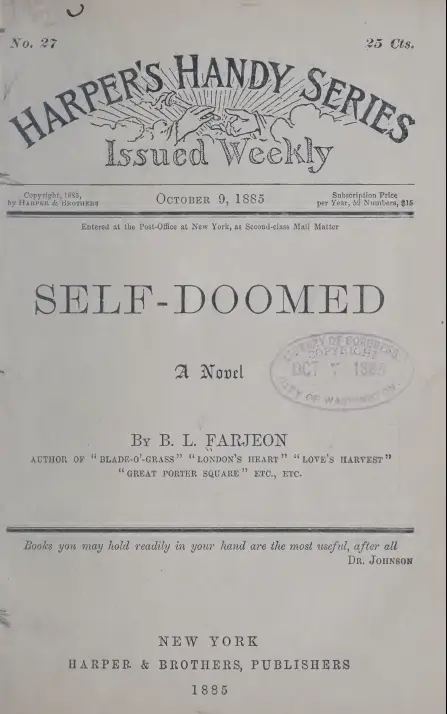
B. L. (Benjamin Leopold) Farjeon
BEHIND THE BOOK
This eBook is for the use of anyone anywhere in the United States and most other parts of the world at no cost and with almost no restrictions whatsoever. You may copy it, give it away or re-use it under the terms of the Project Gutenberg License included with this eBook or online at www.gutenberg.org. If you are not located in the United States, you will have to check the laws of the country where you are located before using this eBook. Read the source licence.
The original source file, including credits and licence, is retained by this library. Request an original-format copy at no charge. Please include the book title and Project Gutenberg identifier #42973.
KEEP YOUR CURIOSITY GOING
Coulson Kernahan

Maurice Baring
Frances Wright
Cécile Tormay

Frederic Jesup Stimson

W. H. P. (William Henry Pope) Jarvis