THE CLASSIC COLLECTION✦The Shield of LoveCLASSIC FREE BOOKS
The Shield of Love
B. L. (Benjamin Leopold) Farjeon
THE CLASSIC COLLECTION · 1903
"The House of the White Shadows" by B. L. Farjeon is a novel written in the early 20th century. The story revolves around a murder trial that captivates the city of Geneva, centering on Gautran, a woodman accused of murdering a flower-girl named Madeline. As the trial unfolds, themes of love, jealousy, and class struggle emerge, particularly through the character of the renowned Advocate who takes on Gautran's defense. The opening of the novel sets a tense atmosphere, highlighting the excitement in Geneva over the impending trial of Gautran, the brutal suspicion that surrounds him, and the tragic fate of Madeline. We are introduced to the dynamics of their relationship, revealing Gautran’s possessiveness and jealousy, and the societal backdrop that complicates these themes. The narrative hints at deeper secrets involving Madeline’s past and her protector, Pauline, creating an intricate web of intrigue. In parallel, the arrival of the Advocate and his wife at the enigmatic House of White Shadows sets the stage for a story that will intertwine their lives with the criminal case, suggesting a journey into the mysteries and moral dilemmas surrounding justice and personal redemption.
Introduction adapted from the source catalogue; source summaries may be automatically generated.
Free to read · English · 132,640 words · No account needed
MAKE TIME FOR A GOOD BOOK
On by default. Untick to stop anonymous reading totals. Each page counts after 10 seconds in view. How this works.
Anonymous counting is on unless you have switched it off.
"This would have served," replied Pierre Lamont, tapping his forehead with his forefinger. "I should have contrived so as to be a match for them. Bring that small table close to the bedside. Now place the lamp on it. Put your hand into the tail-pocket of my coat; you will find a silk handkerchief there."
He tied the handkerchief--the colour of which was yellow--about his head; and as the small, thin face peeped out of it, brown-skinned and hairless, it looked like the face of a mummy.
Fritz gazed at him, and laughed immoderately, and Pierre Lamont nodded and nodded at the fool, with a smile of much humour on his lips.
"Enjoy yourself, fool, enjoy yourself," he said kindly; "but don't pass your life in laughter; it is destructive of brain power. What do you think of the spirit, Fritz, the appearance of which so alarmed one of the young ladies in our merry party to-night?"
"What do you think of it?" asked Fritz in return, with a quivering of his right eyelid, which suspiciously resembled a wink.
"Ah, ah, knave!" cried Pierre Lamont, chuckling. "I half suspected
you."
"You will not tell on me, Master Lamont?"
"Not I, fool. How did you contrive it?"
"With a white sheet and a lantern. I thought it a pity that my lady should be disappointed. Should she leave the place without some warranty that spirits are here, the house would lose its character. Then there is the young master, your Christian Almer. He spoke to me very much as if I were a beast of the field instead of a--fool. So I thought I would give him food for thought."
"A dangerous trick, Fritz. Your secret is safe with me, but I would not try it too often. Are there any books in the room? Look about, Fritz, look about."
"For books!" exclaimed Fritz. "People go to bed to sleep."
"I go to bed to think," retorted Pierre Lamont, "and read. People are idiots--they don't know how to use the nights."
"Men are not owls," said Fritz. "There are no books in the room."
"How shall I pass the night?" grumbled Pierre Lamont. "Open that drawer; there may be something to read in it."
Fritz opened the drawer; it was filled with books. Pierre Lamont
uttered a cry of delight.
"Bring half-a-dozen of them--quick. Now I am happy."
He opened the books which Fritz handed to him, and placed them by his side on the bed. They were in various languages. Lavater, Zimmermann, a Latin book on Demonology, poems of Lope da Vega, Klingemann's tragedies, Italian poems by Zappi, Filicaja, Cassiani, and others.
"You understand all these books, Master Lamont?"
Your reading position is saved on this browser. Take it to another device with a library code. Reading pages adapt to text, rather than matching a printed edition.
B. L. (Benjamin Leopold) Farjeon
B. L. (Benjamin Leopold) Farjeon
B. L. (Benjamin Leopold) Farjeon
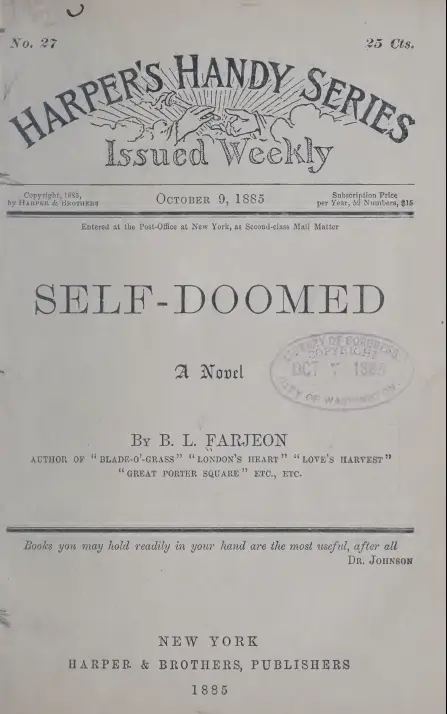
B. L. (Benjamin Leopold) Farjeon
BEHIND THE BOOK
This eBook is for the use of anyone anywhere in the United States and most other parts of the world at no cost and with almost no restrictions whatsoever. You may copy it, give it away or re-use it under the terms of the Project Gutenberg License included with this eBook or online at www.gutenberg.org. If you are not located in the United States, you will have to check the laws of the country where you are located before using this eBook. Read the source licence.
The original source file, including credits and licence, is retained by this library. Request an original-format copy at no charge. Please include the book title and Project Gutenberg identifier #42973.
KEEP YOUR CURIOSITY GOING
Coulson Kernahan

Maurice Baring
Frances Wright
Cécile Tormay

Frederic Jesup Stimson

W. H. P. (William Henry Pope) Jarvis