THE CLASSIC COLLECTION✦The man in the street: Papers on American topicsCLASSIC FREE BOOKS
The man in the street: Papers on American topics
Meredith Nicholson
THE CLASSIC COLLECTION · 1900
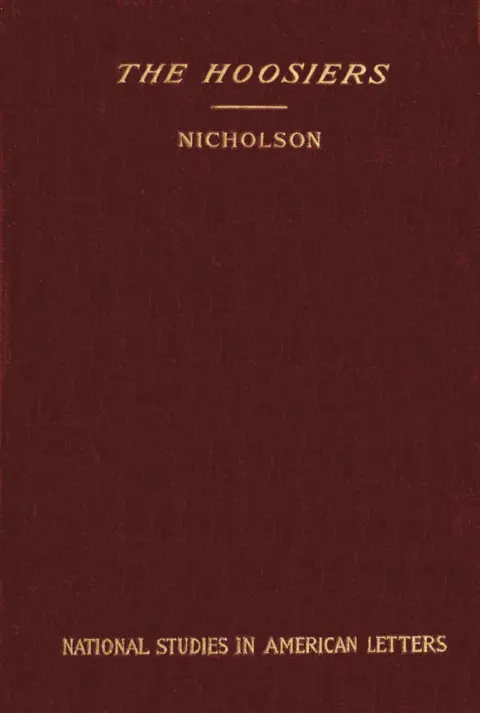
"The Hoosiers" by Meredith Nicholson is a historical account written in the late 19th century. The work examines the cultural, social, and literary evolution of Indiana, highlighting the state's development and the various forces that shaped it over time. Nicholson presents a nuanced portrayal of the Hoosier identity, countering common stereotypes about the inhabitants with a deeper understanding of their contributions to American culture. At the start of "The Hoosiers," the author sets the stage for a comprehensive exploration of Indiana's historical context, emphasizing how the state's origins and early inhabitants influenced its intellectual life. He discusses the complex relationship between the Hoosiers’ pioneering past and their eventual emergence as a community capable of substantive literary and cultural output. The opening chapters introduce the state's formation and early demographics, providing a backdrop for the subsequent discussion about the development of education and cultural enlightenment in Indiana. Through a meticulous review of historical influences and prominent figures, Nicholson argues that the progress of Indiana should be recognized not merely as a series of literary achievements but as a collective effort to uplift the community's general cultivation.
Introduction adapted from the source catalogue; source summaries may be automatically generated.
Free to read · English · 51,323 words · No account needed
MAKE TIME FOR A GOOD BOOK
On by default. Untick to stop anonymous reading totals. Each page counts after 10 seconds in view. How this works.
Anonymous counting is on unless you have switched it off.
[8] “History of Indianapolis and Marion County,” p. 72.
[9] “Early Indiana Trials,” p. 450.
[10] “Sketches,” p. 45.
[11] Woollen’s “Sketches,” p. 265.
[12] Banta’s “Johnson County,” p. 55.
[13] The Current, November, 1884.
[14] “The New Purchase,” p. 401.
[15] “Neighborly Poems,” p. 26.
[16] Report of W. A. Ketcham, attorney-general, 1897-8, p. 173.
[17] Fifth Edition, 1872, pp. 171-172.
[18] The Forum, Vol. 14, p. 465.
[19] Sulgrove, p. 90.
[20] “Dialect Notes,” Part VIII, p. 392.
[21] “The New Purchase,” p. 143.
[22] “Dialect Notes,” Part IV, p. 211.
[23] D before i or u does not become j in cultivated usage anywhere at the west. Personally, I have never heard Injiana within the State; but I have heard it from a Bostonian, a native of Maine, who had never lived outside of New England.
[24] “Souvenir of the Western Association of Writers,” 1891.
[25] “Indiana Methodism,” p. 317.
[26] Edson’s “Early Indiana Presbyterianism,” p. 171.
[27] Evans’s “Pioneer Preachers,” p. 43; Edson’s “Early Indiana Presbyterianism,” p. 40.
[28] Goodwin’s “Heroic Women of Indiana Methodism,” p. 9.
[29] Woodburn’s “Higher Education in Indiana,” p. 31.
[30] Woodburn, p. 75.
[31] In Dr. Hall’s narrative “Woodville,” “Spiceburg,” “Sugartown,” “Sproutsburg,” and “Timberopolis” are respectively Bloomington, Spencer, Crawfordsville, Lafayette, and Indianapolis. The author assumes the names “Carlton” and “Mr. Clarence.” “Cutswell” became Governor Whitcomb; “The Rev. James Hilsbury” is the Rev. Isaac Reed; “Dr. Bloduplex” is Dr. Wiley, and “Dr. Shrub” is the Rev. George Bush.
[32] Banta’s “History of Indiana University,” p. 44.
[33] Boone’s “History of Education in Indiana,” p. 87.
[34] “Caleb Mills and Indiana Common Schools,” Tuttle Miscellany,
Vol. 38.
[35] Boone’s “Education in Indiana,” p. 87.
[36] Boone, supra, p. 104 et seq.
[37] In 1899 Indiana’s total school fund, exclusive of college endowment, was $10,312,000. The school revenue for that year, from all sources, was $6,534,300. The census of 1890 showed the per cent of illiterates (ten years of age and older) in Indiana to be 6.32; in Ohio 5.24; in Illinois 5.25; in Michigan 5.92. In Massachusetts it was 6.22; in New York 5.53; in New Jersey 6.50; in Pennsylvania 6.78.
[38] “Some Western Schoolmasters,” Scribner’s Magazine, Vol. 17, p.
747.
[39] Scribner’s, supra.
[40] One of the passengers on “the boat load of knowledge,” Victor Duclas, is still living (July, 1900) at New Harmony.
[41] The Forum, November, 1890.
[42] The Forum, supra.
[43] “War Papers,” Indiana Commandery, Loyal Legion, 1898.
[44] “Essays at Home and Elsewhere,” p. 211.
[45] “Beginnings of Literary Culture in the Ohio Valley,” by W. H. Venable, LL.D., p. 58 et seq.
[46] Atlantic Monthly, Vol. 35.
[47] Indianapolis News, March 2, 1895.
Italicized text is surrounded by underscores: italics.
Obvious typographical errors have been corrected.
Inconsistencies in hyphenation have been standardized.
Your reading position is saved on this browser. Take it to another device with a library code. Reading pages adapt to text, rather than matching a printed edition.
Meredith Nicholson
Meredith Nicholson
Meredith Nicholson

Meredith Nicholson
BEHIND THE BOOK
This eBook is for the use of anyone anywhere in the United States and most other parts of the world at no cost and with almost no restrictions whatsoever. You may copy it, give it away or re-use it under the terms of the Project Gutenberg License included with this eBook or online at www.gutenberg.org. If you are not located in the United States, you will have to check the laws of the country where you are located before using this eBook. Read the source licence.
The original source file, including credits and licence, is retained by this library. Request an original-format copy at no charge. Please include the book title and Project Gutenberg identifier #66276.
KEEP YOUR CURIOSITY GOING
Cécile Tormay

Moritz Busch
John L. Ransom
Frances Wright
Cécile Tormay

Mabel Potter Daggett