READ · DISCOVER · ENJOYClassic literature · Always free
THE CLASSIC COLLECTION✦The Homosexual NeurosisWilhelm StekelCLASSIC FREE BOOKS

THE CLASSIC COLLECTION · 1922

The Homosexual Neurosis

"The Homosexual Neurosis" by Wilhelm Stekel is a scientific publication written in the early 20th century. The work delves into the psychological dimensions of homosexuality, exploring various factors such as familial relationships, individual experiences, and the dynamics of sexual attraction. It aims to shed light on the complexities associated with homosexual behavior and its neurological or emotional roots, making fundamental distinctions in the current understanding of sexual orientations. At the start of the book, the opening section includes a translated preface by the translator, which emphasizes the significance of Stekel's clinical studies rooted in Freudian psychoanalysis. It presents the context of the text as a continuation of prior discussions on bisexuality and autoerotism. The first chapter introduces the themes of fear, disgust, and aversion that homosexuals may experience towards the opposite sex, along with discussions on neuroses and personal experiences connected to sexuality. The text begins to outline the ideas and findings regarding the psychological barriers that influence sexual preference, setting a foundation for the comprehensive clinical evaluations and theories that follow in the text.

Introduction adapted from the source catalogue; source summaries may be automatically generated.

Start reading ↓

Free to read · English · 73,261 words · No account needed

MAKE TIME FOR A GOOD BOOK

The Homosexual Neurosis

On by default. Untick to stop anonymous reading totals. Each page counts after 10 seconds in view. How this works.

Anonymous counting is on unless you have switched it off.

The Homosexual Neurosis

“I shall attempt to conform with your request and give you a cursive and true insight into my sexual and mental life. Born and raised the youngest of ten children, three of whom died early of children’s diseases, I lived in the country till my 5th year, when I started going to school and I remember nothing of that period except that I was tremendously fond of playing with fire and that I kept up till then, more or less, the habit of bed-wetting, an act which was associated with the pleasurable feeling that I was sitting on the chamber. I know also that I envied my sisters a great deal. My unusually strict and religious parents naturally subjected me to rigorous training and thus I learned early to distinguish between mine and thine, good and evil, truth and falsehood. Continually watched over by parents and instructors—a custom contrary to the modern spirit—I was kept from many of the children’s games.

“When I did play, it was mostly with boys and I do not recall having preferred the company of girls. My free time was taken up a great deal with agricultural pursuits and I was about 8 years of age when the first sexual episode took place which left an impression on my mind, having witnessed that year how some boys of my own age played with the sexual parts of a dog and, another time, how the same boys played with their own sexual parts, taking one another’s member in the mouth,—but without feeling on my part any desire to imitate them. With girls I came but little into contact as a child, but I remember once having been present when several boys, 11–12 years of age, abused a girl but I took no part in the deed. At about that period I put on women’s clothes a few times though today a man in women’s clothes rather disgusts me. Two incidents concerning me personally are still vivid in my memory, namely, playing once with my privates, in the presence of other boys, and another time, warmly embracing the naked body of another boy while playing a ‘mother and father’ game. Thirteen years thus passed with nothing eventful taking place, except a fall from a tree as the result of which I hurt myself rather seriously. It was at that period that my teacher, who considered me not only a bright boy but a model student as well, prevailed upon my struggling parents to permit me to continue my schooling. I was able to secure, in fact, a free scholarship at an Institute. Shortly after that a schoolmate grew attached to me and he taught me to masturbate. Although I had already erections, there was no seminal loss, probably on account of deficient development. He and another schoolmate prevailed on me to masturbate then—but nothing more. About that time other comrades were in the habit of speaking of some girl or other, admiring her beauty. This talk about a ‘pretty girl’ struck me as strange, so far as I remember. It was during my second high school year (gymnasial-klasse),—I may have been just over my 14th year, at the time,—when a teacher appeared in class with the trousers absent-mindedly unbuttoned and when I noticed it my eyes became glued on his trouser fly as though in a trance, and thus I awoke, for the first time, to the sad realization of my sexual bend. From that time on I noticed that I was extraordinarily attracted to this teacher although he did not like me in school. It was then that my first struggles, the first wishes in my awakened boyish soul, began to shape themselves. There were two boys in particular who, among others, charmed me with their attractiveness. I masturbated a great deal during that period, without indulging in any particular phantasies,—occasionally in the company of other boys. But I had the feeling of being sexually attracted to boys and in my dreams appeared the wish to be their friend. But the stimuli were not of a character which I found impossible to curb. Next I felt myself irresistibly attracted to an elderly man. Neither in the waking state nor in my dreams did I think at all of women during that time. Around my 18th year I experienced the first stormy upheaval which nearly unbalanced me. I came into close touch with a distant relative, an attractive, interesting and splendid intellectual man who, moreover, was happily married. I then passed through the anguish of unrequited love, kept dreaming of what was beyond my reach, and endeavored to still my unnatural passion through excessive onanism. The keen struggle to preserve my secret, the intense mental torture, caused me one day to break down. The strict but kind-hearted talk of my relative in whom, of necessity, I forced myself to confide, saved me that time from suicide. The next day the house physician was called, a cordial and kindly young man, who took a strong professional interest in me. Day after day he spoke to me and tried to influence my mind and he succeeded in shifting my sexual feelings entirely into the background and in about five months he thought I was ready to try regular intercourse. But the attempt proved a new defeat for me. The secret aversion, the fear of infection, made me prove myself impotent at the critical moment. But I did not tell the physician and shortly thereafter he dismissed me as cured. There followed again years of struggle. Fearing mental breakdown I was driven to the idea of seeking final release through suicide. But I lacked courage for the deed.... Was it cowardice, was it the yearning of my sickly body that prevented me from ending then a life unblessed by a single experience of that highest yearning of a healthy body,—the consummation of love? During that time my relative also died and my anguish was unbearable. For I was absorbed in that great passion of mine so deeply that I had forgotten all about the rest of the world. I was hardly reconciled to that misfortune when further anguish came into my life; several men crossed my path with whom I would have no doubt entered into intimacy if I had found any points of contact. In my despairing mood I confided in Hofrat W., who consoled me saying that my misfortune could not be very deep rooted since I had come to him about it. He advised me to seek intimacy with girls (I came a great deal in contact with girls in the course of my daily work and also forced myself to learn dancing). In accordance with his advice I resorted to puellæ publicæ and had intercourse a number of times but without particular pleasure or satisfaction. Yes, I went so far as to propose marriage to a girl of a good family. It was my fate not to meet with a favorable response, although secretly I was gratified at that. For I could not think that my supreme passion intimately and indissolubly linked to the nature, the appearance and form of boyhood and charming old age would ever be overcome. Springtide and autumn, boyhood and old age, evoke in me the wonders of development and suggest the soft quiet stealing in of blissful eternal peace. Although the sense of touch alone is enough to rouse in me the most wonderful feeling of bliss, contact with a woman leaves me indifferent, if it does not actually inspire me with disgust. Thus I kept up for a time longer, greatly agitated but unyielding, the fear of being discovered keeping me back. Tortured at night by the yearnings of the day while dreaming of endless bliss by conjuring up the most intimate scenes depicting contact, dreaming and thinking also of oral (lip) contact, but never of any love act a posteriori. In terror of being found out—I blushed at the lightest pointed joke when in company—I often thought of joining the foreign legion or to migrate to some country where homosexual love is not looked upon as a crime or as something shameful.

Your reading position is saved on this browser. Take it to another device with a library code. Reading pages adapt to text, rather than matching a printed edition.

More from this author

BEHIND THE WORDS

About Wilhelm Stekel

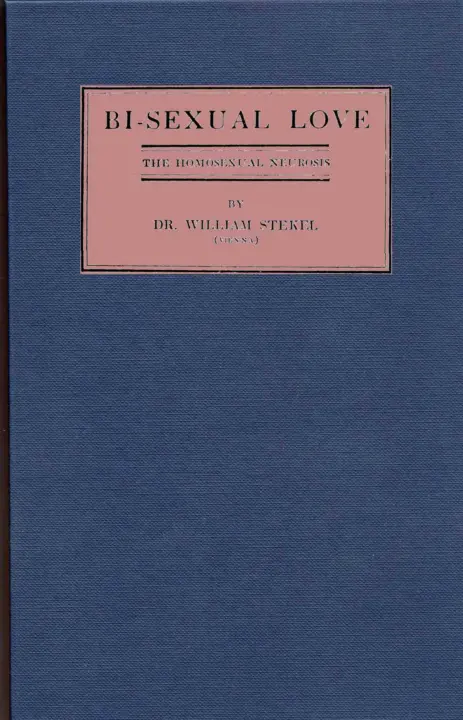
Wilhelm Stekel (1868–1940). Explore The Homosexual Neurosis, Bi-sexual love; the homosexual neurosis in this collection. These books span literature & collections.

Explore this author’s books →

THE READERS’ VERDICT

How did this story stay with you?

Not rated yet
Your rating for The Homosexual Neurosis

Be the first to share your verdict.

One rating per browser, which you can change or remove. A necessary browser identifier remembers your vote. How ratings work

A GOOD STORY DESERVES COMPANY

Pass this book along.

A great read is even better when it’s shared.

SEND A LITTLE INSPIRATION

Share this book

BEHIND THE BOOK

Edition & source details.

Title
The Homosexual Neurosis
Author
Wilhelm Stekel
Publication year
1922
Digital edition publisher
Project Gutenberg
Gutenberg release date
2022-03-04
Language
English
Source edition imprint
$aUnited States :$bRichard G. Badger,$c1922.
Source identifier
Project Gutenberg #67557
Contributors
James S. (James Samuel) Van Teslaar (trl)

Public-domain source & licence

This eBook is for the use of anyone anywhere in the United States and most other parts of the world at no cost and with almost no restrictions whatsoever. You may copy it, give it away or re-use it under the terms of the Project Gutenberg License included with this eBook or online at www.gutenberg.org. If you are not located in the United States, you will have to check the laws of the country where you are located before using this eBook. Read the source licence.

Full source licence and obtaining an original copy

The original source file, including credits and licence, is retained by this library. Request an original-format copy at no charge. Please include the book title and Project Gutenberg identifier #67557.

the full Project Gutenberg License must appear
prominently whenever any copy of a Project Gutenberg work (any work
on which the phrase “Project Gutenberg” appears, or with which the
phrase “Project Gutenberg” is associated) is accessed, displayed,
performed, viewed, copied or distributed:

This eBook is for the use of anyone anywhere in the United States and most
other parts of the world at no cost and with almost no restrictions
whatsoever. You may copy it, give it away or re-use it under the terms
of the Project Gutenberg™ License included with this eBook or online
at www.gutenberg.org. If you
are not located in the United States, you will have to check the laws
of the country where you are located before using this eBook.

1.E.2. If an individual Project Gutenberg electronic work is
derived from texts not protected by U.S. copyright law (does not
contain a notice indicating that it is posted with permission of the
copyright holder), the work can be copied and distributed to anyone in
the United States without paying any fees or charges. If you are
redistributing or providing access to a work with the phrase “Project
Gutenberg” associated with or appearing on the work, you must comply
either with the requirements of paragraphs 1.E.1 through 1.E.7 or
obtain permission for the use of the work and the Project Gutenberg
trademark as set forth in paragraphs 1.E.8 or 1.E.9.

1.E.3. If an individual Project Gutenberg electronic work is posted
with the permission of the copyright holder, your use and distribution
must comply with both paragraphs 1.E.1 through 1.E.7 and any
additional terms imposed by the copyright holder. Additional terms
will be linked to the Project Gutenberg License for all works
posted with the permission of the copyright holder found at the
beginning of this work.

1.E.4. Do not unlink or detach or remove the full Project Gutenberg
License terms from this work, or any files containing a part of this
work or any other work associated with Project Gutenberg.

1.E.5. Do not copy, display, perform, distribute or redistribute this
electronic work, or any part of this electronic work, without
prominently displaying the sentence set forth in paragraph 1.E.1 with
active links or immediate access to the full terms of the Project
Gutenberg License.

1.E.6. You may convert to and distribute this work in any binary,
compressed, marked up, nonproprietary or proprietary form, including
any word processing or hypertext form. However, if you provide access
to or distribute copies of a Project Gutenberg work in a format
other than “Plain Vanilla ASCII” or other format used in the official
version posted on the official Project Gutenberg website
(www.gutenberg.org), you must, at no additional cost, fee or expense
to the user, provide a copy, a means of exporting a copy, or a means
of obtaining a copy upon request, of the work in its original “Plain
Vanilla ASCII” or other form. Any alternate format must include the
full Project Gutenberg License as specified in paragraph 1.E.1.

1.E.7. Do not charge a fee for access to, viewing, displaying,
performing, copying or distributing any Project Gutenberg works
unless you comply with paragraph 1.E.8 or 1.E.9.

1.E.8. You may charge a reasonable fee for copies of or providing
access to or distributing Project Gutenberg electronic works
provided that:

• You pay a royalty fee of 20% of the gross profits you derive from
the use of Project Gutenberg works calculated using the method
you already use to calculate your applicable taxes. The fee is owed
to the owner of the Project Gutenberg trademark, but he has
agreed to donate royalties under this paragraph to the Project
Gutenberg Literary Archive Foundation. Royalty payments must be paid
within 60 days following each date on which you prepare (or are
legally required to prepare) your periodic tax returns. Royalty
payments should be clearly marked as such and sent to the Project
Gutenberg Literary Archive Foundation at the address specified in
Section 4, “Information about donations to the Project Gutenberg
Literary Archive Foundation.”

• You provide a full refund of any money paid by a user who notifies
you in writing (or by e-mail) within 30 days of receipt that s/he
does not agree to the terms of the full Project Gutenberg™
License. You must require such a user to return or destroy all
copies of the works possessed in a physical medium and discontinue
all use of and all access to other copies of Project Gutenberg™
works.

• You provide, in accordance with paragraph 1.F.3, a full refund of
any money paid for a work or a replacement copy, if a defect in the
electronic work is discovered and reported to you within 90 days of
receipt of the work.

• You comply with all other terms of this agreement for free
distribution of Project Gutenberg™ works.


1.E.9. If you wish to charge a fee or distribute a Project
Gutenberg™ electronic work or group of works on different terms than
are set forth in this agreement, you must obtain permission in writing
from the Project Gutenberg Literary Archive Foundation, the manager of
the Project Gutenberg™ trademark. Contact the Foundation as set
forth in Section 3 below.

1.F.

1.F.1. Project Gutenberg volunteers and employees expend considerable
effort to identify, do copyright research on, transcribe and proofread
works not protected by U.S. copyright law in creating the Project
Gutenberg™ collection. Despite these efforts, Project Gutenberg™
electronic works, and the medium on which they may be stored, may
contain “Defects,” such as, but not limited to, incomplete, inaccurate
or corrupt data, transcription errors, a copyright or other
intellectual property infringement, a defective or damaged disk or
other medium, a computer virus, or computer codes that damage or
cannot be read by your equipment.

1.F.2. LIMITED WARRANTY, DISCLAIMER OF DAMAGES - Except for the “Right
of Replacement or Refund” described in paragraph 1.F.3, the Project
Gutenberg Literary Archive Foundation, the owner of the Project
Gutenberg™ trademark, and any other party distributing a Project
Gutenberg™ electronic work under this agreement, disclaim all
liability to you for damages, costs and expenses, including legal
fees. YOU AGREE THAT YOU HAVE NO REMEDIES FOR NEGLIGENCE, STRICT
LIABILITY, BREACH OF WARRANTY OR BREACH OF CONTRACT EXCEPT THOSE
PROVIDED IN PARAGRAPH 1.F.3. YOU AGREE THAT THE FOUNDATION, THE
TRADEMARK OWNER, AND ANY DISTRIBUTOR UNDER THIS AGREEMENT WILL NOT BE
LIABLE TO YOU FOR ACTUAL, DIRECT, INDIRECT, CONSEQUENTIAL, PUNITIVE OR
INCIDENTAL DAMAGES EVEN IF YOU GIVE NOTICE OF THE POSSIBILITY OF SUCH
DAMAGE.

1.F.3. LIMITED RIGHT OF REPLACEMENT OR REFUND - If you discover a
defect in this electronic work within 90 days of receiving it, you can
receive a refund of the money (if any) you paid for it by sending a
written explanation to the person you received the work from. If you
received the work on a physical medium, you must return the medium
with your written explanation. The person or entity that provided you
with the defective work may elect to provide a replacement copy in
lieu of a refund. If you received the work electronically, the person
or entity providing it to you may choose to give you a second
opportunity to receive the work electronically in lieu of a refund. If
the second copy is also defective, you may demand a refund in writing
without further opportunities to fix the problem.

1.F.4. Except for the limited right of replacement or refund set forth
in paragraph 1.F.3, this work is provided to you ‘AS-IS’, WITH NO
OTHER WARRANTIES OF ANY KIND, EXPRESS OR IMPLIED, INCLUDING BUT NOT
LIMITED TO WARRANTIES OF MERCHANTABILITY OR FITNESS FOR ANY PURPOSE.

1.F.5. Some states do not allow disclaimers of certain implied
warranties or the exclusion or limitation of certain types of
damages. If any disclaimer or limitation set forth in this agreement
violates the law of the state applicable to this agreement, the
agreement shall be interpreted to make the maximum disclaimer or
limitation permitted by the applicable state law. The invalidity or
unenforceability of any provision of this agreement shall not void the
remaining provisions.

1.F.6. INDEMNITY - You agree to indemnify and hold the Foundation, the
trademark owner, any agent or employee of the Foundation, anyone
providing copies of Project Gutenberg™ electronic works in
accordance with this agreement, and any volunteers associated with the
production, promotion and distribution of Project Gutenberg™
electronic works, harmless from all liability, costs and expenses,
including legal fees, that arise directly or indirectly from any of
the following which you do or cause to occur: (a) distribution of this
or any Project Gutenberg work, (b) alteration, modification, or
additions or deletions to any Project Gutenberg work, and (c) any
Defect you cause.

Section 2. Information about the Mission of Project Gutenberg

Project Gutenberg is synonymous with the free distribution of
electronic works in formats readable by the widest variety of
computers including obsolete, old, middle-aged and new computers. It
exists because of the efforts of hundreds of volunteers and donations
from people in all walks of life.

Volunteers and financial support to provide volunteers with the
assistance they need are critical to reaching Project Gutenberg’s
goals and ensuring that the Project Gutenberg collection will
remain freely available for generations to come. In 2001, the Project
Gutenberg Literary Archive Foundation was created to provide a secure
and permanent future for Project Gutenberg and future
generations. To learn more about the Project Gutenberg Literary
Archive Foundation and how your efforts and donations can help, see
Sections 3 and 4 and the Foundation information page at www.gutenberg.org.

Section 3. Information about the Project Gutenberg Literary Archive Foundation

The Project Gutenberg Literary Archive Foundation is a non-profit
501(c)(3) educational corporation organized under the laws of the
state of Mississippi and granted tax exempt status by the Internal
Revenue Service. The Foundation’s EIN or federal tax identification
number is 64-6221541. Contributions to the Project Gutenberg Literary
Archive Foundation are tax deductible to the full extent permitted by
U.S. federal laws and your state’s laws.

The Foundation’s business office is located at 41 Watchung Plaza #516,
Montclair NJ 07042, USA, +1 (862) 621-9288. Email contact links and up
to date contact information can be found at the Foundation’s website
and official page at www.gutenberg.org/contact

Section 4. Information about Donations to the Project Gutenberg
Literary Archive Foundation

Project Gutenberg™ depends upon and cannot survive without widespread
public support and donations to carry out its mission of
increasing the number of public domain and licensed works that can be
freely distributed in machine-readable form accessible by the widest
array of equipment including outdated equipment. Many small donations
($1 to $5,000) are particularly important to maintaining tax exempt
status with the IRS.

The Foundation is committed to complying with the laws regulating
charities and charitable donations in all 50 states of the United
States. Compliance requirements are not uniform and it takes a
considerable effort, much paperwork and many fees to meet and keep up
with these requirements. We do not solicit donations in locations
where we have not received written confirmation of compliance. To SEND
DONATIONS or determine the status of compliance for any particular state
visit www.gutenberg.org/donate.

While we cannot and do not solicit contributions from states where we
have not met the solicitation requirements, we know of no prohibition
against accepting unsolicited donations from donors in such states who
approach us with offers to donate.

International donations are gratefully accepted, but we cannot make
any statements concerning tax treatment of donations received from
outside the United States. U.S. laws alone swamp our small staff.

Please check the Project Gutenberg web pages for current donation
methods and addresses. Donations are accepted in a number of other
ways including checks, online payments and credit card donations. To
donate, please visit: www.gutenberg.org/donate.

Section 5. General Information About Project Gutenberg electronic works

Professor Michael S. Hart was the originator of the Project
Gutenberg concept of a library of electronic works that could be
freely shared with anyone. For forty years, he produced and
distributed Project Gutenberg eBooks with only a loose network of
volunteer support.

Project Gutenberg eBooks are often created from several printed
editions, all of which are confirmed as not protected by copyright in
the U.S. unless a copyright notice is included. Thus, we do not
necessarily keep eBooks in compliance with any particular paper
edition.

Most people start at our website which has the main PG search
facility: www.gutenberg.org.

This website includes information about Project Gutenberg,
including how to make donations to the Project Gutenberg Literary
Archive Foundation, how to help produce our new eBooks, and how to
subscribe to our email newsletter to hear about new eBooks.


KEEP YOUR CURIOSITY GOING

Your next chapter awaits.

THE CLASSIC COLLECTION✦The Boarding School; Lessons of a Preceptress to Her Pupils Consisting of Information, Instruction and Advice, Calculated to Improve the Manners and Form the Character of Young Ladies. To Which Is Added, a Collection of Letters, Written by the Pupils to Their Instructress, Their Friends, and Each Other.Hannah Webster FosterCLASSIC FREE BOOKS
Open book ↗
Literature & Collections1798

The Boarding School; Lessons of a Preceptress to Her Pupils Consisting of Information, Instruction and Advice, Calculated to Improve the Manners and Form the Character of Young Ladies. To Which Is Added, a Collection of Letters, Written by the Pupils to Their Instructress, Their Friends, and Each Other.

Hannah Webster Foster


