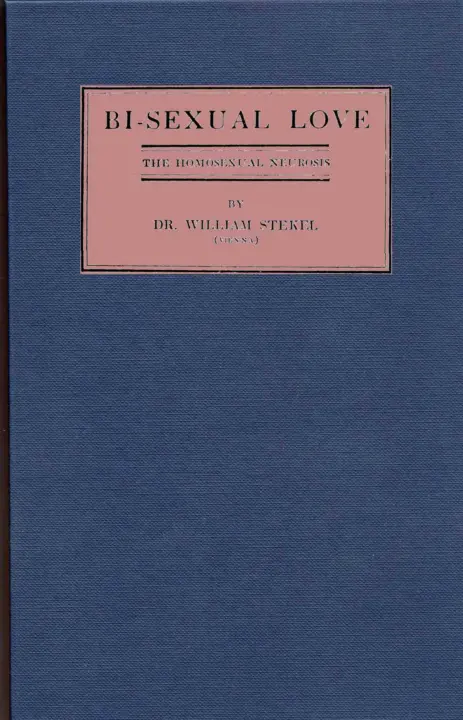
Bi-sexual love; the homosexual neurosis
Wilhelm Stekel
THE CLASSIC COLLECTION · 1922
"The Homosexual Neurosis" by Wilhelm Stekel is a scientific publication written in the early 20th century. The work delves into the psychological dimensions of homosexuality, exploring various factors such as familial relationships, individual experiences, and the dynamics of sexual attraction. It aims to shed light on the complexities associated with homosexual behavior and its neurological or emotional roots, making fundamental distinctions in the current understanding of sexual orientations. At the start of the book, the opening section includes a translated preface by the translator, which emphasizes the significance of Stekel's clinical studies rooted in Freudian psychoanalysis. It presents the context of the text as a continuation of prior discussions on bisexuality and autoerotism. The first chapter introduces the themes of fear, disgust, and aversion that homosexuals may experience towards the opposite sex, along with discussions on neuroses and personal experiences connected to sexuality. The text begins to outline the ideas and findings regarding the psychological barriers that influence sexual preference, setting a foundation for the comprehensive clinical evaluations and theories that follow in the text.
Introduction adapted from the source catalogue; source summaries may be automatically generated.
Free to read · English · 73,261 words · No account needed
MAKE TIME FOR A GOOD BOOK
On by default. Untick to stop anonymous reading totals. Each page counts after 10 seconds in view. How this works.
Anonymous counting is on unless you have switched it off.
“Homosexuals who display their inclination clearly only after puberty show an interest in the other sex before and during the period of puberty. For instance, I have been told by a 23-year-old typical homosexual, today a victim of horror feminae, that at 16 and 17 years of age he entertained strong fancies about girls and ran after them, although without any particular sexual feeling desire. This transitory and undefined preoccupation of homosexuals with the opposite sex is a sort of ‘pseudoheterosexuality.’” (Bloch, loc. cit., p. 597.)
Footnote 2:
In vol. III of Disorders of Instincts and Emotions: The Sexual Frigidity of Woman; Psychopathology of Woman’s Love Life. English translation by Dr. James S. Van Teslaar.
Footnote 3:
Nervöse Angstzustände, 2nd ed., p. 336.
Footnote 4:
Vol. V. in: Disorders of Instincts and Emotions. English version by
Dr. Van Teslaar.
Footnote 5:
B. Tarnowsky, Die krankhaften Erscheinungen des Geschlechtssinnes (The Morbid Manifestations of the Sexual Instinct). Eine forensisch-psychiatrische Studie. Berlin, 1886, p. 51 ff.
Footnote 6:
Jahrbuch f. sexuelle Zwischenstufen, vol. IX, 1908, p. 504.
Footnote 7:
Fragment der Psychoanalyse eines Homosexuellen (Jahrb. f. sexuelle Zwischenstufen, vol. IX, 1908). [A typical illustration of the wrong way of carrying on a psychoanalysis, the kind of painful ordeal during which the subject calls out in distress: “But, pardon me, what must I tell you? You just torture me, nothing less!” The most important relations are overlooked, the patient is tortured to admit that he is in love with Sadger, so that after fourteen hours of this sort of torment he runs off.]
Footnote 8:
J. Sadger: Ist die konträre Sexualempfindung heilbar? Zeitschr. f. Sexualwissenschaft, 1908, p. 712.
Footnote 9:
Jahrb. f. psychoanalytische u. psychopathol. Forschungen, vol. II,
1910.
Footnote 10:
Ibsen, the great psychologist, has described in masterly fashion the transposition of sister love into boy love. In “Little Eyolf,” Almers, the writer, suddenly loses the love for his wife and turns his affection exclusively to his child. That child is called ‘little Eyolf,’ like his sister, who had once put on boy’s clothes and called herself ‘little Eyolf.’ The parents had expected a boy. Almers turns his affection for the sister, which pervades the whole drama, into the love for the boy. He has discovered for himself the law of substitution which corresponds to the changes spoken of in these pages. Little Eyolf in fact is the dramatisation of the latent homosexual fixation on the sister. Almers cannot split his personality, he cannot be both homo- and heterosexual. This inability to split his self, the root of all homosexuality, forms the background of the whole drama. Rita cannot divide her personality any more than Almers can do it; he must give his whole personality self. Almers cannot divide wife and sister. He embraces his wife and thinks of the sister (That sister, whom he calls his little and his big Eyolf. The sister in trousers, who embodied his ideal, a woman in male clothes, a bisexual being which need not be split up at all). “Love of brothers and sisters is the only relationship not subject to the law of transformation.” Rank (Das Inzestmotiv in Dichtung und Sage, 1919, p. 654) and Pfister (Anwendung der Psychoanalyse in der Pädagogik und Seelsorge, p. 72) find the incest motive easily but overlook the fact that the situation involves the outbreak of homosexuality and its psychogenesis. It represents a flight from the sister to man, a wavering homosexuality sublimated into love for the boy. The drama contains numerous other familiar points well worth careful analysis. For Almers, his wife, and his child, are the representatives of the male, female, and infantile components which we endeavor to synthetize in our character (trinity). Regression to the infantile level sets in with flight from the world (flight to the solitude of the mountain top). The solitary Ibsen, as road builder, undertakes to construct a new highway which shall lead up to solitary heights and does not observe that the road leads really straight back to the realm of his youth. Somewhere in the vast expanse of his soul the ‘dead child’ is floating around and staring with wide open eyes into infinity. A child is killed in this drama. It stands for the miscarried regression back to infantilism. Childhood is finally subdued and forgetfulness once more drowns in the soul’s vast expanse all gnawing and biting reproaches. The memories are all dead ... and the next drama has for its theme: When the dead awaken. But in little Eyolf they are already awake.... The dead, whom Ibsen carried in his breast, the corpse to which Rita refers so often.... The child in him is dead and now the man in him also threatens to die. It recalls the admission of impotence, described with such tremendous realism in the great Rita-Almers scene. The man in him dies and the woman in him persists with yearnings. A more detailed treatment of these endopsychic processes will be found in my book on Masochism (Translation by Van Teslaar, in preparation).
Your reading position is saved on this browser. Take it to another device with a library code. Reading pages adapt to text, rather than matching a printed edition.
Wilhelm Stekel
BEHIND THE BOOK
This eBook is for the use of anyone anywhere in the United States and most other parts of the world at no cost and with almost no restrictions whatsoever. You may copy it, give it away or re-use it under the terms of the Project Gutenberg License included with this eBook or online at www.gutenberg.org. If you are not located in the United States, you will have to check the laws of the country where you are located before using this eBook. Read the source licence.
The original source file, including credits and licence, is retained by this library. Request an original-format copy at no charge. Please include the book title and Project Gutenberg identifier #67557.
KEEP YOUR CURIOSITY GOING

Charles G. (Charles Griffith) Ross
Hannah Webster Foster

Emily Lawless
Edwin Hamlin Carr

Charles De Lano Hine
Andrew Ure