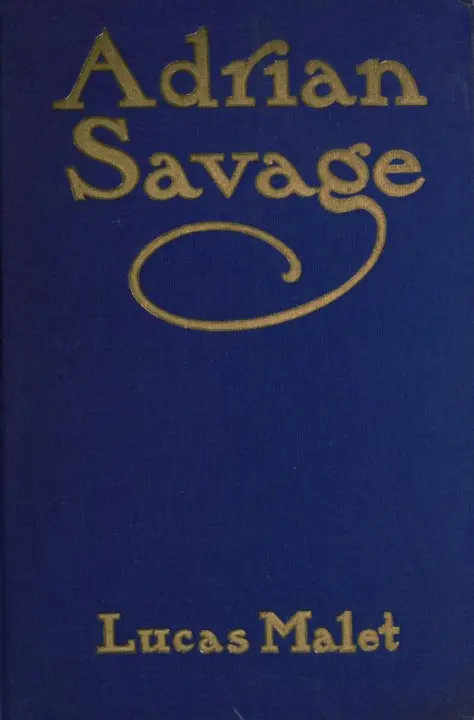
Adrian Savage: A Novel
Lucas Malet
THE CLASSIC COLLECTION · 1901
"The History of Sir Richard Calmady: A Romance" by Lucas Malet is a novel written in the late 19th century. The story is set against the backdrop of a family lineage and revolves around the experiences of Sir Richard Calmady, exploring themes of love, social relations, and the legacies of family history." "The opening of the story introduces the setting of Brockhurst, a grand estate built by Denzil Calmady, and highlights the beauty of the landscape and the weight of familial legacy. The narrative hints at a family curse affecting the male descendants of Denzil Calmady, suggesting an ominous future for Sir Richard. In a close-up view, we meet Richard and Katherine Calmady amidst a post-wedding celebration, where Katherine reflects on her new life and the urgency of motherhood, setting the stage for deeper exploration of love and destiny intertwined with the family's troubled past."
Introduction adapted from the source catalogue; source summaries may be automatically generated.
Free to read · English · 261,873 words · No account needed
MAKE TIME FOR A GOOD BOOK
On by default. Untick to stop anonymous reading totals. Each page counts after 10 seconds in view. How this works.
Anonymous counting is on unless you have switched it off.
And the charm of the scene worked upon Richard, not with any heat of excitement, but with a temperate and reasonable grace. For the spirit of it all was a spirit of temperance, of moderation, of secure tranquillity--a spirit stoic rather than epicurean, ascetic rather than hedonic, yet generous, spacious, nobly reasonable, giving ample scope for very sincere, if soberly-clad pleasures, and for activities by no means despicable or unmanly, though of a modest, unostentatious sort. Dickie had tried not a few desperate adventures, had conformed his thought and action to not a few glaring patterns, rushing to violences of extreme colour, extreme white and black. All that had proved preeminently unsuccessful, a most poisonous harvest of Dead Sea fruit. What, he began to ask himself, if he made an effort to conform it to the pattern actually presented to him--mellow, sun-visited, with the brave red of weather stained masonry in it, blue and silver of water and sky, lustre of sturdy hollies, as well as the solemnity of leafless woods, finger of frost in the hollows, and bleakness of snow?
And, as he sat meditating thus, breathing the clear air, feeling the tempered, yet genial, sun-heat, many questions began to resolve themselves. He seemed to look, as down a long, cloudy vista--beyond the tumult and unruly clamour, the wayward resistance and defiant sinning, the craven complainings, the ever-repeated suspicions and misapprehensions of man--away into the patient, unalterable purposes of God. And looking, for the moment, into those purposes, he saw this also--namely, that sorrow, pain, and death, are sweet to whosoever dares, instead of fighting with, or flying from them, to draw near, to examine closely, to inquire humbly, into their nature and their function. He began to perceive that these three reputed enemies--hated and feared of all men--are, after all, the fashioners and teachers of humanity, to whom it is given to keep hearts pure, godly and compassionate, to purge away the dross of pride, hardness, and arrogance, to break the iron bands of ambition, self-love, and vanity, to purify by endurance and by charity, welding together--as with the cunning strokes of the master-craftsman's hammer--the innumerable individual atoms into a corporate whole, of fair form, of supreme excellence of proportion, the image and example of a perfect brotherhood, of a republic more firmly based and more beneficent than even that pictured by the divine Plato himself--since that was consolidated by exclusion, this by inclusion and pacification of those things which men most dread.--Perceived that, without the guiding and chastening of these three lovely terrors, humanity would, indeed, wax wanton, and this world become the merriest court of hell, lust and corruption have it all their own foul way, the flesh triumph, and all bestial things come forth to flaunt themselves gaudily, greedily, without remonstrance and without shame in the light of day.--Perceived in these three, a Trinity of Holy Spirits, bearing forever the message of the divine mercy and forgiveness.--Perceived how, of necessity, only the Man of Sorrows can truly be the Son of God.
Your reading position is saved on this browser. Take it to another device with a library code. Reading pages adapt to text, rather than matching a printed edition.
Lucas Malet
Lucas Malet
Lucas Malet
Lucas Malet
BEHIND THE BOOK
This eBook is for the use of anyone anywhere in the United States and most other parts of the world at no cost and with almost no restrictions whatsoever. You may copy it, give it away or re-use it under the terms of the Project Gutenberg License included with this eBook or online at www.gutenberg.org. If you are not located in the United States, you will have to check the laws of the country where you are located before using this eBook. Read the source licence.
The original source file, including credits and licence, is retained by this library. Request an original-format copy at no charge. Please include the book title and Project Gutenberg identifier #23784.
KEEP YOUR CURIOSITY GOING
Coulson Kernahan

Maurice Baring
Frances Wright
Cécile Tormay

Frederic Jesup Stimson

W. H. P. (William Henry Pope) Jarvis