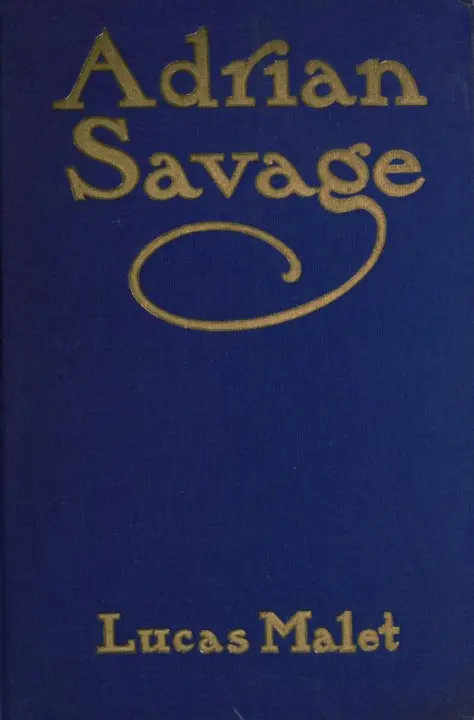
Adrian Savage: A Novel
Lucas Malet
THE CLASSIC COLLECTION · 1901
"The History of Sir Richard Calmady: A Romance" by Lucas Malet is a novel written in the late 19th century. The story is set against the backdrop of a family lineage and revolves around the experiences of Sir Richard Calmady, exploring themes of love, social relations, and the legacies of family history." "The opening of the story introduces the setting of Brockhurst, a grand estate built by Denzil Calmady, and highlights the beauty of the landscape and the weight of familial legacy. The narrative hints at a family curse affecting the male descendants of Denzil Calmady, suggesting an ominous future for Sir Richard. In a close-up view, we meet Richard and Katherine Calmady amidst a post-wedding celebration, where Katherine reflects on her new life and the urgency of motherhood, setting the stage for deeper exploration of love and destiny intertwined with the family's troubled past."
Introduction adapted from the source catalogue; source summaries may be automatically generated.
Free to read · English · 261,873 words · No account needed
MAKE TIME FOR A GOOD BOOK
On by default. Untick to stop anonymous reading totals. Each page counts after 10 seconds in view. How this works.
Anonymous counting is on unless you have switched it off.
Upon those moments of rapture followed days of trembling, during which the sands of Richard Calmady's life ran very low, and his brain wandered in delirium, and he spoke unwittingly of many matters of which it was unprofitable to hear. Periods of unconsciousness, when he lay as one dead; periods of incessant utterance--now violent in unavailing repudiation, now harsh with unavailing remorse--alternated. And, at this juncture, much of Lady Calmady's former very valiant pride asserted itself. In tender jealousy for the honour of her beloved one she shut the door of that sick-room, of sinister aspect, against brother and friend, and even against the faithful Clara. None should see or hear Richard in his present alienation and abjection, save herself and those who had hitherto ministered to him. He should regain a measure, at least, of his old distinction and beauty before any, beyond these, looked on his face. And so his own men-servants--Captain Vanstone, capable, humorous, and alert--and Price, the red-headed, Welsh first-mate, of varied and voluminous gift of invective--continued to nurse him. These men loved him. They would be loyal in silence, since, whatever his lapses, Dickie was and always had been--as Katherine reflected--among the number of those happily-endowed persons who triumphantly give the lie to the cynical saying that "no man is a hero to his valet de chambre."
To herself Katherine reserved the right to enter that sinister sick-room whenever she pleased, and to sit by the bedside, waiting for the moment--should it ever come--when Richard would again recognise her, and give himself to her again. And those vigils proved a searching enough experience, notwithstanding her long apprenticeship to service of sorrow--which was also the service of her son. For, in the mental and moral nudity of delirium, he made strange revelation, not only of acts committed, but of inherent tendencies of character and of thought. He spoke, with bewildering inconsequence and intimacy, of incidents and of persons with whom she was unacquainted, causing her to follow him--a rather brutal pilgrimage--into regions where the feet of women, bred and nurtured like herself, but seldom tread. He spoke of persons with whom she was well acquainted also, and whose names arrested her attention with pathetic significance, offering, for the moment, secure standing ground amid the shifting quicksand of his but half-comprehended words. He spoke of Morabita, the famous prima donna, and of gentle Mrs. Chifney down at the Brockhurst racing-stables. He grew heated in discussion with Lord Fallowfeild. He petted little Lady Constance Quayle. He called Camp, coaxed and chaffed the dog merrily--whereat Lady Calmady rose from her place by the bedside and stood at one of the dim, shuttered windows for a while. He spoke of places, too, and of happenings in them, from Westchurch to Constantinople, from a nautch at Singapore to a country fair at Farley Row. But, recurrent through all his wanderings, were allusions, unsparing in revolt and in self-abasement, to a woman whom he had loved and who had dealt very vilely with him, putting some unpardonable shame upon him, and to a man whom he himself had very basely wronged. The name, neither of man nor woman, did Katherine learn.--Madame de Vallorbes' name, for which she could not but listen, he never mentioned, nor did he mention her own.--And recurrent, also, running as a black thread through all his speech, was lament, not unmanly but very terrible to hear--the lament of a creature, captive, maimed, imprisoned, perpetually striving, perpetually frustrated in the effort, to escape. And, noting all this, Katherine not only divined very dark and evil pages in the history of her beloved one, but a struggle so continuous and a sorrow so abiding that, in her estimation at all events, they cancelled and expiated the darkness and evil of those same pages. While the mystery, both of wrong done and sorrow suffered, so wrought upon her that, having, in the first ecstasy of recovered human love, deserted and depreciated the godward love a little, she now ran back imploring assurance and renewal of that last, in all penitence and humility, lest, deprived of the counsel and sure support of it, she should fail to read the present and deal with the future aright--if, indeed, any future still remained for that beloved one other than the yawning void of death and inscrutable silence of the grave!
Your reading position is saved on this browser. Take it to another device with a library code. Reading pages adapt to text, rather than matching a printed edition.
Lucas Malet
Lucas Malet
Lucas Malet
Lucas Malet
BEHIND THE BOOK
This eBook is for the use of anyone anywhere in the United States and most other parts of the world at no cost and with almost no restrictions whatsoever. You may copy it, give it away or re-use it under the terms of the Project Gutenberg License included with this eBook or online at www.gutenberg.org. If you are not located in the United States, you will have to check the laws of the country where you are located before using this eBook. Read the source licence.
The original source file, including credits and licence, is retained by this library. Request an original-format copy at no charge. Please include the book title and Project Gutenberg identifier #23784.
KEEP YOUR CURIOSITY GOING
Coulson Kernahan

Maurice Baring
Frances Wright
Cécile Tormay

Frederic Jesup Stimson

W. H. P. (William Henry Pope) Jarvis