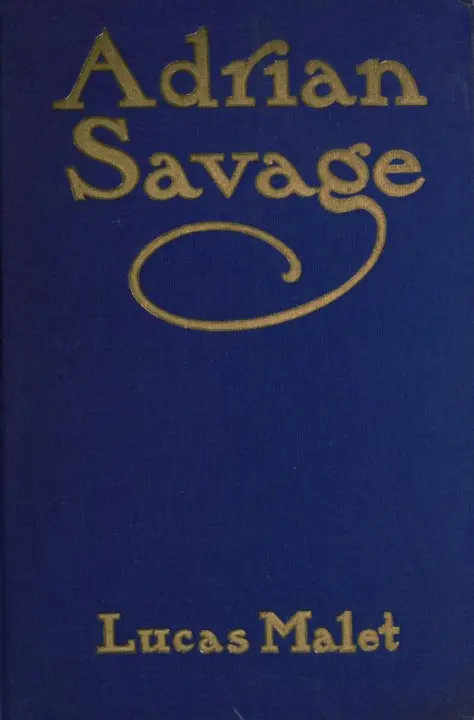
Adrian Savage: A Novel
Lucas Malet
THE CLASSIC COLLECTION · 1901
"The History of Sir Richard Calmady: A Romance" by Lucas Malet is a novel written in the late 19th century. The story is set against the backdrop of a family lineage and revolves around the experiences of Sir Richard Calmady, exploring themes of love, social relations, and the legacies of family history." "The opening of the story introduces the setting of Brockhurst, a grand estate built by Denzil Calmady, and highlights the beauty of the landscape and the weight of familial legacy. The narrative hints at a family curse affecting the male descendants of Denzil Calmady, suggesting an ominous future for Sir Richard. In a close-up view, we meet Richard and Katherine Calmady amidst a post-wedding celebration, where Katherine reflects on her new life and the urgency of motherhood, setting the stage for deeper exploration of love and destiny intertwined with the family's troubled past."
Introduction adapted from the source catalogue; source summaries may be automatically generated.
Free to read · English · 261,873 words · No account needed
MAKE TIME FOR A GOOD BOOK
On by default. Untick to stop anonymous reading totals. Each page counts after 10 seconds in view. How this works.
Anonymous counting is on unless you have switched it off.
"Let us say no more, Helen," he entreated, "lest we both forfeit our
remaining chance, and become involved in hopeless and final
condemnation."
But Madame de Vallorbes' anger rose to overwhelming height. She slapped
her hands together.
"Ah, you despise me!" she cried. "But let me assure you that in any case this assumption of virtue becomes you singularly ill. It really is a little bit too cheap, a work of supererogation in the matter of hypocrisy. Have the courage of your vices. Be honest. You can be so to the point of insult when it serves your purpose. Own that you are capricious, own that you have lighted upon some woman who provokes your appetite more than I do! I have been too tender of you, too lenient with you. I have loved too much and been weakly desirous to please. Own that you are tired of me, that you no longer care for me!"
And he answered, sadly enough:--
"Yes, that last is true. Having seen the Whole, that has happened which I always dreaded might happen. The last of my self-made gods has indeed gone overboard. I care for you no longer."
Helen sprang up from her chair, ran to the door, flung it open. The first act of the opera was concluded. The curtain had come down. The house below and around, the corridor without, were full of confused noise and movement.
"Paul, M. Destournelle, come here," she cried, "and at once!"
But Richard was more than ever tired. The strain of waiting had been too prolonged. Lights, draperies, figures, the crowded arena, the vast honeycomb of boxes, tier above tier, swam before his eyes, blurred, indistinct, vague, shifting, colossal in height, giddy in depth. The bees were swarming, at last, swarming upward through seas of iridescent mist. But he had no longer empire over his own attitude and thoughts. He had hoped to meet the supreme moment in full consciousness, with clear vision and thankfulness of heart. But he was too tired to do so, tired in brain and body alike. And so it happened that a dogged endurance grew on him, simply a setting of the teeth and bracing of himself to suffer silently, even stupidly, all that might be in store. For the bees were close upon him now, countless in number, angry, grudging, violent. But they no longer appeared as insects. They were human, save for their velvet-like, expressionless eyes. And all those eyes were fixed upon him, and him alone. He was the centre towards which, in thought and action, all turned. Nor were the dull-coloured occupants of the parterre alone in their attack. For those gay-coloured larvae--the men and women of his own class--indolent, licentious, full-fed, hung out of the angular mouths of the waxen cells, above the crimson and gold of their cushions, pointing at him, claiming and yet denouncing him. And in the attitude of these the democratic and the aristocratic sections--he detected a difference. The former swarmed to inflict punishment for his selfishness, uselessness, sensuality. But the latter jeered and mocked at his bodily infirmity, deriding his deformity, making merry over his shortened limbs and shuffling walk. And against this background, against this all-enclosing tapestry of faces which encircled him, two persons, and the atmosphere and aroma of them, so to speak, were clearly defined. They were close to him, here within the narrow limits of the opera box. Then a great humiliation overtook Richard, perceiving that they, and not the people, the workers, august in their corporate power and strength, were to be his executioners.--No--no--he wasn't worth that! And, for all his present dulness of sensation, a sob rose in his throat. Madame de Vallorbes, resplendent in crocus-yellow brocade, costly lace, and seed pearls, the young man, her companion--the young man of the light, forked beard, domed skull, vain eyes and peevish mouth--the young man of holy and dissolute aspect--were good enough instruments for the Eternal Justice to employ in respect of him, Richard Calmady.
Your reading position is saved on this browser. Take it to another device with a library code. Reading pages adapt to text, rather than matching a printed edition.
Lucas Malet
Lucas Malet
Lucas Malet
Lucas Malet
BEHIND THE BOOK
This eBook is for the use of anyone anywhere in the United States and most other parts of the world at no cost and with almost no restrictions whatsoever. You may copy it, give it away or re-use it under the terms of the Project Gutenberg License included with this eBook or online at www.gutenberg.org. If you are not located in the United States, you will have to check the laws of the country where you are located before using this eBook. Read the source licence.
The original source file, including credits and licence, is retained by this library. Request an original-format copy at no charge. Please include the book title and Project Gutenberg identifier #23784.
KEEP YOUR CURIOSITY GOING
Coulson Kernahan

Maurice Baring
Frances Wright
Cécile Tormay

Frederic Jesup Stimson

W. H. P. (William Henry Pope) Jarvis