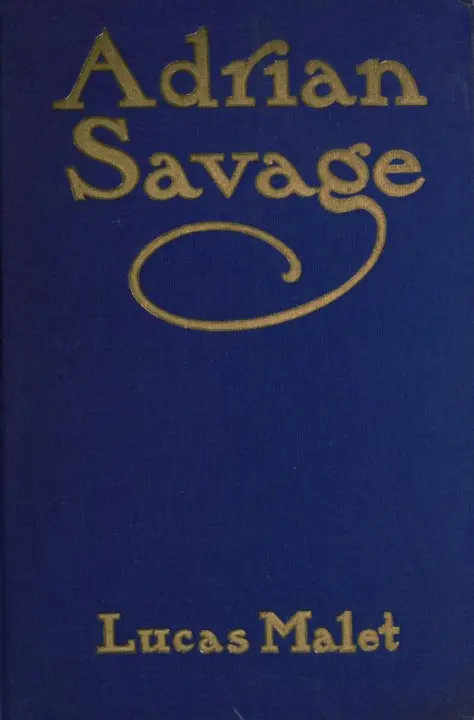
Adrian Savage: A Novel
Lucas Malet
THE CLASSIC COLLECTION · 1901
"The History of Sir Richard Calmady: A Romance" by Lucas Malet is a novel written in the late 19th century. The story is set against the backdrop of a family lineage and revolves around the experiences of Sir Richard Calmady, exploring themes of love, social relations, and the legacies of family history." "The opening of the story introduces the setting of Brockhurst, a grand estate built by Denzil Calmady, and highlights the beauty of the landscape and the weight of familial legacy. The narrative hints at a family curse affecting the male descendants of Denzil Calmady, suggesting an ominous future for Sir Richard. In a close-up view, we meet Richard and Katherine Calmady amidst a post-wedding celebration, where Katherine reflects on her new life and the urgency of motherhood, setting the stage for deeper exploration of love and destiny intertwined with the family's troubled past."
Introduction adapted from the source catalogue; source summaries may be automatically generated.
Free to read · English · 261,873 words · No account needed
MAKE TIME FOR A GOOD BOOK
On by default. Untick to stop anonymous reading totals. Each page counts after 10 seconds in view. How this works.
Anonymous counting is on unless you have switched it off.
That this, in any case, had a stamp of sincerity upon it, Richard could not doubt. It must be admitted that he had long ceased to accept Madame de Vallorbes' estimate of her husband with unqualified belief. But, be that as it might, whether he were a consummate, or merely an average, profligate, one thing was certain that this man trusted him--Richard Calmady,--and that he--Richard Calmady--had very vilely betrayed that trust. He stared at the letter, and certain sentences in it seemed to sear him, even as the branding-iron used on a felon might. This was a new shame, different to, and greater than, any his deformity had ever induced in him, even as evil done is different to, and greater than, evil suffered. Morality may be relative only and conventional. Honour, for all persons of a certain standing and breeding, remains absolute. And it was precisely of his own honour that he had deprived himself. Not only in body, but in character, he was henceforth monstrous. For a while Richard had remained very still, looking at this thing into which he had made himself as though it were external and physically visible to him.
Then, suddenly, he had reached out his hand for his mother's letter. A decision of great moment was impending. He would know what she had to say before finally making that decision. He wondered bitterly, grimly, whether her words would plunge him yet deeper in this abyss of self-hatred and self-contempt.
MY DARLING,"--she wrote,--"I am foolishly glad to learn that you are back at Naples. It gives me comfort to know you are even thus much nearer home and in a country where I too have traveled and of which I retain many dear and delightful recollections. You may be surprised, perhaps, to see the unaccustomed address upon my note-paper and may wonder what has made me guilty of deserting my post. Now, since the worst of it is certainly over, I may tell you that my health has failed a good deal of late. Nothing of a really serious nature--you need not be alarmed about me. But I had got into a rather weak and unworthy state, from which it became very desirable I should rouse myself. Selfishness is insidious, but none the less reprehensible because it takes the apparently innocent form of sitting in a chair with one's eyes shut! However, that best of men, John Knott, brought very bracing influences to bear on me, convincing me of sin--in the gentlest way in the world--by means of Honoria St. Quentin. And so I picked myself up, dear Dickie,--picked the whole of myself up, as I hope, always saving and excepting my self-indulgent inertia,--and came away here to Ormiston. At first, I confess, I felt very much like a dog at a fair, or the proverbial mummy at a feast. But they all bore with me in the plenty of their kindness, and, in the last week, I have banished the mummy and trained the scared dog to altogether polite and pretty behaviour. Till I came back to it, I hardly realised how truly I loved this place. How should it be otherwise? I met your father first here after his third term at Eton. I remember he snubbed me roundly. I met him again the year before our marriage. Without vanity I declare that then he snubbed me not one little bit. These things are very far away. But to me, though far away, they are very vivid and very lovely. I see them as you, when you were small, so often pleaded to see a fairy landscape by looking through the large end of the gold and tortoise-shell spy-glass upon my writing-table. All of which may seem to you somewhat childish and trivial, but I grow an old woman and have a fancy for toys and tender make-believes--such as fairy landscapes seen through the big end of a spy-glass. The actual landscape, at times, is a trifle discouragingly rain-washed and cloudy!---Roger and Mary are here. Their two boys are just gone back to school again. They are fine, courteous, fearless, little fellows. Roger makes a rather superb middle-aged man. He has much of my father--your grandfather's reticence and dignity. Indeed, he might prove slightly alarming, was one not so perfectly sure of him, dear creature. Mary remains, as of old, the most wholesome and helpful of women. Yes, it is good to dwell, for a time, among one's own people. And I cannot but rejoice that my eldest brother has come to an arrangement by which, at his death, your Uncle William will receive a considerable sum of money in lieu of the property. This last will go direct to Roger, and eventually to his boys. If your Uncle William had a son, the whole matter would be different. But I own it would hurt me that in the event of his death there would be no Ormiston at Ormiston after these many generations. In all probability the place would be sold immediately, moreover, for it is an open secret that, through no fault of his own, poor man, William is sadly embarrassed in money matters. And he has other sorrows--of a rather terrible nature, since they are touched with disgrace. But here you will probably detect a point of prejudice, so I had better stop!--I look out upon a gray, northern sea, where 'the white horses fume and fret' under a cold, gray, northern sky. The oaks in the park are just thickening with yellow-green buds. And there, close to my window, perched on a topmost twig, a missel-thrush is singing, facing the wind like a gentleman. You look out upon a purple sea, I suppose, beneath clear skies and over orange trees and palms. I wonder if any brave bird pipes to you as my storm-cock to me? It brings up one's courage to hear his song, so strong and wild and sweet, in the very teeth of the gale too! But now you will have had enough of my news and more than enough. I write to you more freely, you see, than for a long time past, being myself more free of spirit. And therefore I dare add this, in all and every case, my darling, God keep you. And remember, should you weary of wandering, that not only the doors of Brockhurst, but the doors of my heart, stand forever wide open to welcome you home.--Yours always,
Your reading position is saved on this browser. Take it to another device with a library code. Reading pages adapt to text, rather than matching a printed edition.
Lucas Malet
Lucas Malet
Lucas Malet
Lucas Malet
BEHIND THE BOOK
This eBook is for the use of anyone anywhere in the United States and most other parts of the world at no cost and with almost no restrictions whatsoever. You may copy it, give it away or re-use it under the terms of the Project Gutenberg License included with this eBook or online at www.gutenberg.org. If you are not located in the United States, you will have to check the laws of the country where you are located before using this eBook. Read the source licence.
The original source file, including credits and licence, is retained by this library. Request an original-format copy at no charge. Please include the book title and Project Gutenberg identifier #23784.
KEEP YOUR CURIOSITY GOING
Coulson Kernahan

Maurice Baring
Frances Wright
Cécile Tormay

Frederic Jesup Stimson

W. H. P. (William Henry Pope) Jarvis