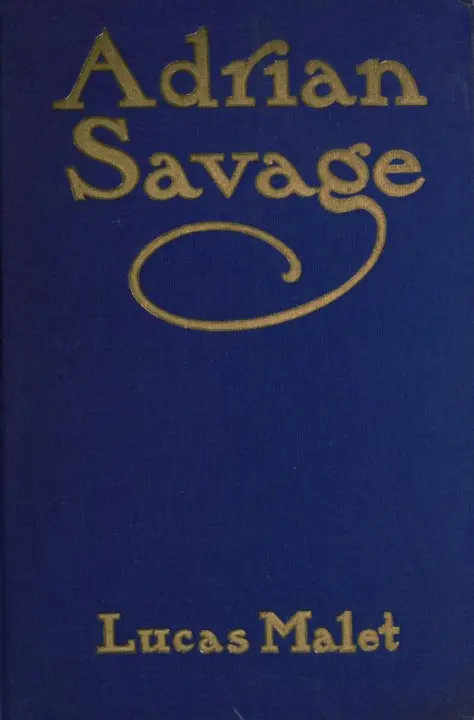
Adrian Savage: A Novel
Lucas Malet
THE CLASSIC COLLECTION · 1901
"The History of Sir Richard Calmady: A Romance" by Lucas Malet is a novel written in the late 19th century. The story is set against the backdrop of a family lineage and revolves around the experiences of Sir Richard Calmady, exploring themes of love, social relations, and the legacies of family history." "The opening of the story introduces the setting of Brockhurst, a grand estate built by Denzil Calmady, and highlights the beauty of the landscape and the weight of familial legacy. The narrative hints at a family curse affecting the male descendants of Denzil Calmady, suggesting an ominous future for Sir Richard. In a close-up view, we meet Richard and Katherine Calmady amidst a post-wedding celebration, where Katherine reflects on her new life and the urgency of motherhood, setting the stage for deeper exploration of love and destiny intertwined with the family's troubled past."
Introduction adapted from the source catalogue; source summaries may be automatically generated.
Free to read · English · 261,873 words · No account needed
MAKE TIME FOR A GOOD BOOK
On by default. Untick to stop anonymous reading totals. Each page counts after 10 seconds in view. How this works.
Anonymous counting is on unless you have switched it off.
"It is inconceivable that, knowing my cruel capacity for suffering, you should be indifferent to my present situation," he asserted, half violently, half fretfully. "The whole range of history would fail to offer a case of parallel callousness. You, whose personality has penetrated the recesses of my being! You, who are acquainted with the infinite intricacy of my mental and emotional organisation! A touch will endanger the harmony of that exquisite mechanism. The interpenetration of the component parts of my being is too complete. I exist, I receive sensations, I suffer, I rejoice, as a whole. And this lays me open to universal, to incalculable, pain. Now my nerves are shattered--intellectual, moral, physical anguish permeate in every part. I rally my self-reverence, my nobility of soul. I make efforts. By day I visit spots of natural beauty and objects of art. But these refuse to gratify me. My thought is too turgid to receive the impress of them. Concentration is impossible to me. Feverish agitation perverts my imagination. My ideas are fugitive. I endure a chronic delirium. This by day," he extended one hand with a despairing gesture, "but by night----"
"Oh, I implore you," Helen interrupted, "spare me the description of your nights! The subject is a hardly modest one. And then, at various times, I have already heard so very much about them, those nights!"
Calmly she resumed her walk. The amazing vanity of the young man's speech appeased her, in a measure, since it fed her contempt. Let him sink himself beyond all hope of recovery, that was best. Let him go down, down, in exposition of fatuous self-conceit. When he was low enough, then she would kick him! Meanwhile her eyes, ever greedy of incident and colour, registered the scene immediately submitted to them. In the centre of the piazza, women--saffron and poppy-coloured handkerchiefs tied round their dark heads--washed, with a fine impartiality, soiled linen and vegetables in an iron trough, grated for a third of its length, before a fountain of debased and flamboyant design. Their voices were alternately shrill and gutteral. It was perhaps as well not to understand too clearly all which they said. On the left came a break in the high, painted house-fronts, off which in places the plaster scaled, and from the windows of which protruded miscellaneous samples of wearing apparel and bedding soliciting much-needed purification by means of air and light. In the said break was a low wall where coarse plants rooted, and atop of which lay some half-dozen ragged youths, outstretched upon their stomachs, playing cards. The least decrepit of the beggars, armed with Helen's largesse of copper coin, had joined them from beneath the portico. Gambling, seasoned by shouts, imprecations, blows, grew fast and furious. In the steep roadway on the right a dray, loaded with barrels, creaked and jolted upward. The wheels of it were solid discs of wood. The great, mild-eyed, cream-coloured oxen strained, with slowly swinging heads, under the heavy yoke. Scarlet, woolen bands and tassels adorned their broad foreheads and wide-sweeping, black-tipped horns, and here and there a scarlet drop their flanks, where the goad had pricked them too shrewdly. And upon it all the unrelenting southern sun looked down, and Helen de Vallorbes' unrelenting eyes looked forth. One of those quick realisations of the inexhaustible excitement of living came to her. She looked at the elegant young man walking beside her, apprised, measured, him. She thought of Richard Calmady, self-imprisoned in the luxurious villa, and of the possibilities of her, so far platonic, relation to him. She glanced down at her own rustling skirts and daintily-shod feet traveling over the hot stones, then at the noisy gamblers, then at the women washing, with that consummate disregard of sanitation, food and raiment together in the rusty iron trough by the fountain. The violent contrasts, the violent lights and shadows, the violent diversities of purpose and emotion, of rank, of health, of fortune and misfortune, went to her head. Whatever the risks or dangers that excitement remained inexhaustible. Nay, those very dangers and risks ministered to its perpetual upflowing. It struck her she had been over-scrupulous, weakly conscientious, in making confession and seeking absolution. Such timid moralities do not really shape destiny, control or determine human fate. The shouting, fighting youths there, with their filthy pack of cards and few centissimi, sprawling in the unstinted sunshine, were nearer the essential truth. They were the profound, because the practical philosophers! Therefore let us gamble, gamble, gamble, be the stake small or great, as long as the merest flicker of life, or fraction of uttermost farthing, is left! And so, when Destournelle took up his lament again, she listened to him, for the moment, with remarkable lightness of heart.
Your reading position is saved on this browser. Take it to another device with a library code. Reading pages adapt to text, rather than matching a printed edition.
Lucas Malet
Lucas Malet
Lucas Malet
Lucas Malet
BEHIND THE BOOK
This eBook is for the use of anyone anywhere in the United States and most other parts of the world at no cost and with almost no restrictions whatsoever. You may copy it, give it away or re-use it under the terms of the Project Gutenberg License included with this eBook or online at www.gutenberg.org. If you are not located in the United States, you will have to check the laws of the country where you are located before using this eBook. Read the source licence.
The original source file, including credits and licence, is retained by this library. Request an original-format copy at no charge. Please include the book title and Project Gutenberg identifier #23784.
KEEP YOUR CURIOSITY GOING
Coulson Kernahan

Maurice Baring
Frances Wright
Cécile Tormay

Frederic Jesup Stimson

W. H. P. (William Henry Pope) Jarvis