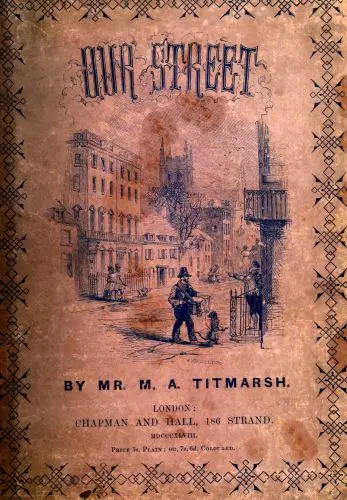
“Our Street”
William Makepeace Thackeray
THE CLASSIC COLLECTION · 1849
"The History of Samuel Titmarsh and the Great Hoggarty Diamond" by Thackeray is a novel likely written in the mid-19th century. The story follows Samuel Titmarsh, a young clerk who is navigating life in London after receiving an extravagant diamond pin from his wealthy aunt, Mrs. Hoggarty. The diamond serves as a catalyst for various social excursions and misadventures as Samuel navigates his relationships with both aristocrats and fellow clerks, contrasting his humble beginnings with his newfound social standing. The opening of the novel sets the stage for Samuel's life, illuminating his close relationship with his wealthy aunt, who gifts him an ornate locket containing a valuable diamond. As he returns to London, Samuel is filled with hope and expectations of fortune and social elevation, dreaming of a handsome gift that might come his way. However, he is met with the humor and absurdity of his aunt’s actual present: an ornate locket meant to symbolize his connection to his uncle, rather than cash. This scenario underlines Samuel's mix of ambition and dissatisfaction as he engages with both the working-class life and the upper echelons of society, suggesting he is on the brink of a series of comical encounters tied to his diamond pin.
Introduction adapted from the source catalogue; source summaries may be automatically generated.
Free to read · English · 49,968 words · No account needed
MAKE TIME FOR A GOOD BOOK
On by default. Untick to stop anonymous reading totals. Each page counts after 10 seconds in view. How this works.
Anonymous counting is on unless you have switched it off.
"Well, the first bird was bagged: both I and Brough had had a shot at him. Now I had to fire at the whole Rookery; and off I went, primed and loaded, sir,--primed and loaded.
"It was past eight when I arrived, and I saw, after I passed the lodge- gates, a figure that I knew, walking in the shrubbery--that of your respected aunt, sir: but I wished to meet the amiable ladies of the house before I saw her; because look, friend Titmarsh, I saw by Mrs. Hoggarty's letter, that she and they were at daggers drawn, and hoped to get her out of the house at once by means of a quarrel with them."
I laughed, and owned that Mr. Smithers was a very cunning fellow.
"As luck would have it," continued he, "Miss Brough was in the drawing- room twangling on a guitar, and singing most atrociously out of tune; but as I entered at the door, I cried 'Hush!' to the footman, as loud as possible, stood stock-still, and then walked forward on tip-toe lightly. Miss B. could see in the glass every movement that I made; she pretended not to see, however, and finished the song with a regular roulade.
"'Gracious Heaven!' said I, 'do, madam, pardon me for interrupting that delicious harmony,--for coming unaware upon it, for daring uninvited to listen to it.'
"'Do you come for Mamma, sir?' said Miss Brough, with as much graciousness as her physiognomy could command. 'I am Miss Brough, sir.'
"'I wish, madam, you would let me not breathe a word regarding my business until you have sung another charming strain.'
"She did not sing, but looked pleased, and said, 'La! sir, what is your
business?'
"'My business is with a lady, your respected father's guest in this
house.'
"'Oh, Mrs. Hoggarty!' says Miss Brough, flouncing towards the bell, and ringing it. 'John, send to Mrs. Hoggarty, in the shrubbery; here is a gentleman who wants to see her.'
"'I know,' continued I, 'Mrs. Hoggarty's peculiarities as well as anyone, madam; and aware that those and her education are not such as to make her a fit companion for you. I know you do not like her: she has written to us in Somersetshire that you do not like her.'
"'What! she has been abusing us to her friends, has she?' cried Miss Brough (it was the very point I wished to insinuate). 'If she does not like us, why does she not leave us?'
Your reading position is saved on this browser. Take it to another device with a library code. Reading pages adapt to text, rather than matching a printed edition.
William Makepeace Thackeray
William Makepeace Thackeray
Charles Dickens & William Makepeace Thackeray
William Makepeace Thackeray
BEHIND THE BOOK
This eBook is for the use of anyone anywhere in the United States and most other parts of the world at no cost and with almost no restrictions whatsoever. You may copy it, give it away or re-use it under the terms of the Project Gutenberg License included with this eBook or online at www.gutenberg.org. If you are not located in the United States, you will have to check the laws of the country where you are located before using this eBook. Read the source licence.
The original source file, including credits and licence, is retained by this library. Request an original-format copy at no charge. Please include the book title and Project Gutenberg identifier #1933.
KEEP YOUR CURIOSITY GOING
Coulson Kernahan

Maurice Baring
Frances Wright
Cécile Tormay

Frederic Jesup Stimson

W. H. P. (William Henry Pope) Jarvis