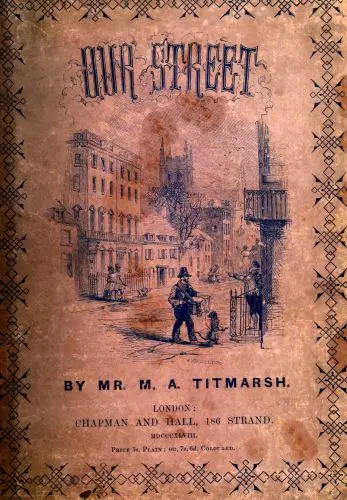
“Our Street”
William Makepeace Thackeray
THE CLASSIC COLLECTION · 1849
"The History of Samuel Titmarsh and the Great Hoggarty Diamond" by Thackeray is a novel likely written in the mid-19th century. The story follows Samuel Titmarsh, a young clerk who is navigating life in London after receiving an extravagant diamond pin from his wealthy aunt, Mrs. Hoggarty. The diamond serves as a catalyst for various social excursions and misadventures as Samuel navigates his relationships with both aristocrats and fellow clerks, contrasting his humble beginnings with his newfound social standing. The opening of the novel sets the stage for Samuel's life, illuminating his close relationship with his wealthy aunt, who gifts him an ornate locket containing a valuable diamond. As he returns to London, Samuel is filled with hope and expectations of fortune and social elevation, dreaming of a handsome gift that might come his way. However, he is met with the humor and absurdity of his aunt’s actual present: an ornate locket meant to symbolize his connection to his uncle, rather than cash. This scenario underlines Samuel's mix of ambition and dissatisfaction as he engages with both the working-class life and the upper echelons of society, suggesting he is on the brink of a series of comical encounters tied to his diamond pin.
Introduction adapted from the source catalogue; source summaries may be automatically generated.
Free to read · English · 49,968 words · No account needed
MAKE TIME FOR A GOOD BOOK
On by default. Untick to stop anonymous reading totals. Each page counts after 10 seconds in view. How this works.
Anonymous counting is on unless you have switched it off.
If I had the pen of a George Robins, I might describe the Rookery properly: suffice it, however, to say it is a very handsome country place; with handsome lawns sloping down to the river, handsome shrubberies and conservatories, fine stables, outhouses, kitchen-gardens, and everything belonging to a first-rate rus in urbe, as the great auctioneer called it when he hammered it down some years after.
I arrived on a Saturday at half-an-hour before dinner: a grave gentleman out of livery showed me to my room; a man in a chocolate coat and gold lace, with Brough's crest on the buttons, brought me a silver shaving-pot of hot water on a silver tray; and a grand dinner was ready at six, at which I had the honour of appearing in Von Stiltz's dress-coat and my new silk stockings and pumps.
Brough took me by the hand as I came in, and presented me to his lady, a stout fair-haired woman, in light blue satin; then to his daughter, a tall, thin, dark-eyed girl, with beetle-brows, looking very ill-natured, and about eighteen.
"Belinda my love," said her papa, "this young gentleman is one of my clerks, who was at our ball."
"Oh, indeed!" says Belinda, tossing up her head.
"But not a common clerk, Miss Belinda,--so, if you please, we will have none of your aristocratic airs with him. He is a nephew of the Countess of Drum; and I hope he will soon be very high in our establishment, and in the city of London."
At the name of Countess (I had a dozen times rectified the error about our relationship), Miss Belinda made a low curtsey, and stared at me very hard, and said she would try and make the Rookery pleasant to any friend of Papa's. "We have not much monde to-day," continued Miss Brough, "and are only in petit comite; but I hope before you leave us you will see some societe that will make your sejour agreeable."
I saw at once that she was a fashionable girl, from her using the French
language in this way.
"Isn't she a fine girl?" said Brough, whispering to me, and evidently as proud of her as a man could be. "Isn't she a fine girl--eh, you dog? Do you see breeding like that in Somersetshire?"
"No, sir, upon my word!" answered I, rather slily; for I was thinking all the while how "Somebody" was a thousand times more beautiful, simple, and ladylike.
"And what has my dearest love been doing all day?" said her papa.
"Oh, Pa! I have pinced the harp a little to Captain Fizgig's flute. Didn't I, Captain Fizgig?"
Your reading position is saved on this browser. Take it to another device with a library code. Reading pages adapt to text, rather than matching a printed edition.
William Makepeace Thackeray
William Makepeace Thackeray
Charles Dickens & William Makepeace Thackeray
William Makepeace Thackeray
BEHIND THE BOOK
This eBook is for the use of anyone anywhere in the United States and most other parts of the world at no cost and with almost no restrictions whatsoever. You may copy it, give it away or re-use it under the terms of the Project Gutenberg License included with this eBook or online at www.gutenberg.org. If you are not located in the United States, you will have to check the laws of the country where you are located before using this eBook. Read the source licence.
The original source file, including credits and licence, is retained by this library. Request an original-format copy at no charge. Please include the book title and Project Gutenberg identifier #1933.
KEEP YOUR CURIOSITY GOING
Coulson Kernahan

Maurice Baring
Frances Wright
Cécile Tormay

Frederic Jesup Stimson

W. H. P. (William Henry Pope) Jarvis