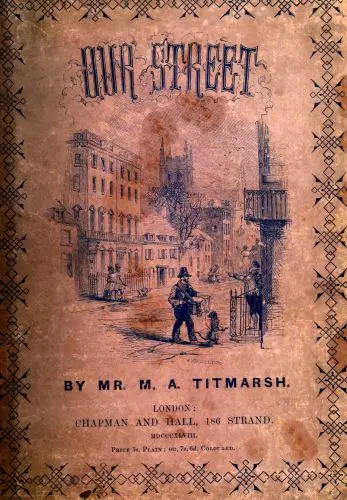
“Our Street”
William Makepeace Thackeray
THE CLASSIC COLLECTION · 1849
"The History of Samuel Titmarsh and the Great Hoggarty Diamond" by Thackeray is a novel likely written in the mid-19th century. The story follows Samuel Titmarsh, a young clerk who is navigating life in London after receiving an extravagant diamond pin from his wealthy aunt, Mrs. Hoggarty. The diamond serves as a catalyst for various social excursions and misadventures as Samuel navigates his relationships with both aristocrats and fellow clerks, contrasting his humble beginnings with his newfound social standing. The opening of the novel sets the stage for Samuel's life, illuminating his close relationship with his wealthy aunt, who gifts him an ornate locket containing a valuable diamond. As he returns to London, Samuel is filled with hope and expectations of fortune and social elevation, dreaming of a handsome gift that might come his way. However, he is met with the humor and absurdity of his aunt’s actual present: an ornate locket meant to symbolize his connection to his uncle, rather than cash. This scenario underlines Samuel's mix of ambition and dissatisfaction as he engages with both the working-class life and the upper echelons of society, suggesting he is on the brink of a series of comical encounters tied to his diamond pin.
Introduction adapted from the source catalogue; source summaries may be automatically generated.
Free to read · English · 49,968 words · No account needed
MAKE TIME FOR A GOOD BOOK
On by default. Untick to stop anonymous reading totals. Each page counts after 10 seconds in view. How this works.
Anonymous counting is on unless you have switched it off.
The door was open, and a number of carriages full of ladies were drawing up and setting down. Gus kept his hands in his pockets--trousers were worn very full then, with large tucks, and pigeon-holes for your boots, or Bluchers, to come through (the fashionables wore boots, but we chaps in the City, on 80l. a year, contented ourselves with Bluchers); and as Gus stretched out his pantaloons as wide as he could from his hips, and kept blowing away at his cheroot, and clamping with the iron heels of his boots, and had very large whiskers for so young a man, he really looked quite the genteel thing, and was taken by everybody to be a person of consideration.
He would not come into the shop though, but stood staring at the gold pots and kettles in the window outside. I went in; and after a little hemming and hawing--for I had never been at such a fashionable place before--asked one of the gentlemen to let me speak to Mr. Polonius.
"What can I do for you, sir?" says Mr. Polonius, who was standing close by, as it happened, serving three ladies,--a very old one and two young ones, who were examining pearl necklaces very attentively.
"Sir," said I, producing my jewel out of my coat-pocket, "this jewel has, I believe, been in your house before: it belonged to my aunt, Mrs. Hoggarty, of Castle Hoggarty." The old lady standing near looked round as I spoke.
"I sold her a gold neck-chain and repeating watch in the year 1795," said Mr. Polonius, who made it a point to recollect everything; "and a silver punch-ladle to the Captain. How is the Major--Colonel--General--eh, sir?"
"The General," said I, "I am sorry to say"--though I was quite proud that this man of fashion should address me so.--"Mr. Hoggarty is--no more. My aunt has made me a present, however, of this--this trinket--which, as you see, contains her husband's portrait, that I will thank you, sir, to preserve for me very carefully; and she wishes that you would set this diamond neatly."
"Neatly and handsomely, of course, sir."
"Neatly, in the present fashion; and send down the account to her. There is a great deal of gold about the trinket, for which, of course, you will make an allowance."
"To the last fraction of a sixpence," says Mr. Polonius, bowing, and looking at the jewel. "It's a wonderful piece of goods, certainly," said he; "though the diamond's a neat little bit, certainly. Do, my Lady, look at it. The thing is of Irish manufacture, bears the stamp of '95, and will recall perhaps the times of your Ladyship's earliest youth."
Your reading position is saved on this browser. Take it to another device with a library code. Reading pages adapt to text, rather than matching a printed edition.
William Makepeace Thackeray
William Makepeace Thackeray
Charles Dickens & William Makepeace Thackeray
William Makepeace Thackeray
BEHIND THE BOOK
This eBook is for the use of anyone anywhere in the United States and most other parts of the world at no cost and with almost no restrictions whatsoever. You may copy it, give it away or re-use it under the terms of the Project Gutenberg License included with this eBook or online at www.gutenberg.org. If you are not located in the United States, you will have to check the laws of the country where you are located before using this eBook. Read the source licence.
The original source file, including credits and licence, is retained by this library. Request an original-format copy at no charge. Please include the book title and Project Gutenberg identifier #1933.
KEEP YOUR CURIOSITY GOING
Coulson Kernahan

Maurice Baring
Frances Wright
Cécile Tormay

Frederic Jesup Stimson

W. H. P. (William Henry Pope) Jarvis