THE CLASSIC COLLECTION✦An outlaw’s diary: the CommuneCLASSIC FREE BOOKS
An outlaw’s diary: the Commune
Cécile Tormay
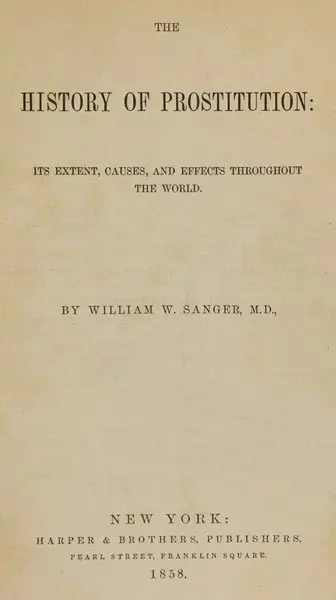
THE CLASSIC COLLECTION · 1858
"The History of Prostitution: Its Extent, Causes, and Effects throughout the World" by William W. Sanger, M.D. is a historical account written in the mid-19th century. The book examines the widespread phenomenon of prostitution, its historical contexts, and its social implications, specifically addressing the factors that contribute to its existence and persistence across societies. It offers an extensive analysis of prostitution from ancient times to modern practices, aiming to raise awareness about the issue and provoke discussion on potential solutions. At the start of the volume, Sanger outlines the gravity of prostitution as a societal plague, emphasizing its historical presence and the necessity of discussing it openly. He critiques the tendency of society to ignore the issue and its consequences, arguing for a need to understand its roots and impacts. The introduction sets the stage for his investigation, revealing his intention to delve into the origins, evolution, and regulation of prostitution throughout history. Sanger touches upon various civilizations, starting with ancient Jewish customs and legislation, indicating that prostitution has always been intertwined with societal norms and moral frameworks.
Introduction adapted from the source catalogue; source summaries may be automatically generated.
Free to read · English · 274,600 words · No account needed
MAKE TIME FOR A GOOD BOOK
On by default. Untick to stop anonymous reading totals. Each page counts after 10 seconds in view. How this works.
Anonymous counting is on unless you have switched it off.
[187] Brantome, in his Dames Galantes, describing a marriage, says, "Chacun estoit a l'escontes, a l'accoustumée."
[188] Vies des Hommes Illust.: Bonnivet.
[189] Sauval, Amours des rois de France; from which work many of the facts in the text throughout this chapter are drawn.
[190] Le divorce Satirique.
[191] Bayle's Dictionary, Vo. Henry IV.
[192] De Matrimonio, Le Somme des Peches.
[193] Charles V. 17th Octob. 1367.
[195] Cabinet du Roi de France, Paris, 1581.
[196] Parent-Duchatelet, De la Prostitution dans la Ville de Paris, ii.
473.
[197] See Taylor's House of Orleans, vol. i. and Memoires de la Duchesse
d'Orleans, passim.
[198] Nicolas Leoniceno, De Morbo Gallico, and others.
[199] Ulrich de Hutton, De Morbi Gallici curatione.
[200] Roderic Dias, Contra las Bubas.
[201] W. Beckett, Phil. Trans. vol. xxx.
[202] Registres du Parlement de Paris, 1497.
[203] Jerome Fracastor, De Morb. Contag.
[204] Registres du Parlement de Paris, 1505.
[205] Cullerier: Report of Chirurgien Mareschal; Report of M. de Breteuil to the Government; Parent-Duchatelet, ii. 180.
[206] Cullerier; Parent-Duchatelet, ii. 184.
[207] Parent-Duchatelet, ii. 186.
[208] Parent-Duchatelet, ii. 124.
[209] Parent-Duchatelet, ii. 130.
[210] Id. ii. 138.
[211] MSS. Reports quoted by Parent-Duchatelet, i. 30; Restif de la
Bretonne; Pornographe.
[212] Parent-Duchatelet, ii. 273.
[213] Id. ii. 398.
[214] Id. ii. 403.
[215] Dennistoun's Dukes of Urbino; Ranke's History of the Popes; Gibbon's
Rome.
[216] Ranke, ii. Appendix.
[217] In 1849, when the Roman people opened the palace of the Inquisition, there was found in the library a department styled "Summary of Solicitations," being a record of cases in which women had been solicited to acts of criminality by their confessors in the pontifical state, and the summary is not brief.--Dwight's "Roman Republic in 1849," p. 115.
[218] Discorsi, i. 12.
[219] Life of Leo X. Appendix.
[220] Fabronius, Leo X. p. 287.
[221] Paris de Grassine, Memoirs of the Court of Julius II. p. 579.
[222] Jovius, lib. iii. p. 56.
[223] De Commines, v. ii. c. 6.
[224] The Roman Pontiffs, New York, 1845.
[225] After the occupation by the French in 1809, a collection of facts was made by the French authorities, with a view to a census, but this we have been unable to obtain.
[226] Medical and Chirurgical Review, April, 1854.
[227] Ibid.
[228] Harper's Magazine, February, 1855, p. 326; Italian Life and Morals.
[229] Rome, by a New Yorker, 1845.
[230] Sharpe's Letters from Italy, 1705.
[231] History of Italy: Family Library, vol. iii.
[232] Roman Republic, 1849; Rome, by a New Yorker.
[233] Valery.
[234] Prescott, History of Ferdinand and Isabella, i. 66.
[235] Prescott, i. 66, et seq.
[236] Id. i. 227.
[237] Id. iii. 171.
[238] Voltaire says that these prurient questions were debated with a gusto and a minuteness of detail not found elsewhere. He instances a variety of these absurd theorems.
[239] It may be imagined, as was the case in Berlin, that this behest flowed from the irregular manner and conduct of the clergy; but some of the fathers of the Church entertained and avowed this opinion at a time when the morals of the clergy were not open to impeachment.
Your reading position is saved on this browser. Take it to another device with a library code. Reading pages adapt to text, rather than matching a printed edition.
BEHIND THE BOOK
This eBook is for the use of anyone anywhere in the United States and most other parts of the world at no cost and with almost no restrictions whatsoever. You may copy it, give it away or re-use it under the terms of the Project Gutenberg License included with this eBook or online at www.gutenberg.org. If you are not located in the United States, you will have to check the laws of the country where you are located before using this eBook. Read the source licence.
The original source file, including credits and licence, is retained by this library. Request an original-format copy at no charge. Please include the book title and Project Gutenberg identifier #41873.
KEEP YOUR CURIOSITY GOING
Cécile Tormay

Moritz Busch
John L. Ransom
Frances Wright
Cécile Tormay

Mabel Potter Daggett