THE CLASSIC COLLECTION✦An outlaw’s diary: the CommuneCLASSIC FREE BOOKS
An outlaw’s diary: the Commune
Cécile Tormay
THE CLASSIC COLLECTION · 1858
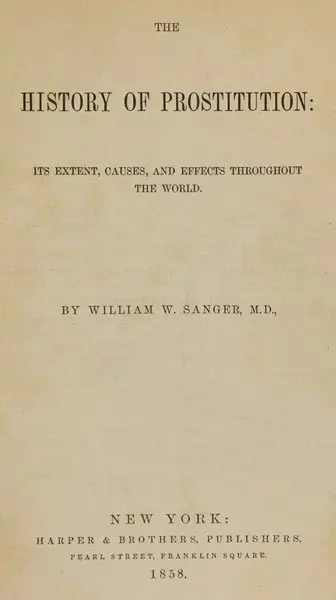
"The History of Prostitution: Its Extent, Causes, and Effects throughout the World" by William W. Sanger, M.D. is a historical account written in the mid-19th century. The book examines the widespread phenomenon of prostitution, its historical contexts, and its social implications, specifically addressing the factors that contribute to its existence and persistence across societies. It offers an extensive analysis of prostitution from ancient times to modern practices, aiming to raise awareness about the issue and provoke discussion on potential solutions. At the start of the volume, Sanger outlines the gravity of prostitution as a societal plague, emphasizing its historical presence and the necessity of discussing it openly. He critiques the tendency of society to ignore the issue and its consequences, arguing for a need to understand its roots and impacts. The introduction sets the stage for his investigation, revealing his intention to delve into the origins, evolution, and regulation of prostitution throughout history. Sanger touches upon various civilizations, starting with ancient Jewish customs and legislation, indicating that prostitution has always been intertwined with societal norms and moral frameworks.
Introduction adapted from the source catalogue; source summaries may be automatically generated.
Free to read · English · 274,600 words · No account needed
MAKE TIME FOR A GOOD BOOK
On by default. Untick to stop anonymous reading totals. Each page counts after 10 seconds in view. How this works.
Anonymous counting is on unless you have switched it off.
The speaker "begged to remind the meeting that a change had already been effected through the action of the police in the aspect of the Haymarket and Regent Street, heretofore so much complained of. The sense that the public eye was upon their class had caused a corresponding amendment in the dress and demeanor of the females frequenting those streets; and the objects of this association were, so far, in good train. Strongly oppressive, or, as some delicately said, repressive measures could only be carried out by an extent of police interference inconsistent with the prejudices of English people, who were indisposed to deny a large extent of personal freedom to persons of even the most disorderly classes who had not absolutely forfeited their civil rights. If the association went the length of advocating that the act of prostitution should involve such forfeiture, and the entire riddance of London streets from the presence of prostitutes, they would soon find their hands over full. Unless they thought it possible to exterminate the vice altogether, they would find that its wholesale clearance from the streets would necessitate registration, licensing, and confinement in certain authorized quarters or streets, as prevailed abroad; but such restrictions would entail a more ample recognition and legalization than had hitherto obtained, and so ample, indeed, as to be very distasteful to what was called the religious public. It would be obviously unjust to exempt from pressure the lady-like prosperous harlot, while a miserable, vulgar, painted outcast was consignable, because she stood out from the picture somewhat broadly, to the police cell and the bridewell. The meeting must be aware that there was already abroad among the lower half million of Londoners an impression that the police was already strict enough--and that this opinion was shared by numbers of intelligent men, neither paupers nor criminals. They must remember that many a gentleman of character had passed a night in a police cell for interfering in the defense of prostitutes against the police. And this sentiment would deepen very dangerously if the police pressure were put on double, or, as some would have it, tenfold. The very policemen, too--men sprung from the same class of society as those female offenders--were as likely as any one else to be fainthearted in the work of relieving the eyes and ears of gentility from the presence of those whose situation they were not slow to trace to the schemes and desires of the genteel class. He did not think that the power of discrimination could be safely intrusted to the ill-paid constables of the Metropolitan Police, and the association of certain rate-payers with the police as witnesses, as hinted at by one of the delegates, would soon, if established, fall into desuetude. With the view of checking the evil in a satisfactory manner, he would recommend the institution of a special service of street orderlies or regulators in uniform, a well-paid, superior, temperate, and discreet class of men, if possible, whose functions should be to observe, not to spy upon all prostitutes, especially those of the street-walking order, and whose circulation, as opposed to loitering and haunting particular spots, they should insist upon. They should work, not by threats, but by entreaty, advice, suggestion; but in case of contumacy, should have the right to call in the regular force. He believed that the right of entry and inspection of all places of ill fame should be vested in the Home Secretary and his delegates, and this would be attained least oppressively by a proper system of licensing. Forced concentration would not be tolerated here; but concentration was valuable, as bringing immorality more under control. Parochial crusades, though prima facie a public blessing, had often the effect of spreading corruption. It was recollected at Cambridge that when a certain proctor made very frequent descents upon the hamlet of Barnwall, where much of the parasitical vices of that University had taken root, the people in question, far from cure or conversion, merely extended their radius into more rural villages. These were so soon corrupted that representations were addressed to the University by the parochial clergy, praying that the plague of Barnwall should be confined to its old bounds, and not let loose upon their simpler parishes. It was notorious that the same kind of thing followed on a very large scale the expulsion of prostitutes from Brussels, and it could not be supposed that the attempt to strangle the growth of immorality by broadcasting its seeds, which was found impracticable under the powerful discipline of the English University and the Belgian capital, could answer among this enormous, and when roused, unmanageable population. The evicted of Norton Street, in the parish of All Souls, had settled quietly down in the next parish. Incompressible as water, the vice had but shifted its ground, and from a really moral point of view, more harm than good had accrued from the change."
Your reading position is saved on this browser. Take it to another device with a library code. Reading pages adapt to text, rather than matching a printed edition.
BEHIND THE BOOK
This eBook is for the use of anyone anywhere in the United States and most other parts of the world at no cost and with almost no restrictions whatsoever. You may copy it, give it away or re-use it under the terms of the Project Gutenberg License included with this eBook or online at www.gutenberg.org. If you are not located in the United States, you will have to check the laws of the country where you are located before using this eBook. Read the source licence.
The original source file, including credits and licence, is retained by this library. Request an original-format copy at no charge. Please include the book title and Project Gutenberg identifier #41873.
KEEP YOUR CURIOSITY GOING
Cécile Tormay

Moritz Busch
John L. Ransom
Frances Wright
Cécile Tormay

Mabel Potter Daggett