THE CLASSIC COLLECTION✦An outlaw’s diary: the CommuneCLASSIC FREE BOOKS
An outlaw’s diary: the Commune
Cécile Tormay
THE CLASSIC COLLECTION · 1858
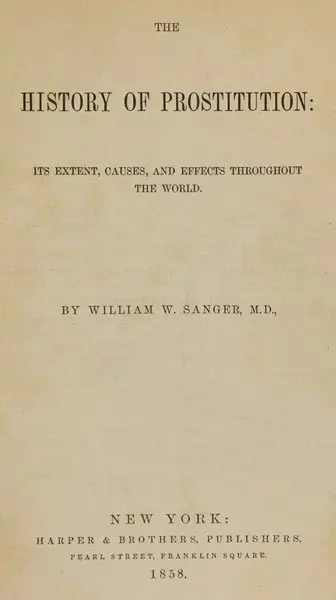
"The History of Prostitution: Its Extent, Causes, and Effects throughout the World" by William W. Sanger, M.D. is a historical account written in the mid-19th century. The book examines the widespread phenomenon of prostitution, its historical contexts, and its social implications, specifically addressing the factors that contribute to its existence and persistence across societies. It offers an extensive analysis of prostitution from ancient times to modern practices, aiming to raise awareness about the issue and provoke discussion on potential solutions. At the start of the volume, Sanger outlines the gravity of prostitution as a societal plague, emphasizing its historical presence and the necessity of discussing it openly. He critiques the tendency of society to ignore the issue and its consequences, arguing for a need to understand its roots and impacts. The introduction sets the stage for his investigation, revealing his intention to delve into the origins, evolution, and regulation of prostitution throughout history. Sanger touches upon various civilizations, starting with ancient Jewish customs and legislation, indicating that prostitution has always been intertwined with societal norms and moral frameworks.
Introduction adapted from the source catalogue; source summaries may be automatically generated.
Free to read · English · 274,600 words · No account needed
MAKE TIME FOR A GOOD BOOK
On by default. Untick to stop anonymous reading totals. Each page counts after 10 seconds in view. How this works.
Anonymous counting is on unless you have switched it off.
It will be seen from this that in 1850 the males were in excess at the rate of 2.08 per cent., and by applying the same rule to the population of 1858 a fair estimate of the relative number of each sex at the present time may be made as follows:
Males (1858) 14,925,188
Females 14,316,951
Excess of males 608,237
----------
Total estimated population 29,242,139
In the several geographical divisions of the Union the proportion of white males to white females is thus shown:[405]
New England States (Maine, New Hampshire, Vermont, Massachusetts, Rhode Island, and Connecticut), 100·87 females to 100 males.
Middle States (New York, New Jersey, Pennsylvania, Delaware, Maryland, and District of Columbia), 97·70 females to 100 males.
Southern States (Virginia, North Carolina, South Carolina, Georgia, and Florida), 98·54 females to 100 males.
Southwestern States (Alabama, Mississippi, Louisiana, Texas, Arkansas, and Tennessee), 91·66 females to 100 males.
Northwestern States (Kentucky, Missouri, Illinois, Indiana, Ohio, Michigan, Wisconsin, and Iowa), 92·11 females to 100 males.
California and Territories, 36·73 females to 100 males.
Two facts are developed in this statement. In the New England States females are in excess of males. From this district comes the majority of all the native-born prostitutes who find their home in New York City. In the Northwestern States, to which it has been proposed to remove some of the surplus female labor of New York, the males are in excess, and any women sent there would aid in restoring the equilibrium of the sexes.
The following table gives the relative percentage of each sex at different ages, and also the number of females to each hundred males:[406]
+---------------------------------------------------------+ | |Percentage|Percentage| Females | | | of | of | to each | | Ages. | Males. | Females. |100 Males.| |------------------------|----------|----------|----------| |Under 5 years | 14·68 | 14·95 | 96·76 | |From 5 years to 10 years| 13·69 | 13·98 | 97·03 | | " 10 " 15 " | 12·23 | 12·35 | 96·00 | | " 15 " 20 " | 10·39 | 11·42 | 104·46 | | " 20 " 30 " | 18·64 | 18·46 | 94·08 | | " 30 " 40 " | 12·85 | 11·84 | 87·55 | | " 40 " 50 " | 8·38 | 7·86 | 89·09 | | " 50 " 60 " | 4·97 | 4·83 | 92·15 | | " 60 " 70 " | 2·64 | 2·69 | 96·88 | | " 70 " 80 " | 1·11 | 1·18 | 101·01 | | " 80 " 90 " | ·31 | ·36 | 110·11 | | " 90 " 100 " |} ·04 | ·05 {| 123·16 | | " 100 years upward |} | {| 120·45 | |Ages unknown | ·07 | ·03 | 44·09 | | |----------|----------|----------| | | 100· | 100· | 95· | +---------------------------------------------------------+
Experience has proved that the age at which female virtue is exposed to the most temptations, or at least the age at which the greater part of the prostitutes in New York have embraced their wretched calling, is from fifteen to twenty years, and the table above shows that at those periods females are in excess over males nearly 4-1/2 per cent. Is it to be supposed that the numerical predominance is the cause of the temptations; or may it not rather be concluded that both are co-existent, and equally contribute to the sad result; or even would not temptation be more aggravated, because concentrated, if, at that critical period of life, males and females were in equal numbers?
The following table gives the relative ages of the whole population without distinction of sex, but compares the white, free colored, and slave classes:
Your reading position is saved on this browser. Take it to another device with a library code. Reading pages adapt to text, rather than matching a printed edition.
BEHIND THE BOOK
This eBook is for the use of anyone anywhere in the United States and most other parts of the world at no cost and with almost no restrictions whatsoever. You may copy it, give it away or re-use it under the terms of the Project Gutenberg License included with this eBook or online at www.gutenberg.org. If you are not located in the United States, you will have to check the laws of the country where you are located before using this eBook. Read the source licence.
The original source file, including credits and licence, is retained by this library. Request an original-format copy at no charge. Please include the book title and Project Gutenberg identifier #41873.
KEEP YOUR CURIOSITY GOING
Cécile Tormay

Moritz Busch
John L. Ransom
Frances Wright
Cécile Tormay

Mabel Potter Daggett