THE CLASSIC COLLECTION✦An outlaw’s diary: the CommuneCLASSIC FREE BOOKS
An outlaw’s diary: the Commune
Cécile Tormay
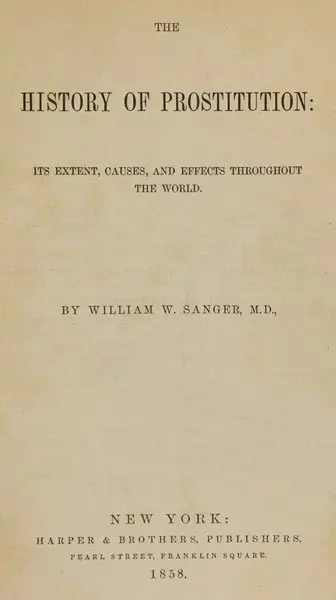
THE CLASSIC COLLECTION · 1858
"The History of Prostitution: Its Extent, Causes, and Effects throughout the World" by William W. Sanger, M.D. is a historical account written in the mid-19th century. The book examines the widespread phenomenon of prostitution, its historical contexts, and its social implications, specifically addressing the factors that contribute to its existence and persistence across societies. It offers an extensive analysis of prostitution from ancient times to modern practices, aiming to raise awareness about the issue and provoke discussion on potential solutions. At the start of the volume, Sanger outlines the gravity of prostitution as a societal plague, emphasizing its historical presence and the necessity of discussing it openly. He critiques the tendency of society to ignore the issue and its consequences, arguing for a need to understand its roots and impacts. The introduction sets the stage for his investigation, revealing his intention to delve into the origins, evolution, and regulation of prostitution throughout history. Sanger touches upon various civilizations, starting with ancient Jewish customs and legislation, indicating that prostitution has always been intertwined with societal norms and moral frameworks.
Introduction adapted from the source catalogue; source summaries may be automatically generated.
Free to read · English · 274,600 words · No account needed
MAKE TIME FOR A GOOD BOOK
On by default. Untick to stop anonymous reading totals. Each page counts after 10 seconds in view. How this works.
Anonymous counting is on unless you have switched it off.
The third-class houses of assignation are not situated in such select parts of the city as are the other two classes. Some of them are managed with much privacy and seclusion, while others are simply houses of public prostitution on a large scale. Their principal female patrons are those prostitutes who have rebelled against the exorbitant charges made by keepers of fashionable houses, and shop-girls who resort to prostitution to augment their income. Many of these live some distance up town, and any one who is journeying downward in the after part of the day may see numbers of them going to these places in the cars and stages. This is another imitation of the French and English systems. Very little disguise is attempted about these third-class houses. Each has a parlor or reception-room, where a man can have a bottle of wine, and one or two of the girls named will join him. Of course many couples visit there, but a large number of men go alone, knowing that there are always women in the house. Fast young men about town are in the habit of keeping their mistresses at these houses, as more economical than boarding with them at hotels. Considerable disease is propagated in such places, a contingency from which the first and second classes are almost entirely exempt. Business is generally over here in three or four hours, commencing in the dusk of the evening; but it is unquestionably a source of considerable revenue to the keeper, particularly in those cases where she acts as procuress, since, in addition to the rent of the room which the man pays, she always receives a present from the woman.
There is another or fourth class of assignation-houses to which the commonest portion of street-walkers take their company, and these may be emphatically described by an old saying, "Cheap and nasty." Dirty and insufficient accommodations are the equivalents for low prices, and such places are, in the general estimation of connoiseurs, very low and despicable. Notwithstanding this they thrive and multiply, from which it may safely be inferred that they are profitable in a business point of view, repulsive as they may be in their features and arrangements. Some of them are ingeniously arranged with a view to robbery, and are called "panel-houses." The plan adopted is somewhat as follows: Some man, generally a countryman not very well informed in the tricks of the metropolis, meets with a prostitute, and agrees to ac-company her to an assignation-house. She is in league with the "panel thieves," and therefore introduces her victim to one of their rooms. The apartment seldom contains more furniture than a bed and a chair or lounge, with the floor covered with a thick carpet. To make "assurance doubly sure," the man himself locks the door by which he enters, and, when undressing, naturally throws his clothes upon the chair or lounge. The bedstead is placed so that the feet come toward the only apparent door in the room, with one side against the wall, and the head and other side hung with curtains, which the woman carefully draws as soon as the man lies down by her side. At the head of the bed, and of course concealed by the drapery from any one occupying it, is another door, which forms the secret entrance. It is so adroitly arranged, and so neatly covered with paper the same as the walls, that no one would suspect its existence. The hinges and fastening on the outside are oiled, so that no noise can be perceived when it is opened, and the operator steals with cat-like step over the carpet, and quietly examines the clothes without alarming the unsuspecting stranger. The thief completes his inspection, appropriates as much as he thinks proper, and the temporary occupant of the apartment resumes his clothes and prepares to leave. If his suspicions are excited by the circumstance that his wallet looks less plethoric than it did, and an examination reveals that some of its contents are missing, he knows not how to account for it. He is perfectly certain that no one has entered that room while he was there, and if he has "visited" much before meeting the girl, he concludes that he must have lost some of his money in his career, and that the only way is to take the loss contentedly, and avoid New York fascinations in future. Sometimes the loser has not enough philosophy for this, and if he can be certain that his money was right when he entered the room, will call in the police, and thus expose the secret arrangements of the establishment. This is comparatively a rare case, as most men would rather submit to a pecuniary loss than encounter the trouble and exposure attending a criminal prosecution, and the knowledge of this reluctance enables the "panel thieves" to pursue their operations almost with impunity.
Your reading position is saved on this browser. Take it to another device with a library code. Reading pages adapt to text, rather than matching a printed edition.
BEHIND THE BOOK
This eBook is for the use of anyone anywhere in the United States and most other parts of the world at no cost and with almost no restrictions whatsoever. You may copy it, give it away or re-use it under the terms of the Project Gutenberg License included with this eBook or online at www.gutenberg.org. If you are not located in the United States, you will have to check the laws of the country where you are located before using this eBook. Read the source licence.
The original source file, including credits and licence, is retained by this library. Request an original-format copy at no charge. Please include the book title and Project Gutenberg identifier #41873.
KEEP YOUR CURIOSITY GOING
Cécile Tormay

Moritz Busch
John L. Ransom
Frances Wright
Cécile Tormay

Mabel Potter Daggett