THE CLASSIC COLLECTION✦An outlaw’s diary: the CommuneCLASSIC FREE BOOKS
An outlaw’s diary: the Commune
Cécile Tormay
THE CLASSIC COLLECTION · 1858
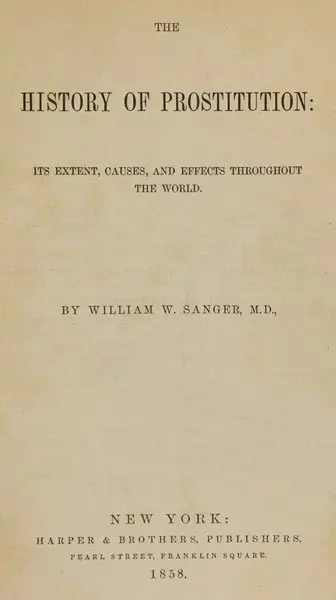
"The History of Prostitution: Its Extent, Causes, and Effects throughout the World" by William W. Sanger, M.D. is a historical account written in the mid-19th century. The book examines the widespread phenomenon of prostitution, its historical contexts, and its social implications, specifically addressing the factors that contribute to its existence and persistence across societies. It offers an extensive analysis of prostitution from ancient times to modern practices, aiming to raise awareness about the issue and provoke discussion on potential solutions. At the start of the volume, Sanger outlines the gravity of prostitution as a societal plague, emphasizing its historical presence and the necessity of discussing it openly. He critiques the tendency of society to ignore the issue and its consequences, arguing for a need to understand its roots and impacts. The introduction sets the stage for his investigation, revealing his intention to delve into the origins, evolution, and regulation of prostitution throughout history. Sanger touches upon various civilizations, starting with ancient Jewish customs and legislation, indicating that prostitution has always been intertwined with societal norms and moral frameworks.
Introduction adapted from the source catalogue; source summaries may be automatically generated.
Free to read · English · 274,600 words · No account needed
MAKE TIME FOR A GOOD BOOK
On by default. Untick to stop anonymous reading totals. Each page counts after 10 seconds in view. How this works.
Anonymous counting is on unless you have switched it off.
Thus far it has been supposed that man is the chief agent in the propagation of vice, nor is there any apparent reason to recede from that position. The numerous cases of seduction under false promises and subsequent desertion; of seduction by married men; of violations of helpless and unprotected females, are abundantly sufficient to prove this, much as it may be regretted for the credit of the stronger sex, and also to vindicate the opinion that employing males and females under one roof, in different branches of the same business, has a strong tendency to promote prostitution. Sometimes, however, it is true that woman, lost and abandoned herself, lends her aid to drag her fellow-women down to perdition. In many of the stores and workshops in our city, in every factory throughout the country, such are to be found, and their insidious influence is quickly felt. By false representations and elaborate coloring, they work upon the minds of the simple, or inflame the passions of the ambitious, but in either case their object is the same, and in it they frequently succeed.
Question. WHAT BUSINESS DID YOUR FATHER FOLLOW?
Fathers' business. Numbers.
Architects 4
Auctioneer 1
Agents 5
Butchers 47
Blacksmiths 63
Barbers 2
Bakers 21
Builders 11
Book-keepers 3
Boatmen 7
Brothel-keeper 1
Bankers 2
Carpenters 139
Carmen 26
Coopers 19
Clerks 32
Coachmen 10
Clergymen 6
Coach-makers 9
Cabinet-makers 16
Diver 1
Drover 1
Dyers 3
Engineers 18
Engraver 1
Farmers 440
Fishermen 6
Grocers 14
Gilders 2
Gardeners 10
Glass-blowers 2
Hotel and Tavern keepers 36
Hatters 13
Jewelers 10
Laborers 259
Liquor-dealers 22
Lawyers 13
Lumber-merchants 7
Livery-stable-keepers 5
Millers 20
Masons 82
Merchants 37
Moulders 3
Manufacturers 24
Musicians 8
Men of Property 5
Naval Officers 31
Overseers 5
Peddlers 5
Policemen 15
Painters 16
Printers 3
Planters 5
Pavers 4
Physicians and Surgeons 19
Plumbers 2
Pawnbrokers 2
Ship-carpenters 23
Sailors 35
Shoe-makers 48
Stage-drivers 4
Store-keepers 37
Stone-cutters 20
School-teachers 14
Silversmiths 3
Soldiers 38
Sail-makers 4
Saddlers 14
Servants 4
Surveyor 1
Tailors 35
Traders 11
Tanners and Curriers 7
Tinsmiths 2
Weavers 20
Wheelwright 1
Unascertained 106
----
Total 2000
This table shows that almost all classes of society are exposed to the influences which result in prostitution, from the children of men of property, bankers, merchants, and professional men, down to the families of mechanics and laborers. The numerous and varied occupations of the fathers of those women who answered the question renders any classification of them almost impossible. A majority of the parents were either mechanics or laborers, men who earned the daily food for themselves and families by manual labor, and whose resources would be governed by the ordinary fluctuations of trade.
Your reading position is saved on this browser. Take it to another device with a library code. Reading pages adapt to text, rather than matching a printed edition.
BEHIND THE BOOK
This eBook is for the use of anyone anywhere in the United States and most other parts of the world at no cost and with almost no restrictions whatsoever. You may copy it, give it away or re-use it under the terms of the Project Gutenberg License included with this eBook or online at www.gutenberg.org. If you are not located in the United States, you will have to check the laws of the country where you are located before using this eBook. Read the source licence.
The original source file, including credits and licence, is retained by this library. Request an original-format copy at no charge. Please include the book title and Project Gutenberg identifier #41873.
KEEP YOUR CURIOSITY GOING
Cécile Tormay

Moritz Busch
John L. Ransom
Frances Wright
Cécile Tormay

Mabel Potter Daggett