THE CLASSIC COLLECTION✦An outlaw’s diary: the CommuneCLASSIC FREE BOOKS
An outlaw’s diary: the Commune
Cécile Tormay
THE CLASSIC COLLECTION · 1858
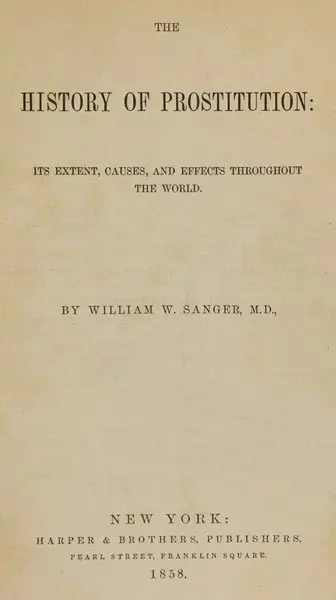
"The History of Prostitution: Its Extent, Causes, and Effects throughout the World" by William W. Sanger, M.D. is a historical account written in the mid-19th century. The book examines the widespread phenomenon of prostitution, its historical contexts, and its social implications, specifically addressing the factors that contribute to its existence and persistence across societies. It offers an extensive analysis of prostitution from ancient times to modern practices, aiming to raise awareness about the issue and provoke discussion on potential solutions. At the start of the volume, Sanger outlines the gravity of prostitution as a societal plague, emphasizing its historical presence and the necessity of discussing it openly. He critiques the tendency of society to ignore the issue and its consequences, arguing for a need to understand its roots and impacts. The introduction sets the stage for his investigation, revealing his intention to delve into the origins, evolution, and regulation of prostitution throughout history. Sanger touches upon various civilizations, starting with ancient Jewish customs and legislation, indicating that prostitution has always been intertwined with societal norms and moral frameworks.
Introduction adapted from the source catalogue; source summaries may be automatically generated.
Free to read · English · 274,600 words · No account needed
MAKE TIME FOR A GOOD BOOK
On by default. Untick to stop anonymous reading totals. Each page counts after 10 seconds in view. How this works.
Anonymous counting is on unless you have switched it off.
In 1844 and 1845, 735 syphilitic cases. Of these,
633 cases of primary syphilis required 17,916 days of attendance; 102 " " secondary " " 4,947 " " --- ------ 735 " " " 22,863 " "
In 1846, and the first six months of 1847, there were 618 cases:
501 cases of primary syphilis required 17,788 days of attendance; 117 " " secondary " " 5,213 " " --- ------ 618 " " " " 23,001 " "
Dr. Behrend states, as the results of conversations and communications with many of the medical profession, and of his own experience:
"1. That in the last four years there are more cases of syphilis.
"2. That, in consequence of the increased facilities for communication, the disease has spread to the small towns and villages.
"3. That it has been introduced more frequently into private families.
"4. That the character of the disease is more obstinate, thereby operating severely on the constitution and on future generations.
"5. That, since the abolition of the toleration system, unnatural crimes have been much more frequently met with."
As to the influence on public morals, he contends that the abolition has produced the most injurious consequences, particularly alluding to the desecration of matrimony. He says:
"It is common for persons of vicious habits to arrange a marriage, for the purpose of enabling them to avoid the police interference. This marriage bond is broken when convenient, and other marriages are formed: sometimes two couples will mutually exchange, and go through the ceremony."
He also made inquiries as to illegitimacy, and publishes some voluminous tables on the subject. From them we condense a
COMPARATIVE STATEMENT OF THE LEGITIMATE AND ILLEGITIMATE BIRTHS IN BERLIN FROM JANUARY 1, 1838, TO MARCH 31, 1849.
+-------------------------------------------------------------------+ | Years | Births. | Ratio of | | |---------------------------------| illegitimate to | | |Legitimate.|Illegitimate.|Total. |legitimate Births.| |--------------|-----------|-------------|-------|------------------| | 1838 | 8,587 | 1196 | 9,783| 1 in 7·2 | | 1839 | 7,820 | 1412 | 9,232| 1 in 5·5 | | 1840 | 9,019 | 1487 | 10,506| 1 in 6· | | 1841 | 9,024 | 1557 | 10,581| 1 in 5·7 | | 1842 | 10,269 | 1928 | 12,177| 1 in 5·3 | | 1843 | 10,370 | 1969 | 12,339| 1 in 5·2 | | 1844 | 10,958 | 2000 | 12,958| 1 in 5·4 | | 1845 | 11,402 | 2138 | 13,540| 1 in 5·3 | | 1846 | 11,717 | 2140 | 13,857| 1 in 5·4 | | 1847 | 11,294 | 2204 | 13,498| 1 in 5·1 | | 1848 | 12,113 | 2303 | 14,416| 1 in 5·2 | |3 mos. of 1849| 3,278 | 646 | 3,921| 1 in 5·1 | +-------------------------------------------------------------------+
Having rapidly traced the Berlin experience of the various methods of controlling prostitution for nearly three fourths of a century, it only remains to say that the increased evils of illicit prostitution, and the total inability of the police to counteract them; the spread of the venereal disease, and its augmented virulence; the palpable and growing licentiousness of the city; the complaints of public journals; the investigations of scientific men; and the memorials of the citizens generally, reached the royal ear, and induced an ordinance in 1851, restoring the toleration system, and entirely repealing the edict of 1845, which had produced such disastrous results.
Your reading position is saved on this browser. Take it to another device with a library code. Reading pages adapt to text, rather than matching a printed edition.
BEHIND THE BOOK
This eBook is for the use of anyone anywhere in the United States and most other parts of the world at no cost and with almost no restrictions whatsoever. You may copy it, give it away or re-use it under the terms of the Project Gutenberg License included with this eBook or online at www.gutenberg.org. If you are not located in the United States, you will have to check the laws of the country where you are located before using this eBook. Read the source licence.
The original source file, including credits and licence, is retained by this library. Request an original-format copy at no charge. Please include the book title and Project Gutenberg identifier #41873.
KEEP YOUR CURIOSITY GOING
Cécile Tormay

Moritz Busch
John L. Ransom
Frances Wright
Cécile Tormay

Mabel Potter Daggett