THE CLASSIC COLLECTION✦The art of fictionCLASSIC FREE BOOKS
The art of fiction
Walter Besant
THE CLASSIC COLLECTION · 1893
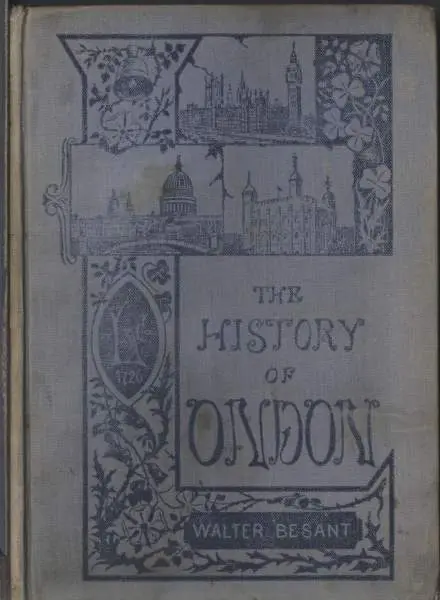
"The History of London" by Walter Besant is a historical account written in the late 19th century. The book explores the rich and complex history of London, documenting its evolution from ancient times through the eras of Roman, Saxon, and Norman rule. Through detailed narratives and analysis, it aims to provide a comprehensive understanding of the city's foundational events, key figures, and significant developments. The opening of the text delves into the legendary origins of London, tracing its foundation to Brutus, a survivor of the Trojan War, and focusing on key historical interpretations surrounding its early settlements. It discusses geographical factors that influenced the city's growth, such as its rivers and topography, which provided strategic advantages. Besant underscores the importance of archaeological discoveries and historical documents in reconstructing the past, advocating for a methodical examination of London's physical landscape to better grasp its historical context. Through this lens, the narrative sets the stage for a deeper exploration of London's societal, political, and architectural transformations throughout the ages.
Introduction adapted from the source catalogue; source summaries may be automatically generated.
Free to read · English · 66,602 words · No account needed
MAKE TIME FOR A GOOD BOOK
On by default. Untick to stop anonymous reading totals. Each page counts after 10 seconds in view. How this works.
Anonymous counting is on unless you have switched it off.
A map of Elizabethan London, drawn by one Agas, which is almost a picture as well as a map, shows us very clearly the aspect of the City. Let us lay down the map before us. First of all, we observe the wall of the City; it is carefully drawn of uniform height, with battlements, and at regular intervals, bastions. Outside the wall there is the ditch, but it is now, as Stow describes it, laid out in gardens--cows are grazing in some parts of it--and there are mean houses built on the other side of it. There is a single street of houses with large gardens outside Aldgate, which is now Whitechapel. The north side of Houndsditch is already built. A street of houses runs north of Bishopsgate. No houses stand between this street and two or three streets outside Cripplegate. Moorfields are really fields. There are windmills, gardens with summer-houses, pasture-fields with cows, a large 'dogge house,' and fields where women appear to be laying out clothes to dry. Really, they are tenter fields, i.e. fields provided with 'tenters,' or pegs, by means of which cloth could be stretched. North of Moorfields is indicated rising ground with woods. There can be no doubt at all as to the course of the wall, which is here marked with the greatest clearness. On the east of the Tower there is already a crowded quarter in the Precinct of St. Katherine's: and a few buildings mark the former site of the great monastery of Eastminster. In the Minories a group of new houses marks the site of the nunnery which stood here. London Bridge is covered with houses: on Bank Side, Southwark, there are two round buildings, 'The Bearebayting' and 'The Bullebayting.' There is also, opposite to Blackfriars, Paris Garden, a very favourite place of resort for the citizens. But as yet there are no theatres. Along the river outside the walls we find, beyond Bridewell Palace, an open space where was formerly Whitefriars. Here presently grew up a curious colony called Alsatia, which claimed to retain the right of Sanctuary once belonging to the monastery. Arrests for debt could not be made within its limits. That is to say, it was so claimed by the residents, who resisted any attempt to violate this privilege by force of arms. It was a notorious place in the seventeenth century, filled with rogues and broken-down gamblers, spendthrifts and profligates. As yet (when this map was drawn) there are very few houses between Whitefriars and the Temple. Beyond the Temple there are marked Arundel Place, Paget Place, Somerset Place, the Savoy, York Place. Duresme--i.e. Durham--Place, and 'the Court'--i.e. Whitehall--of which the map gives a plan, which gives us a clear idea of the plan and appearance of this palace, of which only the Banqueting Hall remains. The Savoy, at the time (1561) was a hospital. Henry VII. made a hospital of it, dedicated to St. John the Baptist, receiving 100 poor people. At the Dissolution of the Monasteries it was suppressed. Queen Mary restored it, and it continued as a hospital till the year 1702, when it was finally suppressed. Like Whitefriars, and for the same reason, it claimed the right of Sanctuary: therefore it became the harbour of people described as 'rogues and masterless men.' In the City itself there are many large gardens and open spaces. The courts of the Grey Friars, now a school, are still standing: there are gardens on the site of the Austin Friars' monastery and gardens between Broad Street and Bishopsgate Street. We must not think of London as a city crowded with narrow lanes and courts, the houses almost touching their opposite neighbours. Such courts were only found beside the river: many streets, it is true, were narrow, but there were broad thoroughfares like Cheapside, Gracechurch Street, Canwicke (now Cannon Street) Tower Street, and Fenchurch Street. The river is covered with boats: one of them is a barge filled with soldiers, which is being tugged by a four-oared boat: packhorses are being taken to the river to drink: below bridge the lighters begin: two or three vessels are moored at Billingsgate: the ships begin opposite the Tower: two or three great three-masted vessels are shown: and two or three smaller ships of the kind called ketch, sloop, or hoy. Along the river front of the Tower are mounted cannon. The ditch of the Tower is filled with water. On Tower Hill there stands a permanent gallows: beside it is some small structure, which is probably a pillory with the stocks.
Your reading position is saved on this browser. Take it to another device with a library code. Reading pages adapt to text, rather than matching a printed edition.
Walter Besant
Walter Besant

Walter Besant

Walter Besant
BEHIND THE BOOK
This eBook is for the use of anyone anywhere in the United States and most other parts of the world at no cost and with almost no restrictions whatsoever. You may copy it, give it away or re-use it under the terms of the Project Gutenberg License included with this eBook or online at www.gutenberg.org. If you are not located in the United States, you will have to check the laws of the country where you are located before using this eBook. Read the source licence.
The original source file, including credits and licence, is retained by this library. Request an original-format copy at no charge. Please include the book title and Project Gutenberg identifier #27995.
KEEP YOUR CURIOSITY GOING
Cécile Tormay

Moritz Busch
John L. Ransom
Frances Wright
Cécile Tormay

Mabel Potter Daggett