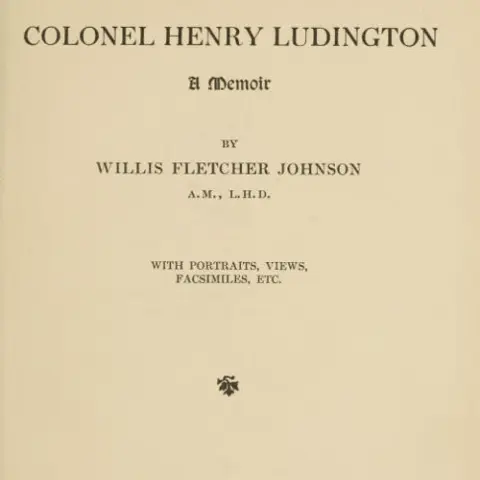
Colonel Henry Ludington: A Memoir
Willis Fletcher Johnson
THE CLASSIC COLLECTION · 1920
"The History of Cuba, vol. 3" by Willis Fletcher Johnson is a historical account written in the early 20th century. This volume focuses on the revolutionary era in Cuba, detailing the political and economic conditions that fueled the quest for independence from Spanish rule. It emphasizes the discontent among the Cuban populace due to oppressive governance and the complexities involved in the revolutionary movements led by figures such as Narciso Lopez. The opening of the text outlines the dire conditions faced by Cuba under Spanish rule, characterizing the period as one rife with exploitation and misgovernment. The narrative presents a detailed overview of Cuba's economic backwardness, the burdensome tax system, and the lack of personal liberties experienced by the Creole population. It sets the stage for the revolutionary movements, particularly highlighting the ambitions of Narciso Lopez, who aimed to liberate Cuba from oppressive Spanish governance. The author provides a vivid context of the political climate, outlining the social dynamics that led to a growing desire among Cubans for freedom and self-determination.
Introduction adapted from the source catalogue; source summaries may be automatically generated.
Free to read · English · 109,758 words · No account needed
MAKE TIME FOR A GOOD BOOK
On by default. Untick to stop anonymous reading totals. Each page counts after 10 seconds in view. How this works.
Anonymous counting is on unless you have switched it off.
Cayo, San Juan de los Remedios del, removal of, I, 319.
Cazones, Gulf of, I, 21.
Cemi, Cuban worship of, I, 55.
Census, of Cuba, first taken, by Torre, II, 131;
by Las Casas, 176;
of slaves, 205;
of 1775, 276;
of 1791, 277;
Humboldt on, 277;
of 1811, 280;
of 1817, 281;
of 1827, 283;
of 1846, 283;
of 1899, IV, 154;
of 1907, 287.
Cespedes, Carlos Manuel, III, 157;
portrait, facing 158;
in Spain, 158;
leads Cuban revolution, 158;
President of Republic, 158;
proclamation, 168;
negotiations with Spain, 187;
removed from office, 275.
Cespedes, Carlos Manuel, filibuster, IV, 55.
Cespedes, Enrique, revolutionist, IV, 30.
Cervera, Admiral, brings Spanish fleet to Cuba, IV, 110;
portrait, 110;
surrenders, 114.
Chacon, Jose Bayoma, II, 13.
Chacon, Luis, I, 331, 333.
Chalons, Sr., Secretary of Public Works, IV, 297.
Chamber of Commerce founded, II, 307.
Charles I, King, I, 74;
denounces oppression of Indians, 128.
Chaves, Antonio, Governor, I, 157;
prosecutes Avila, 157;
ruthless policy toward natives, 159;
controversy with King, 160;
dismissed from office, 161.
Chaves, Juan Baton de, I, 331.
Chilton, John, describes Havana, I, 349.
Chinchilla, Jose, Governor, III, 314.
Chinese, colonies in America, I, 7;
laborers imported into Cuba, II, 295.
Chorrera, expected to be Drake's landing place, I, 248.
Chorrera River, dam built by Antonelli, I, 262.
Christianity, introduced into Cuba by Ojeda, I, 55;
urged by King Ferdinand, 73.
Church, Roman Catholic, organized and influential in Cuba, I, 122; cathedral removed from Baracoa to Santiago, 123; conflict with civil power, 227; controversy with British during British occupation, II, 84; division of island into two dioceses, 173; attitude toward War of Independence, IV, 26; controversy over property, 294.
Cienfuegos, Jose, Governor, II, 311.
Cimmarones, "wild Indians," I, 126;
revolt against De Soto, 148.
Cipango, Cuba identified with, by Columbus, I, 5.
Cisneros, Gaspar Betancourt, sketch and portrait, II, 379.
Cisneros, Pascal Jiminez de, II, 110, 127.
Cisneros, Salvador, III, 167;
sketch and portrait, 276;
President of Cuban Republic, 277;
President of Council of Ministers, IV, 48;
in Constitutional Convention, 190.
Civil Service, law, IV, 325;
respected by President Menocal, 325.
Clay, Henry, policy toward Cuba, II, 261.
Clayton, John M., U. S. Secretary of State, issues proclamation against filibustering, III, 42.
Cleaveland, Samuel, controversy over church bells, II, 83.
Cleveland, Grover. President of United States, issues warning against
breaches of neutrality, IV, 70;
reference to Cuba
in message of 1896, 79;
its significance, 80.
Coat of Arms of Cuba, picture, IV, 251;
significance, 251.
Cobre, copper mines, I, 173, 259.
"Cockfighting and Idleness" campaign, IV, 291.
Coffee, cultivation begun, II, 33, 113.
Coinage, reformed, II, 142;
statistics of, 158.
Collazo, Enrique, filibuster, IV, 55.
Coloma, Antonio Lopez, revolutionist, IV, 30.
Colombia, designs upon Cuba, II, 262;
III, 134;
attitude toward Cuban revolution, 223.
Columbus, Bartholomew, recalled to Spain, I, 57.
Your reading position is saved on this browser. Take it to another device with a library code. Reading pages adapt to text, rather than matching a printed edition.
Willis Fletcher Johnson
Willis Fletcher Johnson
Willis Fletcher Johnson
Willis Fletcher Johnson
BEHIND THE BOOK
This eBook is for the use of anyone anywhere in the United States and most other parts of the world at no cost and with almost no restrictions whatsoever. You may copy it, give it away or re-use it under the terms of the Project Gutenberg License included with this eBook or online at www.gutenberg.org. If you are not located in the United States, you will have to check the laws of the country where you are located before using this eBook. Read the source licence.
The original source file, including credits and licence, is retained by this library. Request an original-format copy at no charge. Please include the book title and Project Gutenberg identifier #38139.
KEEP YOUR CURIOSITY GOING
Cécile Tormay

Moritz Busch
John L. Ransom
Frances Wright
Cécile Tormay

Mabel Potter Daggett