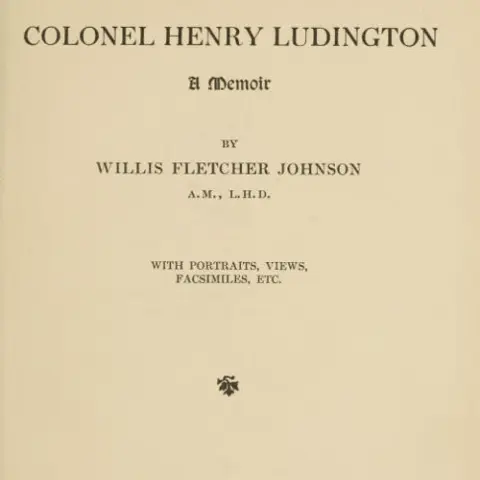
Colonel Henry Ludington: A Memoir
Willis Fletcher Johnson
THE CLASSIC COLLECTION · 1920
"The History of Cuba, vol. 3" by Willis Fletcher Johnson is a historical account written in the early 20th century. This volume focuses on the revolutionary era in Cuba, detailing the political and economic conditions that fueled the quest for independence from Spanish rule. It emphasizes the discontent among the Cuban populace due to oppressive governance and the complexities involved in the revolutionary movements led by figures such as Narciso Lopez. The opening of the text outlines the dire conditions faced by Cuba under Spanish rule, characterizing the period as one rife with exploitation and misgovernment. The narrative presents a detailed overview of Cuba's economic backwardness, the burdensome tax system, and the lack of personal liberties experienced by the Creole population. It sets the stage for the revolutionary movements, particularly highlighting the ambitions of Narciso Lopez, who aimed to liberate Cuba from oppressive Spanish governance. The author provides a vivid context of the political climate, outlining the social dynamics that led to a growing desire among Cubans for freedom and self-determination.
Introduction adapted from the source catalogue; source summaries may be automatically generated.
Free to read · English · 109,758 words · No account needed
MAKE TIME FOR A GOOD BOOK
On by default. Untick to stop anonymous reading totals. Each page counts after 10 seconds in view. How this works.
Anonymous counting is on unless you have switched it off.
While these things were occurring in the "Ever Faithful Isle," there were doings of epochal significance in Peninsular Spain. Queen Isabella had, as we have seen, for some time been an exile, and on June 25, 1870, the Serrano republican government forced her to sign a final manifesto of abdication. The government itself, however, was far from strong, and was unable to stand against strong opposition in the Cortes. It was shortly overthrown by a vote of that body, and a monarchical form of government was re-established. The crown was formally offered to and accepted by Amadeus, son of King Victor Emmanuel II of Italy, on December 4, 1870. When this news reached Cuba, the Spanish troops on the island took formal oath of allegiance to the new king of Spain.
The reestablishment of a monarchy was, of course, exceedingly pleasing to the Volunteers, for they had no sympathy with a republic, and the freedom which it was supposed to entail, although in the case of the republic in Spain, few changes or concessions had been extended to its Cuban subjects. The Volunteers promptly took oath to support the monarchy, and denounced the republican constitution. They embraced this as a favorable opportunity to further an end of their own. They had long suspected the Bishop of Havana of being in sympathy with the revolution. He was at this time absent in attendance at the Vatican Council at Rome, and the Volunteers were able so to manipulate matters that, upon his return on April 13, 1871, he was refused permission to land.
Believing that the new government would give even more cordial support to their machinations than had the previous one, the Volunteers now began a system of persecutions against Cuban patriots. The Volunteer corps, in 1872, numbered eighty thousand members, and in 1870 and 1871 they could not have fallen far below that number. They were so powerful that the Captain-General must either conform to their wishes or sooner or later give way to a successor whom they selected. Now there was published in Havana a paper, called La Voz de Cuba, which was really the "Voice of the Volunteers," for its editor, Gonzalo Castanon, was a Colonel of that organization. It busied itself, among other things, with attacks on the patriots, and took occasion to voice some derogatory remarks concerning Cuban women. Naturally the Cuban husbands, sons, fathers and lovers were hot with indignation against such calumny. Castanon paid the just penalty of his scurrilous lack of chivalry, for he was challenged by an outraged Cuban and in the duel which followed he received a mortal wound. He was buried in a tomb in the Espada Cemetery. Some time afterward, a party of young students--hardly more than boys--from the University of Havana, visited the cemetery, and it was reported to the authorities that one of them had been heard, while standing near the tomb of Castanon, to make remarks derogatory to the dead Colonel. This information was given by a Spanish soldier, who claimed to have overheard the conversation, and when it was repeated to a Spanish judge, the accusation was added that the boy's companions had defaced the glass which closed the Castanon tomb. The Volunteers immediately pounced upon the happening, as a delightful opportunity to chastise and punish the members of wealthy families in Havana who were suspected of aiding and abetting the revolution. The power of the Captain-General was invoked, and forty-three students were arrested and brought to trial. They were ably defended by a Spanish officer, Senor Capdevilla, and he made such a good case for their innocence that they were acquitted. The Volunteers, however, were not satisfied. Injustice had in some manner miscarried, how they could not conceive, and justice had triumphed. Such things would not do in dealing with Cubans. They made a vigorous appeal to the Captain-General, and obtained from him an order for assembling a second court martial, and this time they saw to it that their own body was well represented in that body. The boys were again apprehended, and the trial which ensued was a tragic farce, in which they were given not the slightest chance for justice. Eight of them were condemned to death, and the others to imprisonment at hard labor. Consternation reigned among the best families of Cuba. One distracted father offered a ransom of a million dollars for the life of his son, but without avail. On November 27, 1871, the condemned criminals, whose worst offence, if indeed there was any offense at all, was the utterance of an indignant remark about a ruffian who had attacked those dearest to all loyal, chivalrous and patriotic hearts, the women of Cuba, were led out and shot in the presence of fifteen thousand Spanish Volunteers, all under arms. In after years when the wrong was beyond repair, justice was done to the memory of these martyred youths, for not only did the Spanish Cortes, with admirable fairness, investigate the matter and pronounce in favor of the innocence of the students, but also the son of Castanon came to Cuba from Spain with the object of removing thither his father's remains, investigated the condition of the tomb, and made a sworn statement before a notary that it had never been disturbed.
Your reading position is saved on this browser. Take it to another device with a library code. Reading pages adapt to text, rather than matching a printed edition.
Willis Fletcher Johnson
Willis Fletcher Johnson
Willis Fletcher Johnson

Willis Fletcher Johnson
BEHIND THE BOOK
This eBook is for the use of anyone anywhere in the United States and most other parts of the world at no cost and with almost no restrictions whatsoever. You may copy it, give it away or re-use it under the terms of the Project Gutenberg License included with this eBook or online at www.gutenberg.org. If you are not located in the United States, you will have to check the laws of the country where you are located before using this eBook. Read the source licence.
The original source file, including credits and licence, is retained by this library. Request an original-format copy at no charge. Please include the book title and Project Gutenberg identifier #38139.
KEEP YOUR CURIOSITY GOING
Cécile Tormay

Moritz Busch
John L. Ransom
Frances Wright
Cécile Tormay

Mabel Potter Daggett