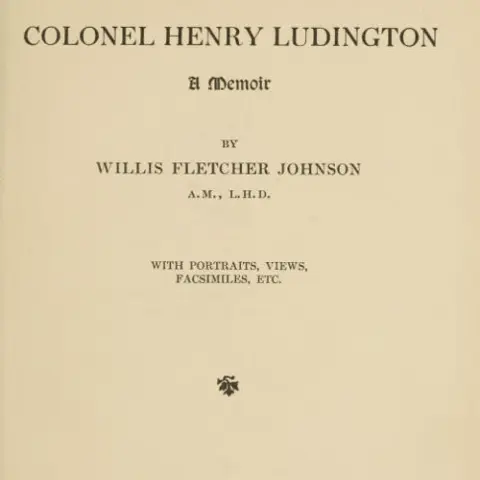
Colonel Henry Ludington: A Memoir
Willis Fletcher Johnson
THE CLASSIC COLLECTION · 1920
"The History of Cuba, vol. 3" by Willis Fletcher Johnson is a historical account written in the early 20th century. This volume focuses on the revolutionary era in Cuba, detailing the political and economic conditions that fueled the quest for independence from Spanish rule. It emphasizes the discontent among the Cuban populace due to oppressive governance and the complexities involved in the revolutionary movements led by figures such as Narciso Lopez. The opening of the text outlines the dire conditions faced by Cuba under Spanish rule, characterizing the period as one rife with exploitation and misgovernment. The narrative presents a detailed overview of Cuba's economic backwardness, the burdensome tax system, and the lack of personal liberties experienced by the Creole population. It sets the stage for the revolutionary movements, particularly highlighting the ambitions of Narciso Lopez, who aimed to liberate Cuba from oppressive Spanish governance. The author provides a vivid context of the political climate, outlining the social dynamics that led to a growing desire among Cubans for freedom and self-determination.
Introduction adapted from the source catalogue; source summaries may be automatically generated.
Free to read · English · 109,758 words · No account needed
MAKE TIME FOR A GOOD BOOK
On by default. Untick to stop anonymous reading totals. Each page counts after 10 seconds in view. How this works.
Anonymous counting is on unless you have switched it off.
The death of General Quesada left the post of Commander-in-Chief of the Cuban army vacant, and General Modeste Diaz was elected to that office. An official report made by the Cubans at this time shows the composition of the army to have been:
Army Corps of Oriente.
Commander-in-Chief, General Modeste Diaz
Division of Santiago de Cuba; Major-General Commanding, Maximo Gomez
Regiments Commander Localities No. of Men 1 and 2 Col. Jesus Perez Cobre 600 3 Lt. Col. Prado Baracoa 450 4 Lt. Col. Guillermo Moncada Baracoa 550 5 Lt. Col. Pacheco Guantanamo 450 6 Brig. Calixto Garcia Jiguani 600 ----- Total 2,650
Division of Holguin--General Commanding, Jose Inclan
Regiments Commander Localities No. of Men 1 Co. Fco. Herrero West 300 2 Gen. Inclan East 500 --- Total 800
Division of Bayamo--General Commanding, Luis Figueredo
Regiments Commander Localities No. of Men 1 Maj. Gen. N. Garrido Manzanillo 550 2 Gen. Luis Figueredo Bayamo 450 ------ Total 1,000 Grand Total Army Corps of Oriente 4,300
Army Corps of Camaguey
Commander-in-Chief, General Vicente Garcia
Division of Las Tunas--General Commanding, Vicente Garcia
Regiments Commander Localities No. of Men 1 General Vincente Garcia Santa Rita 650 2 Brig. Francisco Vega Arenas 400 ------ Total 1,050
Division of Camaguey--General Commanding, Ignacio Agramonte
Regiments Commander Localities No. of Men 1 Lt. Col. La Rosa Guaican Amar 300 2 Col. Agramonte Porro Guaican Amar 400 3 Lt. Col. Espinosa Guaican Amar 250 4 Lt. Col. Manuel Suarez Guaimaro 300 5 Lt. Col. Antonio Rodriguez Cubitas 200 ------ Total 1,450 Grand Total Army Corps of Camaguey 2,600
Army Corps of Las Villas
Commander-in-Chief, Major-General Matso Casanova
No. of Men Division of Trinidad, General Commanding, Brig. Juan Villegas 700 Division of Sancti Spiritus, General Com'ding, Brig. Jose Villamie 800 Division of Villa Clara, General Commanding, Brig. Carlos Ruloff 600 Division of Cienfuegos, General Commanding, Brig. Juan Villegas 700 Division of Remedios, General Commanding, Brig. Salome Hernandez 600 ------ Grand Army Total of Las Villas 3,400 Grand Total 10,300
In June, 1871, three regiments under General Maximo Gomez--that able soldier and patriot who was to figure so largely in the final struggle against Spain in 1895--were instructed to take up their position and endeavor to hold the line between Santiago de Cuba and Guantanamo, and they accordingly entrenched themselves in the Loma de la Gallista, but they were almost immediately attacked by the Spanish. The battle was hotly contested for four hours and ended in a victory for the Cubans. The Spanish losses included arms and ammunition which were eagerly appropriated by the conquerors. A few days later, a Spanish force renewed the attack, advancing fifteen hundred strong against the men under Gomez, and again they went down to defeat, their total losses in the two battles amounting to one hundred killed, and a large number wounded. In addition to this, the Cubans took fifteen Spaniards prisoners. What must have been still more gratifying was an encounter which a small band of Cubans had about this time with a company of Volunteers, in which twenty-five of the latter were made prisoners.
Your reading position is saved on this browser. Take it to another device with a library code. Reading pages adapt to text, rather than matching a printed edition.
Willis Fletcher Johnson
Willis Fletcher Johnson
Willis Fletcher Johnson

Willis Fletcher Johnson
BEHIND THE BOOK
This eBook is for the use of anyone anywhere in the United States and most other parts of the world at no cost and with almost no restrictions whatsoever. You may copy it, give it away or re-use it under the terms of the Project Gutenberg License included with this eBook or online at www.gutenberg.org. If you are not located in the United States, you will have to check the laws of the country where you are located before using this eBook. Read the source licence.
The original source file, including credits and licence, is retained by this library. Request an original-format copy at no charge. Please include the book title and Project Gutenberg identifier #38139.
KEEP YOUR CURIOSITY GOING
Cécile Tormay

Moritz Busch
John L. Ransom
Frances Wright
Cécile Tormay

Mabel Potter Daggett