THE CLASSIC COLLECTION✦An outlaw’s diary: the CommuneCLASSIC FREE BOOKS
An outlaw’s diary: the Commune
Cécile Tormay
THE CLASSIC COLLECTION · 1877
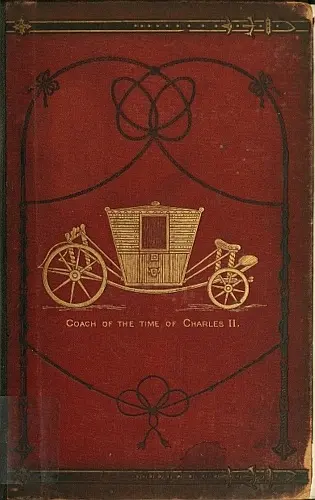
"The History of Coaches" by George Athelstane Thrupp is a historical account written in the late 19th century. The book explores the development and evolution of coaches and carriages over various epochs, highlighting their significance in transport, art, and society throughout the ages. It serves as a comprehensive guide for those interested in the history of vehicle design and coachbuilding techniques from antiquity to modern times. The opening of the text details Thrupp's motivations for writing, as he was commissioned to prepare lectures for the Society for the Encouragement of Arts, Manufactures, and Commerce in 1876. He opted to focus on the history of coachbuilding rather than a mere technical guide to vehicle construction. The introduction lays the groundwork for a chronological exploration, beginning with early wheels and sledges used in ancient civilizations, progress through various significant epochs in transport history, and the first coaches seen in England. Thrupp notes the challenges he faced in assembling historical data, highlighting the gaps in literature and resources available on the subject. This sets the stage for an in-depth examination of ancient vehicles and their implications on culture and technology over time.
Introduction adapted from the source catalogue; source summaries may be automatically generated.
Free to read · English · 44,370 words · No account needed
MAKE TIME FOR A GOOD BOOK
On by default. Untick to stop anonymous reading totals. Each page counts after 10 seconds in view. How this works.
Anonymous counting is on unless you have switched it off.
The next published was, I believe, that by Mr W. Bridges Adams, in 1837, by Messrs C. Knight & Co., of Ludgate Street, entitled, “English Pleasure Carriages.” This book should certainly be possessed by all Coachbuilders who desire information as to the best method of forming and completing a good carriage. It is full and accurate in the rules given, and the theories and mechanical principles expounded, giving very ample details as to materials to be used, and the manner of making the best use of them. Mr Adams, who was for a time in the firm of Hobson & Co., has given a description of the different carriages used in his time, which will form a reference for future ages, as M. Roubo’s descriptions serve for the previous century.
Since Mr Adams’ work we have a valuable contribution to the history of the art of Coachbuilding in the treatise by the Count Giovanni Gozzadini on “The Origin of Coaches,” published in 1864 at Bologna. This is in the Italian language; a copy is in the British Museum. We find in it a spirited defence of Italy from the charge of deriving their knowledge of Carriage-building from France; and the author proves, from the archives of different towns and noble families, that Italy was second only to Germany in its wealth and number of carriages during the sixteenth and seventeenth centuries. Besides these, we have had the Carriage Builders’ Art Journal, which commenced in 1859 and lasted for four years, a journal which reflected great credit upon its editor, and is full of information still worthy of our study; the Art du Carrossier, published at Paris; two American periodicals; and the Saddlers and Coachbuilders’ Gazette in London.
The carriages of America are so different from our own, and from those of Europe, that they require special attention. It is possible that their style may influence in an important degree the carriages of future ages. We see in them primarily “lightness.” That lightness in their larger carriages is carried to excess most Coachbuilders will agree. We are supported in this view by the fact that for some years these, such as landaus, broughams, and coaches, have been materially modified by European types. The Americans have adopted some of the shapes of Europe, and the mode of constructing the under carriages, retaining their own methods of making the pole and splinters, or whipple trees, as giving greater freedom to the horses. I think this principle of allowing the horse greater scope for exertion is particularly worth the attention of Coachbuilders. The manner in which our horses are confined by tight heavy strapping and traces, by tight pole chains, by bearing reins, and the indiscriminate use of blinkers to the bridles has been much overdone in England. If a horse with a heavy load, driven fast over slippery roads should stumble, it is most difficult for him to recover himself--he falls, is sometimes pushed along by the impetus of the carriage, and is more or less injured in his limbs or nerves by the accident, whilst it is difficult for him to rise again until the harness is unstrapped, and the carriage is removed from above him. We also harness our horses too closely to their work in the two-wheeled carriages. We have thought only of the ease of turning and moving the whole vehicle in crowded or narrow ways, without observing the advantage of the long shafts over short shafts. If the shafts are considered as levers by which the horse supports and moves the weight behind him in a two-wheeled cart, it will be at once obvious that (although whilst those levers are parallel with the road) it does not so much signify whether they are long or short; yet the moment they point upwards, and especially when they point downwards, the difference between long and short levers is felt severely by the horse. We can all of us lift a weight or support a weight more easily with a long lever than with a short one, and it is the same with a horse. Those who have travelled abroad must have noticed the great weights placed upon two-wheeled carts in France and Belgium, and the greater comparative distance at which the horse is placed from the wheels, and yet how little the horse is distressed. He manages his load more easily because he does not feel the weight so heavily upon his back. Many drivers in England seem to have observed this, and try to ease the horse and lessen his chance of stumbling by tipping the shafts up in front, but in this way the horse is made to feel a pressure on the under part of the body which is neither natural nor healthy. I think therefore that, in future years, the growth of public opinion will be in favour of longer shafts and poles. This will also tend to preserve good carriages from the damage they at present suffer from the heat of the horses, and the quantity of mud which is thrown by their heels upon the front of the vehicle. The reins will of course have to be longer, but this cannot be of much consequence; the driver of a brougham is further from the horse than the driver of a mail phaeton, but we do not consider that the brougham is more difficult to drive than the mail phaeton on that account.
Your reading position is saved on this browser. Take it to another device with a library code. Reading pages adapt to text, rather than matching a printed edition.
BEHIND THE BOOK
This eBook is for the use of anyone anywhere in the United States and most other parts of the world at no cost and with almost no restrictions whatsoever. You may copy it, give it away or re-use it under the terms of the Project Gutenberg License included with this eBook or online at www.gutenberg.org. If you are not located in the United States, you will have to check the laws of the country where you are located before using this eBook. Read the source licence.
The original source file, including credits and licence, is retained by this library. Request an original-format copy at no charge. Please include the book title and Project Gutenberg identifier #49194.
KEEP YOUR CURIOSITY GOING
Cécile Tormay

Moritz Busch
John L. Ransom
Frances Wright
Cécile Tormay

Mabel Potter Daggett