THE CLASSIC COLLECTION✦An outlaw’s diary: the CommuneCLASSIC FREE BOOKS
An outlaw’s diary: the Commune
Cécile Tormay
THE CLASSIC COLLECTION · 1877
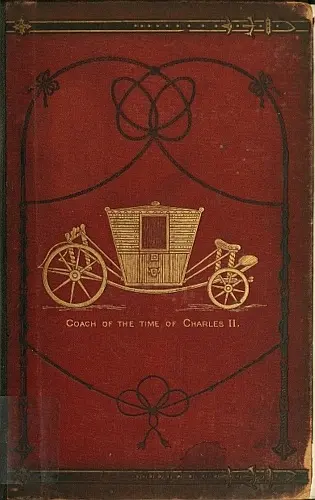
"The History of Coaches" by George Athelstane Thrupp is a historical account written in the late 19th century. The book explores the development and evolution of coaches and carriages over various epochs, highlighting their significance in transport, art, and society throughout the ages. It serves as a comprehensive guide for those interested in the history of vehicle design and coachbuilding techniques from antiquity to modern times. The opening of the text details Thrupp's motivations for writing, as he was commissioned to prepare lectures for the Society for the Encouragement of Arts, Manufactures, and Commerce in 1876. He opted to focus on the history of coachbuilding rather than a mere technical guide to vehicle construction. The introduction lays the groundwork for a chronological exploration, beginning with early wheels and sledges used in ancient civilizations, progress through various significant epochs in transport history, and the first coaches seen in England. Thrupp notes the challenges he faced in assembling historical data, highlighting the gaps in literature and resources available on the subject. This sets the stage for an in-depth examination of ancient vehicles and their implications on culture and technology over time.
Introduction adapted from the source catalogue; source summaries may be automatically generated.
Free to read · English · 44,370 words · No account needed
MAKE TIME FOR A GOOD BOOK
On by default. Untick to stop anonymous reading totals. Each page counts after 10 seconds in view. How this works.
Anonymous counting is on unless you have switched it off.
Writers on Carriages--Periodical Publications on Coaches--Tight Harnessing--Height of the Driver’s Seat--Cover to the Driver’s Seat--American Buggy--American Trotting Waggons--Labour-Saving Machines--Machines Save Time--American Magazines on Carriages--Principles of Draught--Disadvantages of Two-Wheeled Vehicles--Track of Wheels--Utility of High Wheels--Side Thrust and Vibration of Wheels--Pitch of Axles and Dish of Wheels--Springs--Elliptic Springs--Brake Retarders--India Rubber Brake Blocks--A Load Should Rest on the Highest Wheel--Danger to a Stage Coach on Low Front Wheels--Carriage Drawings of Full Size--Value of being a Good Draughtsman--Mr Gladstone on Design--Coachmakers’ Company’s Library 126-140
Frontispiece, as Plate 37.
Plate 1--Figure 1. Egyptian Car.
“ 2. Grecian Car.
“ 3. Roman Car.
Plate 2--British War Chariot.
Plate 3--Ancient Roman Chariot, from a Bas-Relief at Orleans.
Plate 4--The Ordinary German Waggon.
Plate 5--Two-wheeled Carriage, Hindostan.
Plate 6--Four-wheeled Carriage, Hindostan.
Plate 7--Hungarian Coach, from Ginzrot’s Work.
Plate 8--The Araba of Turkey.
Plate 9--Ancient Horse Litter.
Plate 10--Wedding Coach of Duke of Saxony, 1584.
Plate 11--Ancient Italian Coach of 1549.
Plate 12--Queen Elizabeth’s Coach.
Plate 13--Coach of time of Charles I.
Plate 14--Coach of Paris in 1646.
Plate 15--Coach in which Henry IV. was shot.
Plate 16--Coach in which Louis XIV. entered Paris in 1654.
Plate 17--Coach of Louis XIV., 1700.
Plate 18--The Corbillard, an early French Coach.
Plate 19--Brouette of Paris, 1670.
Plate 20--The Berlin, from one now at Vienna.
Plate 21--Litter to be carried by horses, now at Vienna.
Plate 22--Coach of Charles II.’s time.
Plate 23--The first Landau.
Plate 24--Chariot à l’Anglaise, after M. Roubo.
Plate 25--A French Chaise de Poste of 1760.
Plate 26--From a Print published at Rome, 1692.
Plate 27--Landau of 1790.
Plate 28--Sociable after Hatchett.
Plate 29--A high Perch Phaeton of 1790.
Plate 30--A One-horse Phaeton of 1790.
Plate 31--A Chair-back Gig of 1790.
Plate 32--A Caned Whiskey of 1790.
Plate 33--A Briska on =C= Springs.
Plate 34--English Stage Coach, 1787, after Rowlandson.
Plate 35--Diligence from Paris to Lyons.
Plate 36--Modern French Diligence.
Plate 37--Probably the first Sociable. The property of the Emperor of Germany. A Child’s Carriage of the date of 1700.--Frontispiece.
Plate 38--An English Post Chaise of 1790.
The History of the Art of Coachbuilding.
Your reading position is saved on this browser. Take it to another device with a library code. Reading pages adapt to text, rather than matching a printed edition.
BEHIND THE BOOK
This eBook is for the use of anyone anywhere in the United States and most other parts of the world at no cost and with almost no restrictions whatsoever. You may copy it, give it away or re-use it under the terms of the Project Gutenberg License included with this eBook or online at www.gutenberg.org. If you are not located in the United States, you will have to check the laws of the country where you are located before using this eBook. Read the source licence.
The original source file, including credits and licence, is retained by this library. Request an original-format copy at no charge. Please include the book title and Project Gutenberg identifier #49194.
KEEP YOUR CURIOSITY GOING
Cécile Tormay

Moritz Busch
John L. Ransom
Frances Wright
Cécile Tormay

Mabel Potter Daggett