THE CLASSIC COLLECTION✦An outlaw’s diary: the CommuneCLASSIC FREE BOOKS
An outlaw’s diary: the Commune
Cécile Tormay
THE CLASSIC COLLECTION · 1877
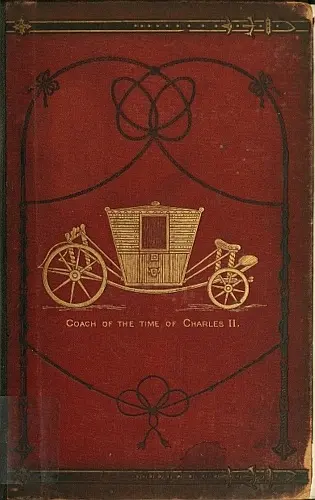
"The History of Coaches" by George Athelstane Thrupp is a historical account written in the late 19th century. The book explores the development and evolution of coaches and carriages over various epochs, highlighting their significance in transport, art, and society throughout the ages. It serves as a comprehensive guide for those interested in the history of vehicle design and coachbuilding techniques from antiquity to modern times. The opening of the text details Thrupp's motivations for writing, as he was commissioned to prepare lectures for the Society for the Encouragement of Arts, Manufactures, and Commerce in 1876. He opted to focus on the history of coachbuilding rather than a mere technical guide to vehicle construction. The introduction lays the groundwork for a chronological exploration, beginning with early wheels and sledges used in ancient civilizations, progress through various significant epochs in transport history, and the first coaches seen in England. Thrupp notes the challenges he faced in assembling historical data, highlighting the gaps in literature and resources available on the subject. This sets the stage for an in-depth examination of ancient vehicles and their implications on culture and technology over time.
Introduction adapted from the source catalogue; source summaries may be automatically generated.
Free to read · English · 44,370 words · No account needed
MAKE TIME FOR A GOOD BOOK
On by default. Untick to stop anonymous reading totals. Each page counts after 10 seconds in view. How this works.
Anonymous counting is on unless you have switched it off.
The word coach in all European languages has the same sound, and is derived from the town of Kotze in Hungary, where coaches were first built, just as Landaus and Berlins were so named from the cities that first produced them. The coach from Hungary was given to Charles VII., at Paris, in the year 1457. In 1474, the Emperor Frederick III. rode to Frankfort in a coach covered and suspended. In 1509, the Pope Paul III. visited Ferrara, and was met by the duke with a train of sixty coaches, whilst to make it clear that these were not the cars, the historian mentions that the Duchess of Ferrara rode in a litter, and her ladies followed her in twenty-two cars. At this period, 1550, there were only three coaches in Paris, one belonging to the Queen of Francis I., another to Diana of Poitiers, and a third to a corpulent nobleman who could not mount a horse. There must have been many other vehicles in France, but, it seems, only three covered and suspended coaches. In 1594, the Margrave of Brandenburg, father of the first Duke of Prussia, had thirty-six coaches, each with six horses.
We will now consider what was the origin and the shape of these coaches. It is in the German waggon that we find the origin of the coach. Throughout Germany, Russia, France, and other parts of Europe, the chief agricultural vehicle is the waggon. [Plate 4.] It is of the same form now that it was a hundred years ago. The under part is similar in its construction to our timber-waggons, and, like them, it is capable of being lengthened or shortened at pleasure. The wheels vary in height, according to the requirements of the owner and the country, and the chief purpose for which it is used. As in our timber-waggons, the wheels are sometimes 4 feet and 5 feet high, and sometimes they are as low as 2 feet 8 inches in front and 3 feet 6 inches behind, but the usual size is 3 feet 6 inches in front and 4 feet behind, the track on the road between the tyres is but 4 feet, and the centres of the axle-trees are about 7 feet apart. The carriage is composed of a transom in front, with a perch (as we name the long piece of timber that unites the front and hind wheels) fastened to it. There is a hind axle-tree bed formed of two pieces of timber, clipped together, between which the wings are notched in; these wings meet together above the perch to which they are united by a strong iron pin. The under works consist of a front axletree bed, also made of two pieces clipped together with two futchels notched in between, and meeting in a point in front, and spreading outwards behind the axletree bed; a long sway bar, generally quite straight, rests on the futchels and bears against the under part of the perch. Our word futchels is derived through the French word fourchils, from the Latin furca or fork. The pole of these waggons has at the hind end two wings fixed by iron hoops; the wings are fitted outside the front end of the futchels and are secured by two moveable iron pins. This method of attaching the pole is very ancient; it was in use in the time of the Romans, and may be traced in old pictures. The horses are harnessed to splinter or drawing bars; the longest of these is attached to the pole by a bolt or pin. When the load is light, it is common to harness one horse only to the left or near side of the pole. The under works being thus complete, a body is formed by two long fir poles laid from the top of the transom to the top of the hind axletree bed, about 18 inches apart, with two planks between. Outside the poles are four standard posts, about 30 inches long, which rise upright from the transom and axle-beds, but which, viewed from behind, spread outwards from four to six inches each towards the wheels. The sides are formed by planks resting against these standard posts, and the ends of the waggon are also moveable. The body is thus much narrower at the bottom than at the top. We shall find that this shape pervades all the early vehicles used by the wealthy classes, showing very plainly the original type of the coach. When the waggon is thus fitted up with plank sides, it can carry earth, manure, or roots. When the farmer wishes to transport a load of hay, the planks are removed, the carriage is lengthened two or more feet, and the sides are formed by long and high hurdles. If a large cask of wine has to be transported, the sides are removed and the cask placed upon the centre of the poles, and, as the waggon moves along, the poles may be seen to sway slightly up and down under the weight of the cask, as the poles of a sedan-chair, or palankeen sway, suggesting, as I hope to show hereafter, a means of forming a species of spring for the ease of anyone riding in the waggon.
Your reading position is saved on this browser. Take it to another device with a library code. Reading pages adapt to text, rather than matching a printed edition.
BEHIND THE BOOK
This eBook is for the use of anyone anywhere in the United States and most other parts of the world at no cost and with almost no restrictions whatsoever. You may copy it, give it away or re-use it under the terms of the Project Gutenberg License included with this eBook or online at www.gutenberg.org. If you are not located in the United States, you will have to check the laws of the country where you are located before using this eBook. Read the source licence.
The original source file, including credits and licence, is retained by this library. Request an original-format copy at no charge. Please include the book title and Project Gutenberg identifier #49194.
KEEP YOUR CURIOSITY GOING
Cécile Tormay

Moritz Busch
John L. Ransom
Frances Wright
Cécile Tormay

Mabel Potter Daggett