THE CLASSIC COLLECTION✦An outlaw’s diary: the CommuneCLASSIC FREE BOOKS
An outlaw’s diary: the Commune
Cécile Tormay
THE CLASSIC COLLECTION · 1912
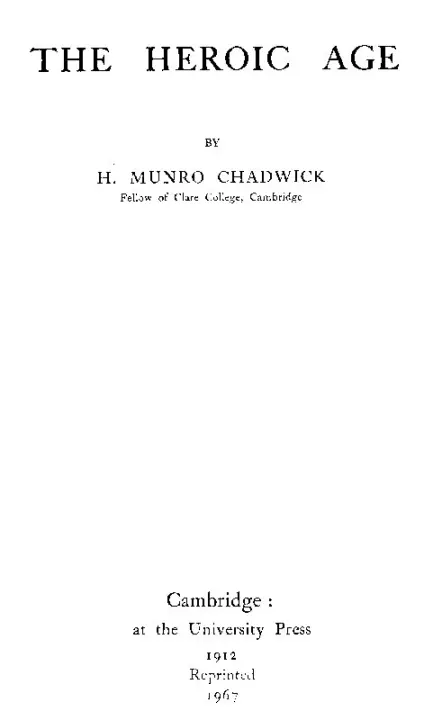
"The Heroic Age" by H. Munro Chadwick is a historical account written in the early 20th century. The work explores the characteristics and themes of heroic poetry across various cultures, particularly focusing on the Teutonic and Greek traditions. It investigates the oral narratives surrounding notable figures and events within these ancient literary forms, seeking to identify their origins and interconnections. The beginning of the book sets the stage for a comparative study of heroic poetry, emphasizing the recurrent themes and narrative structures found in the epics of different cultures. Specifically, Chadwick introduces the early narrative poetry of the Teutonic peoples, referencing significant works such as "Beowulf," and discusses their thematic concerns and historical context. He emphasizes the importance of understanding these stories within the framework of their own time, hinting at the anthropological implications of their content. This methodological approach offers a foundational basis for further exploration of the influence these heroic tales have had across generations and their significance in the development of cultural identity.
Introduction adapted from the source catalogue; source summaries may be automatically generated.
Free to read · English · 190,164 words · No account needed
MAKE TIME FOR A GOOD BOOK
On by default. Untick to stop anonymous reading totals. Each page counts after 10 seconds in view. How this works.
Anonymous counting is on unless you have switched it off.
[50] It is perhaps worth noting that in v. 2186 the expression dryhten wereda is used of Hygelac. Elsewhere in Anglo-Saxon poetry this phrase is applied only to the Deity.
[51] Clark Hall, Beowulf, p. xxviii.
[52] If there is Celtic influence at all it is more probably Welsh.
[53] Cf. p. 46, note, where the passage is quoted in full.
[54] The amount of freedom differs of course greatly from case to case (cf. Note IV, p. 101 ff.); but it is only in communities which have elaborated the art of minstrelsy to a very high degree that the form of words can become absolutely stereotyped.
[55] Beowulf (1889), pp. 110-160.
[56] Quellen und Forschungen, LXII (1888); summarised p. 242 ff.
[57] The Origin of the English Nation, p. 93, note.
[58] The references quoted on p. 41 ff. preclude the possibility that these stories were first acquired from the Danes, when the latter again became known in this country about the close of the eighth century.
[59] A different view is taken by Schücking, Beowulfs Rückkehr (Studien zur engl. Philologie, XXI), p. 65 ff.
[60] We may refer especially to the account of Attila's funeral given by Jordanes, cap. 49 (from Priscus).
[61] Apart from certain expressions the general tone of these speeches, especially the last words of all (v. 2813 ff.), is scarcely Christian; but they contain nothing which is obviously opposed to Christian doctrine.
[62] E.g. in the imprecation, v. 3069 ff. The imprecatory formulae of charters can scarcely be regarded as analogous.
[63] Cf. Brandl, op. cit., p. 1003.
[64] The same idea is frequently expressed in the Homeric poems, e.g. Il. VII 79 f., XXII 342 f., XXIII 75 f., XXIV 37 f., Od. XI 71 ff., etc.
[65] This date does not depend in any way on the question where the poem originated. Cremation may possibly have lingered in Northumbria longer than elsewhere; but that kingdom seems to have become entirely Christian between 626 and 642.
[66] E.g. possibly some of the elegiac passages (e.g. vv. 2236-2270, 2450-2464), which show a certain resemblance to such poems as the Ruin and the Wanderer.
[67] The name Hegelinge in Kûdrûn is probably a corruption of Hetelinge (i.e. Heodeningas).
[68] Presumably including vv. 88-108; but I am not prepared to suggest an elaborate analysis of the poem.
[69] These lists are perhaps derived in part from mnemonic catalogues--'inventories' of the stories known to the minstrels who composed them. Metrical catalogues of this kind are said to be in use among Servian minstrels at the present day; cf. Krauss, Slavische Volkforschungen, p. 186 ff., where a specimen is given.
Your reading position is saved on this browser. Take it to another device with a library code. Reading pages adapt to text, rather than matching a printed edition.
BEHIND THE BOOK
This eBook is for the use of anyone anywhere in the United States and most other parts of the world at no cost and with almost no restrictions whatsoever. You may copy it, give it away or re-use it under the terms of the Project Gutenberg License included with this eBook or online at www.gutenberg.org. If you are not located in the United States, you will have to check the laws of the country where you are located before using this eBook. Read the source licence.
The original source file, including credits and licence, is retained by this library. Request an original-format copy at no charge. Please include the book title and Project Gutenberg identifier #48426.
KEEP YOUR CURIOSITY GOING
Cécile Tormay

Moritz Busch
John L. Ransom

Maurice Baring
Frances Wright
Cécile Tormay