THE CLASSIC COLLECTION✦An outlaw’s diary: the CommuneCLASSIC FREE BOOKS
An outlaw’s diary: the Commune
Cécile Tormay
THE CLASSIC COLLECTION · 1912
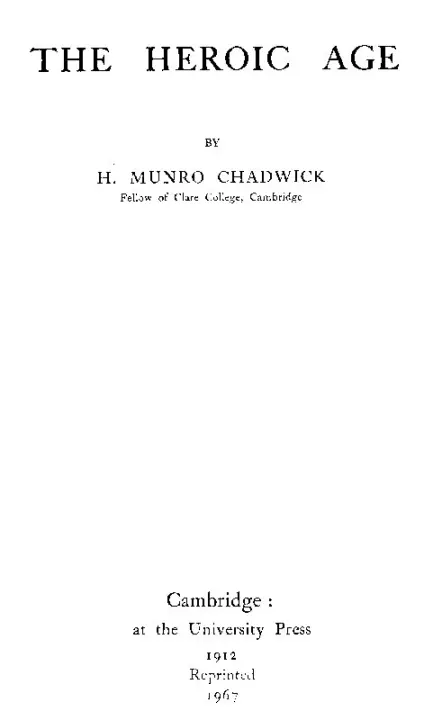
"The Heroic Age" by H. Munro Chadwick is a historical account written in the early 20th century. The work explores the characteristics and themes of heroic poetry across various cultures, particularly focusing on the Teutonic and Greek traditions. It investigates the oral narratives surrounding notable figures and events within these ancient literary forms, seeking to identify their origins and interconnections. The beginning of the book sets the stage for a comparative study of heroic poetry, emphasizing the recurrent themes and narrative structures found in the epics of different cultures. Specifically, Chadwick introduces the early narrative poetry of the Teutonic peoples, referencing significant works such as "Beowulf," and discusses their thematic concerns and historical context. He emphasizes the importance of understanding these stories within the framework of their own time, hinting at the anthropological implications of their content. This methodological approach offers a foundational basis for further exploration of the influence these heroic tales have had across generations and their significance in the development of cultural identity.
Introduction adapted from the source catalogue; source summaries may be automatically generated.
Free to read · English · 190,164 words · No account needed
MAKE TIME FOR A GOOD BOOK
On by default. Untick to stop anonymous reading totals. Each page counts after 10 seconds in view. How this works.
Anonymous counting is on unless you have switched it off.
[33] Verba Dei legantur in sacerdotali conuiuio. ibi decet lectorem audiri, non citharistam; sermones patrum, non carmina gentilium. quid Hinieldus cum Christo? angusta est domus; utrosque tenere non poterit. non uult rex coelestis cum paganis et perditis nominetenus regibus communionem habere, quia rex ille aeternus regnat in coelo, ille paganus perditus plangit in inferno. uoces legentium audiri in domibus tuis, non ridentium turuam in plateis. Mon. Germ., Epist. Carol. II 124; cf. O. Jänicke, ZfdA. XV 314.
[34] The names Grendel, Cain, Abel, Alexandreas and Casere are not
included.
[35] For the figures and the method of calculation see Note I.
[36] But open to very serious objections, as has been shown by Prof. W. W. Lawrence in the Publications of the Modern Language Association of America, XXIV 251 ff.
[37] Compound names containing wīd- or -sīþ (-sinþ-) are used in other Teutonic languages; but the latter apparently does not occur in England, while the former is extremely rare.
[38] In contrast with the body of the poem (vv. 10-134) it is non-strophic, after the general fashion of Anglo-Saxon poetry. Originally when the poem was recited it may have been introduced with a short explanation in prose, such as we find e.g. in Rígsmál or Atlakviða. The epilogue (vv. 135-143), which is likewise non-strophic, may belong to the same stratum.
[39] Especially the regular use of unsyncopated forms such as 3 sg. onwindeð, past part. onsended.
[40] The statistics for these poems are as follows: Juliana 27:3, Christ (II) 28:3, Elene 66:9, Guthlac (A) 42:6, Dream of the Cross 10:5, Exodus 10:14, Beowulf 13:65; see Brandl, S.-B. d. Akad. der Wiss. zu Berlin, 1905, p. 718 f.
[41] Cf. Brandl, l.c. (p. 721 ff.).
[42] Hist. Eccl., IV 24: canebat autem de creatione mundi et origine humani generis et tota genesis historia, de egressu Israel ex Aegypto et ingressu in terram repromissionis, de aliis plurimis sacrae scripturae historiis, de incarnatione dominica, passione, resurrectione et ascensione in caelum, de Spiritus Sancti aduentu et apostolorum doctrina. item de terrore futuri iudicii et horrore poenae gehennalis ac dulcedine regni caelestis multa carmina faciebat; sed et perplura de beneficiis et iudiciis diuinis, etc. Prof. Brandl (Grundr., II 1028) holds that the reference is to lyric poems throughout. But is this interpretation really necessary?
[43] On this date see Note II.
[44] For a brief discussion of this question see Note III.
[45] A few examples are given in the following chapter.
[46] vv. 27, 72, 101, 570, 670, 706, 711, 756 (?), 786, 788, 790, 801, 806, 811, 852, 940, 967, 975, 986 (?), 1201, 1255, 1379, 1626, 1658, 1680, 1682, 2088, 2182, 2216 (?), 2276 (?), 2469, 2650, 3083 (?).
[47] vv. 168 f. (?), 227 f., 440 f., 478 f., 588 f., 625 f., 945 f., 955 f., 1314 f., 1397 f., 1778 f., 1841 f., 1997 f., 2819 f., 2874 f., 3108 f.
[48] vv. 13-17, 90-8, 106-14, 316-8, 381-4, 665-7 (?), 685-7, 696-702, 928-31, 977-9, 1056-62, 1261-5, 1271-6, 1553-6, 1609-11, 1661-4, 1688-93, 1716-8, 2291-3, 2329-31, 2341-3 (?), 2741-3, 2794-7, 2855-9, 3054-7, 3069-73.
[49] vv. 588 f., 977-9. 2741-3. 2819 f.
Your reading position is saved on this browser. Take it to another device with a library code. Reading pages adapt to text, rather than matching a printed edition.
BEHIND THE BOOK
This eBook is for the use of anyone anywhere in the United States and most other parts of the world at no cost and with almost no restrictions whatsoever. You may copy it, give it away or re-use it under the terms of the Project Gutenberg License included with this eBook or online at www.gutenberg.org. If you are not located in the United States, you will have to check the laws of the country where you are located before using this eBook. Read the source licence.
The original source file, including credits and licence, is retained by this library. Request an original-format copy at no charge. Please include the book title and Project Gutenberg identifier #48426.
KEEP YOUR CURIOSITY GOING
Cécile Tormay

Moritz Busch
John L. Ransom

Maurice Baring
Frances Wright
Cécile Tormay