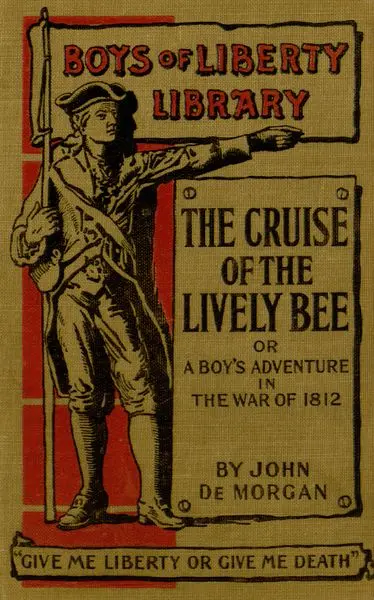
The Cruise of the “Lively Bee”; Or, A Boy’s Adventures in the War of 1812
John De Morgan
THE CLASSIC COLLECTION · 1896
"The Hero of Ticonderoga; or, Ethan Allen and His Green Mountain Boys" by John De Morgan is a historical novel written in the late 19th century. The story centers around Ethan Allen, a determined leader of the Green Mountain Boys, as they stand against the encroachments of New York authorities claiming land rights in the territory known today as Vermont. The narrative promises an exploration of themes like rebellion, loyalty, and the spirit of independence in pre-Revolutionary America. The opening of the book introduces us to a chilly day in January 1764 in Bennington, where the townspeople eagerly gather to hear an important announcement by the sheriff. It quickly becomes clear that the focus revolves around an edict from the New York governor ordering the residents to submit to New York's claim over their land, which they believe belongs to New Hampshire. As tensions rise, Ethan Allen boldly confronts this authority by tearing up the proclamation, signaling the beginning of resistance. Allen's courageous actions spark intrigue among the townsfolk, setting the stage for his rallying of the Green Mountain Boys to protect their rights and livelihoods against external challenges.
Introduction adapted from the source catalogue; source summaries may be automatically generated.
Free to read · English · 52,664 words · No account needed
MAKE TIME FOR A GOOD BOOK
On by default. Untick to stop anonymous reading totals. Each page counts after 10 seconds in view. How this works.
Anonymous counting is on unless you have switched it off.
"These colonies should be Great Britain's strength, they are her weakness. Give us the right to make our own laws, to raise the taxation as we please, to defend our coasts from external assaults and our land from internal troubles, and we shall honor the king and prove that the American Confederation of Colonies is the strength of that country. Let us tell the king plainly what we want. Let our petition be backed by a good army, and we shall win."
"What do you propose?" asked Jefferson.
"I propose that we organize an army, not of one colony, but of a confederation of all colonies, and that we appoint a commander-in-chief, a man who shall be able to organize the army and to lead it, ay, even if it be necessary until we have entire independence."
"Where could we find such a man?" asked one of the Northern delegates.
"We have one here. The man who saved the wreck of Braddock's army is just the one to build a nation. I nominate George Washington as the commander-in-chief of the army of liberation!"
There was an outburst of cheering such as the Quaker City had but seldom
heard.
The delegates knew Washington.
He was a member of the Virginia House of Burgesses, and had previously made a name for himself with Braddock.
When his name was mentioned by Adams he left the hall.
He was afraid to remain for fear he should be called upon to accept.
He wanted time for deliberation.
The congress adjourned until the following Thursday.
The delegates talked the matter over, and when the Congress reassembled George Washington was the unanimous choice of the delegates.
But before he was asked to give his answer, articles of confederation were drawn up and signed, and the colonies became one for the purposes of mutual defense.
"I fear that this day will mark the downfall of my reputation," said Washington to Patrick Henry when he heard he was unanimously selected to organize an army of twenty thousand men, who were undisciplined, without weapons, without arms of any kind worth speaking of, and having no money to pay for the food they would require, not mentioning arms.
The question of salary was next discussed, but Washington stopped it by emphatically declaring that he would not touch one penny of salary, and only asked that out-of-pocket expenses should be paid.
In the midst of the cheering which these words evoked, Ethan Allen
entered the hall.
"Who is that man?" asked John Hancock.
"Ethan Allen, the hero of Ticonderoga," answered Sam Adams.
The cheering broke out again, but this time it was for the Green Mountain
leader.
Your reading position is saved on this browser. Take it to another device with a library code. Reading pages adapt to text, rather than matching a printed edition.
BEHIND THE BOOK
This eBook is for the use of anyone anywhere in the United States and most other parts of the world at no cost and with almost no restrictions whatsoever. You may copy it, give it away or re-use it under the terms of the Project Gutenberg License included with this eBook or online at www.gutenberg.org. If you are not located in the United States, you will have to check the laws of the country where you are located before using this eBook. Read the source licence.
The original source file, including credits and licence, is retained by this library. Request an original-format copy at no charge. Please include the book title and Project Gutenberg identifier #25708.
KEEP YOUR CURIOSITY GOING
Cécile Tormay

Moritz Busch
Coulson Kernahan
John L. Ransom

Maurice Baring
Frances Wright