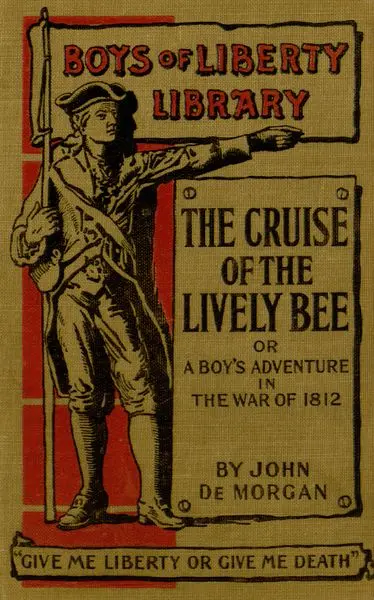
The Cruise of the “Lively Bee”; Or, A Boy’s Adventures in the War of 1812
John De Morgan
THE CLASSIC COLLECTION · 1896
"The Hero of Ticonderoga; or, Ethan Allen and His Green Mountain Boys" by John De Morgan is a historical novel written in the late 19th century. The story centers around Ethan Allen, a determined leader of the Green Mountain Boys, as they stand against the encroachments of New York authorities claiming land rights in the territory known today as Vermont. The narrative promises an exploration of themes like rebellion, loyalty, and the spirit of independence in pre-Revolutionary America. The opening of the book introduces us to a chilly day in January 1764 in Bennington, where the townspeople eagerly gather to hear an important announcement by the sheriff. It quickly becomes clear that the focus revolves around an edict from the New York governor ordering the residents to submit to New York's claim over their land, which they believe belongs to New Hampshire. As tensions rise, Ethan Allen boldly confronts this authority by tearing up the proclamation, signaling the beginning of resistance. Allen's courageous actions spark intrigue among the townsfolk, setting the stage for his rallying of the Green Mountain Boys to protect their rights and livelihoods against external challenges.
Introduction adapted from the source catalogue; source summaries may be automatically generated.
Free to read · English · 52,664 words · No account needed
MAKE TIME FOR A GOOD BOOK
On by default. Untick to stop anonymous reading totals. Each page counts after 10 seconds in view. How this works.
Anonymous counting is on unless you have switched it off.
Ethan Allen could see no possible chance of escape.
He was not afraid to meet the punishment, but he felt it galling to be
trapped in such a way.
If he had not been a bitter opponent of New York before, that treachery
would have made him one.
For greater security the two mountaineers had been bound together, so that they could be more easily guarded.
Nearly an hour passed before the officer determined to march.
He had sent out scouts to ascertain if the Mountain Boys were in the vicinity, and the men had returned to report all quiet.
Then the small company, with its valuable captives, set out to cross into York at the nearest point.
For about an hour the march was continued in silence, and the men were fatigued, for they had to carry the prisoners, both Allen and Baker refusing to walk one step.
A halt was called, and the soldiers were told they could rest for one
hour.
They were delighted at the prospect, and laid themselves down on the
grass.
So secure did they feel that they relaxed their watchfulness and allowed the prisoners to lie down by themselves a little distance away, yet not so far that they had any chance of escape.
Allen was singing a song of freedom; it was an old French ditty he had
learned and often sung.
He sang, not because his spirits were light, but simply to prevent a feeling of melancholy overmastering him.
The singing satisfied his captors that he was resigned, and was not meditating any plan of escape.
In the midst of his song he heard a soft, low voice say:
"Do not speak, but listen."
Baker had fallen asleep, and Allen knew that it was Eben who spoke; but how the boy got there, or, in fact, where he was, Allen could not conjecture.
"Here is a knife," said Eben; "I am going to cut the cords which bind your hands; you can then liberate Baker. When you are both free, keep still until you hear the cry of the catbird, and then leap to your feet and run, taking a course direct to the left; the boys are there in ambush, and you will be safe."
While Eben was speaking he succeeded in cutting the cords, and Allen's
hands were free.
Eben glided away as noiselessly as he came, and Allen woke Baker as
quickly as possible.
"Heigho! Have we to continue our journey?"
"Hush! do not utter a word! We have a chance to escape, if you will
listen and not speak."
Allen told him all that had been done, and then quietly cut the other's
cords.
Your reading position is saved on this browser. Take it to another device with a library code. Reading pages adapt to text, rather than matching a printed edition.
BEHIND THE BOOK
This eBook is for the use of anyone anywhere in the United States and most other parts of the world at no cost and with almost no restrictions whatsoever. You may copy it, give it away or re-use it under the terms of the Project Gutenberg License included with this eBook or online at www.gutenberg.org. If you are not located in the United States, you will have to check the laws of the country where you are located before using this eBook. Read the source licence.
The original source file, including credits and licence, is retained by this library. Request an original-format copy at no charge. Please include the book title and Project Gutenberg identifier #25708.
KEEP YOUR CURIOSITY GOING
Cécile Tormay

Moritz Busch
Coulson Kernahan
John L. Ransom

Maurice Baring
Frances Wright