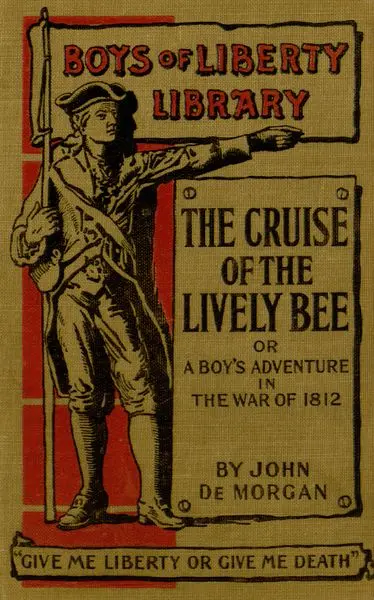
The Cruise of the “Lively Bee”; Or, A Boy’s Adventures in the War of 1812
John De Morgan
THE CLASSIC COLLECTION · 1896
"The Hero of Ticonderoga; or, Ethan Allen and His Green Mountain Boys" by John De Morgan is a historical novel written in the late 19th century. The story centers around Ethan Allen, a determined leader of the Green Mountain Boys, as they stand against the encroachments of New York authorities claiming land rights in the territory known today as Vermont. The narrative promises an exploration of themes like rebellion, loyalty, and the spirit of independence in pre-Revolutionary America. The opening of the book introduces us to a chilly day in January 1764 in Bennington, where the townspeople eagerly gather to hear an important announcement by the sheriff. It quickly becomes clear that the focus revolves around an edict from the New York governor ordering the residents to submit to New York's claim over their land, which they believe belongs to New Hampshire. As tensions rise, Ethan Allen boldly confronts this authority by tearing up the proclamation, signaling the beginning of resistance. Allen's courageous actions spark intrigue among the townsfolk, setting the stage for his rallying of the Green Mountain Boys to protect their rights and livelihoods against external challenges.
Introduction adapted from the source catalogue; source summaries may be automatically generated.
Free to read · English · 52,664 words · No account needed
MAKE TIME FOR A GOOD BOOK
On by default. Untick to stop anonymous reading totals. Each page counts after 10 seconds in view. How this works.
Anonymous counting is on unless you have switched it off.
"Forest, do you pick the men in your company who have the strongest nerves and the pluckiest spirits to cross first; take the largest of the two large boats and get as many of the men over as possible."
"It shall be done."
"And you, Baker, follow the same instruction in reference to the Mountain Boys. The small boat we will reserve for Col. Arnold and myself. When you reach the other side, remember that there must not be a sound. No word must be uttered, no fire made, but let every man lie in the long grass and wait for orders."
A crew was selected for each boat, and the work of transporting the little army across the lake was commenced.
The men pulled steadily and noiselessly across the waters of the beautiful lake which the Indians called "Troquois," [Transcriber's note: Iroquois?] and the early French settlers, who objected to honoring the explorer, Samuel de Champlain, "Mere les Iroquois," and still later, "Iracosia."
It was slow work, and the men asked permission to swim across, but Allen was afraid the swim would be too exhausting.
When day broke the work had to cease, for the men at the fort would have seen the boats and been put on their guard.
Arnold looked at the handful of men and predicted failure.
Allen counted the men and found eighty-three.
That was the strength of his little army.
It seemed absurd to think of attacking one of the strongest fortresses on the continent with such a handful of men.
True, the garrison was small, but it was intrenched behind strong walls, a well-filled moat and a line of breastworks carefully designed, and improved bastions.
Allen called all his men together and addressed them.
"It is for your country that you will risk your lives," he said, "and while you take care not to run into needless danger, remember that only the daring will succeed. If we enter the fort, as we shall undoubtedly do, set up a shout which shall make the garrison think we have eight hundred instead of eighty men. Be brave, and the victory will be ours."
A thrill of excitement made every heart beat fast; cheeks glowed with pleasure, heads were borne erect with pride, and the few men looked invincible.
Allen and Arnold led the way; they never were in the rear.
When close to the fort they made a dash and gained the gateway.
"Stand back!" exclaimed the sentry.
He raised his musket to fire, but Allen knocked it on one side.
"Are you mad? Do you want to die?" he asked.
"Better die than be craven," answered the English soldier, bravely.
Your reading position is saved on this browser. Take it to another device with a library code. Reading pages adapt to text, rather than matching a printed edition.
BEHIND THE BOOK
This eBook is for the use of anyone anywhere in the United States and most other parts of the world at no cost and with almost no restrictions whatsoever. You may copy it, give it away or re-use it under the terms of the Project Gutenberg License included with this eBook or online at www.gutenberg.org. If you are not located in the United States, you will have to check the laws of the country where you are located before using this eBook. Read the source licence.
The original source file, including credits and licence, is retained by this library. Request an original-format copy at no charge. Please include the book title and Project Gutenberg identifier #25708.
KEEP YOUR CURIOSITY GOING
Cécile Tormay

Moritz Busch
Coulson Kernahan
John L. Ransom

Maurice Baring
Frances Wright