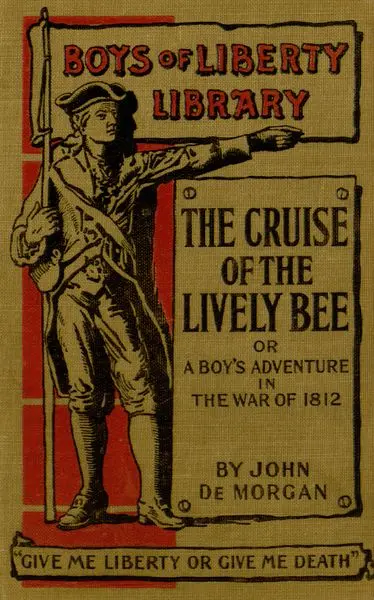
The Cruise of the “Lively Bee”; Or, A Boy’s Adventures in the War of 1812
John De Morgan
THE CLASSIC COLLECTION · 1896
"The Hero of Ticonderoga; or, Ethan Allen and His Green Mountain Boys" by John De Morgan is a historical novel written in the late 19th century. The story centers around Ethan Allen, a determined leader of the Green Mountain Boys, as they stand against the encroachments of New York authorities claiming land rights in the territory known today as Vermont. The narrative promises an exploration of themes like rebellion, loyalty, and the spirit of independence in pre-Revolutionary America. The opening of the book introduces us to a chilly day in January 1764 in Bennington, where the townspeople eagerly gather to hear an important announcement by the sheriff. It quickly becomes clear that the focus revolves around an edict from the New York governor ordering the residents to submit to New York's claim over their land, which they believe belongs to New Hampshire. As tensions rise, Ethan Allen boldly confronts this authority by tearing up the proclamation, signaling the beginning of resistance. Allen's courageous actions spark intrigue among the townsfolk, setting the stage for his rallying of the Green Mountain Boys to protect their rights and livelihoods against external challenges.
Introduction adapted from the source catalogue; source summaries may be automatically generated.
Free to read · English · 52,664 words · No account needed
MAKE TIME FOR A GOOD BOOK
On by default. Untick to stop anonymous reading totals. Each page counts after 10 seconds in view. How this works.
Anonymous counting is on unless you have switched it off.
An expedition was sent against Concord, and eight hundred men marched
toward the town.
But the people of Boston were not to be taken by surprise.
Bells were rung and cannon fired, and the citizens were informed of the
expedition.
Joseph Warren--all honor to him--had dispatched Paul Revere and William Dawes to ride with all speed to Concord and Lexington and rouse the whole country to resistance.
A company of one hundred and thirty Minute Men assembled on Lexington Common and awaited the approach of the enemy, but after staying some hours they dispersed.
At five o'clock in the morning the English appeared, led by the
notorious Pitcairn.
The Minute Men had gone back to their homes, tired of waiting; but seventy, led by Capt. Parker, were roused and reached the common before the enemy.
Pitcairn rode up to them and exclaimed:
"Disperse, you villains! Throw down your arms, ye rebels, and
disperse!"
The Minute Men stood defiant and still.
Pitcairn discharged his pistol at them and shouted to his men:
"Fire!"
The first volley whistled through the air, and sixteen of the Minute
Men fell, dead or wounded.
The rest fired a few random shots and dispersed.
The English pressed on to Concord.
The people had quietly removed most of the ammunition, and the English found but little worth taking. They started to sack the town.
While they were doing this the Minute Men had rallied and began to
assemble from all quarters.
A company of English guarded the bridge over Concord River. They were attacked by the Minute Men and two English soldiers were killed. The Minute Men captured the bridge, and the enemy began a retreat into the town, and then on the road to Lexington.
On every side the patriots assembled. For six miles the battle waged.
Every tree, every house and barn sheltered the patriots, who poured a murderous fire into the ranks of the retreating English.
Had it not been for the arrival of reinforcements under Lord Percy, the English army would have been completely routed.
The fight continued right up to Charlestown, and only ceased because the people feared the fleet would burn the city.
The first battle had been fought.
The English had suffered a loss of two hundred and seventy-three, while the patriots lost only eighty-three in dead and wounded.
The battle of Lexington fired the country.
Within a few days an army of twenty thousand men had gathered round
Boston.
New Hampshire sent its militia, with John Stark at its head; Rhode Island sent her quota under the leadership of Nathaniel Greene.
New Haven was not behind, for a regiment was dispatched from that city with Benedict Arnold as leader.
Your reading position is saved on this browser. Take it to another device with a library code. Reading pages adapt to text, rather than matching a printed edition.
BEHIND THE BOOK
This eBook is for the use of anyone anywhere in the United States and most other parts of the world at no cost and with almost no restrictions whatsoever. You may copy it, give it away or re-use it under the terms of the Project Gutenberg License included with this eBook or online at www.gutenberg.org. If you are not located in the United States, you will have to check the laws of the country where you are located before using this eBook. Read the source licence.
The original source file, including credits and licence, is retained by this library. Request an original-format copy at no charge. Please include the book title and Project Gutenberg identifier #25708.
KEEP YOUR CURIOSITY GOING
Cécile Tormay

Moritz Busch
Coulson Kernahan
John L. Ransom

Maurice Baring
Frances Wright