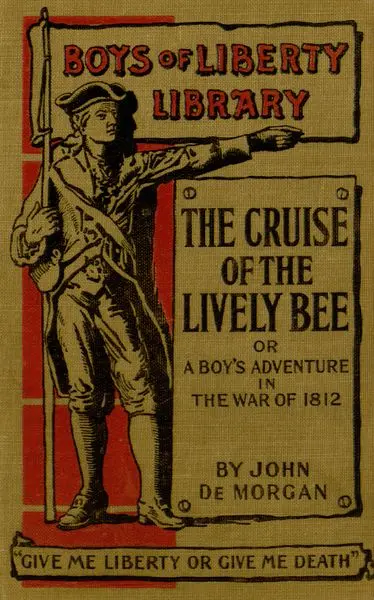
The Cruise of the “Lively Bee”; Or, A Boy’s Adventures in the War of 1812
John De Morgan
THE CLASSIC COLLECTION · 1896
"The Hero of Ticonderoga; or, Ethan Allen and His Green Mountain Boys" by John De Morgan is a historical novel written in the late 19th century. The story centers around Ethan Allen, a determined leader of the Green Mountain Boys, as they stand against the encroachments of New York authorities claiming land rights in the territory known today as Vermont. The narrative promises an exploration of themes like rebellion, loyalty, and the spirit of independence in pre-Revolutionary America. The opening of the book introduces us to a chilly day in January 1764 in Bennington, where the townspeople eagerly gather to hear an important announcement by the sheriff. It quickly becomes clear that the focus revolves around an edict from the New York governor ordering the residents to submit to New York's claim over their land, which they believe belongs to New Hampshire. As tensions rise, Ethan Allen boldly confronts this authority by tearing up the proclamation, signaling the beginning of resistance. Allen's courageous actions spark intrigue among the townsfolk, setting the stage for his rallying of the Green Mountain Boys to protect their rights and livelihoods against external challenges.
Introduction adapted from the source catalogue; source summaries may be automatically generated.
Free to read · English · 52,664 words · No account needed
MAKE TIME FOR A GOOD BOOK
On by default. Untick to stop anonymous reading totals. Each page counts after 10 seconds in view. How this works.
Anonymous counting is on unless you have switched it off.
The people on the dock pushed and stared at the Green Mountain men.
"Why, they aren't green!" exclaimed one of the bystanders with disgust.
"No, they aren't Americans; they're Irish," said another.
"Of course they're Irish; Americans are black."
"No, red."
"Not by a long shot; they're all as yellow as guineas."
Absurd as it may appear at this day to have to record such ideas, it is an absolute fact that when it was rumored that the Green Mountain heroes were on their way to England the prevalent idea was that they derived their name from the color of their skin.
When the other prisoners disembarked the march was commenced to the
barracks.
The people flocked round the prisoners so that progress was impeded.
The soldiers had to charge the crowd with bayonets many times.
"What did they mean by saying they thought we were Irish?" asked Eben. "I heard an Englishman say in New York that if it had not been for the Irish the Americans would not have rebelled. Of course it was nonsense, but the people do not know us yet, while they do know the Irish."
At the barracks the prisoners were received with as much curiosity as we can imagine was shown by Ferdinand and Isabella when Columbus presented the American Indians in 1492.
Every man was made to answer a lot of questions, and many times over.
Allen was questioned about the strength of the American army, and
replied:
"I know not its numbers, but it is well equipped and can beat all the armies you can send over there."
"They are rebels, and only the lowest people sympathize with them."
"Do you call George Washington a common man?" asked Allen.
"He is a rebel, and ought to know better."
"And Richard Montgomery, who fought with you at Havana and Martinique?"
"Is he with the rebels?"
"I had the honor of serving under him."
"He will be hanged, for he was a soldier of his majesty."
"You will have to capture him first."
They could not make anything of Allen, so they desisted questioning and sent all the prisoners to the guardroom.
It was a difficult question for the government of England to decide.
The men were locked up in the barracks at Falmouth, but England did not know what to do with them.
If the prisoners were hanged as rebels, England would be blamed by other civilized nations, and yet it would not do to pardon them.
There was a very powerful opposition among the English people to harsh measures, and, in fact, many English wished America success in its struggle with the tory ministry.
Your reading position is saved on this browser. Take it to another device with a library code. Reading pages adapt to text, rather than matching a printed edition.
BEHIND THE BOOK
This eBook is for the use of anyone anywhere in the United States and most other parts of the world at no cost and with almost no restrictions whatsoever. You may copy it, give it away or re-use it under the terms of the Project Gutenberg License included with this eBook or online at www.gutenberg.org. If you are not located in the United States, you will have to check the laws of the country where you are located before using this eBook. Read the source licence.
The original source file, including credits and licence, is retained by this library. Request an original-format copy at no charge. Please include the book title and Project Gutenberg identifier #25708.
KEEP YOUR CURIOSITY GOING
Cécile Tormay

Moritz Busch
Coulson Kernahan
John L. Ransom

Maurice Baring
Frances Wright