
The Writing of News A Handbook with Chapters on Newspaper Correspondence and Copy Reading
Charles G. (Charles Griffith) Ross
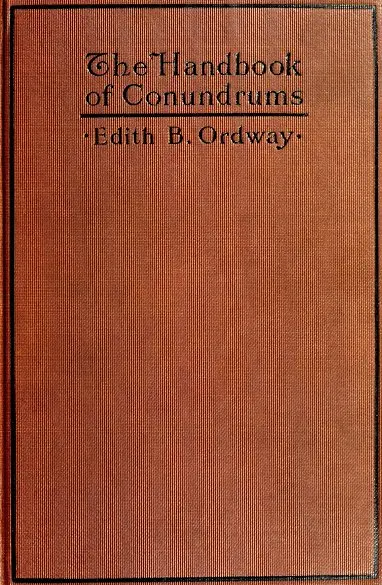
THE CLASSIC COLLECTION · 1914
"The Handbook of Conundrums" by Edith B. Ordway is a collection of riddles and witty wordplay written in the early 20th century. The text focuses on various forms of conundrums, puns, and riddles, exploring their history and significance across cultures while also engaging readers to challenge their wits. This work blends humor with an intellectual exercise, making it ideal for lovers of language and playful challenges. At the start of the book, the author introduces the concept of a conundrum as a riddle that typically involves a pun, providing context on their historical and cultural importance. The preface likens the book to a grindstone meant to sharpen the intellect, and the introduction elaborates on the origins of riddles, showcasing their role in ancient societies as markers of wisdom and wit. The ensuing chapters promise a plethora of humorous conundrums categorized into themes like historical, literary, and geographical topics, inviting readers to enjoy the clever interplay of language as they solve each riddle.
Introduction adapted from the source catalogue; source summaries may be automatically generated.
Free to read · English · 32,322 words · No account needed
MAKE TIME FOR A GOOD BOOK
On by default. Untick to stop anonymous reading totals. Each page counts after 10 seconds in view. How this works.
Anonymous counting is on unless you have switched it off.
How do you punctuate the sentence, "I saw a five-dollar bill on the street?" Make a dash after it.
There was a carpenter who made a cupboard door; it proved too big. He cut it, and unfortunately, he cut it too little; he thereupon cut it again, and made it fit beautifully. How was this? He did not cut it enough the first time.
There are twelve birds in a covey. A hunter kills a brace, then how many remain? None, for, unless they are idiots, they fly away.
A one-eyed beggar bet a friend that he could see more with one eye than his friend could with two. How was this? Because he saw his friend's two eyes, whilst the other only saw his one.
A hunter and his dog went out hunting. The dog went not behind, went
not before, nor on one side of him. Where did he go? On the other
side.
Which would you rather--look a greater fool than you are, or be a greater fool than you look? (Let the person choose, then say, "That is impossible.")
Which would you rather--that a lion ate you or a tiger? Why, you would rather that the lion ate the tiger, of course.
A man stopped before the window of a trunk store; within, a large trunk was marked "$25.00," a medium-sized one "$15.00," and a small one bore the placard, "This size for $5.00." "So do I," the man said, and walked on.
A man was crossing a bridge over a small stream, and noticed a sign which read, "Don't fish here." "Do they?" he asked, and walked on.
What age will people reach if they live long enough? Dotage.
To what age do most people look forward? Marriage.
A necessary attribute of a soldier? Courage.
What age is required at sea? Tonnage.
What age are we forbidden to worship? Image.
What age do people get stuck on? Mucilage.
What age is neither more nor less? Average.
What is the age of profanity? Damage.
At what age will vessels ride safely? Anchorage.
What age does the infant in arms pass through? Crib-bage.
What age does the small boy enjoy? Sauce-age (sausage).
What age is the young lady most interested in? Garb-age.
What age does the child in primary school dislike? Ad(d)-age.
What age does the bride desire? Dotage.
What age is necessary for a clergyman? Parsonage.
What is the age of communication? Postage.
What age is most important to travelers? Mileage.
What is the age of slavery? Bondage.
What age is served for breakfast? Sausage.
What is the most indigestible age? Cabbage.
What age signifies the farmer? Tillage.
What age belongs to travelers? Baggage.
Your reading position is saved on this browser. Take it to another device with a library code. Reading pages adapt to text, rather than matching a printed edition.
BEHIND THE BOOK
This eBook is for the use of anyone anywhere in the United States and most other parts of the world at no cost and with almost no restrictions whatsoever. You may copy it, give it away or re-use it under the terms of the Project Gutenberg License included with this eBook or online at www.gutenberg.org. If you are not located in the United States, you will have to check the laws of the country where you are located before using this eBook. Read the source licence.
The original source file, including credits and licence, is retained by this library. Request an original-format copy at no charge. Please include the book title and Project Gutenberg identifier #32898.
KEEP YOUR CURIOSITY GOING
Charles G. (Charles Griffith) Ross
Hannah Webster Foster

Emily Lawless
Edwin Hamlin Carr

Charles De Lano Hine
Andrew Ure