
The Writing of News A Handbook with Chapters on Newspaper Correspondence and Copy Reading
Charles G. (Charles Griffith) Ross
THE CLASSIC COLLECTION · 1914
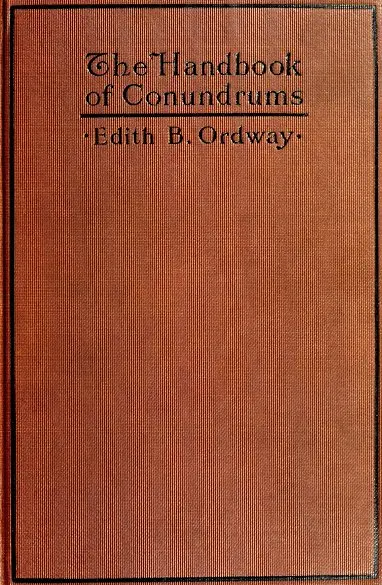
"The Handbook of Conundrums" by Edith B. Ordway is a collection of riddles and witty wordplay written in the early 20th century. The text focuses on various forms of conundrums, puns, and riddles, exploring their history and significance across cultures while also engaging readers to challenge their wits. This work blends humor with an intellectual exercise, making it ideal for lovers of language and playful challenges. At the start of the book, the author introduces the concept of a conundrum as a riddle that typically involves a pun, providing context on their historical and cultural importance. The preface likens the book to a grindstone meant to sharpen the intellect, and the introduction elaborates on the origins of riddles, showcasing their role in ancient societies as markers of wisdom and wit. The ensuing chapters promise a plethora of humorous conundrums categorized into themes like historical, literary, and geographical topics, inviting readers to enjoy the clever interplay of language as they solve each riddle.
Introduction adapted from the source catalogue; source summaries may be automatically generated.
Free to read · English · 32,322 words · No account needed
MAKE TIME FOR A GOOD BOOK
On by default. Untick to stop anonymous reading totals. Each page counts after 10 seconds in view. How this works.
Anonymous counting is on unless you have switched it off.
A rich lawyer, whose fortune had been made by the practice of his profession, desired to bequeath a certain sum to the insane asylum of Bedlam. Being questioned why, he replied that he had got his money of mad men, and he would give it to them again.
The trade of tooth drawer is a conscienceless one, because it is
"nothing else but to take away those things whereby every man gets
his living."
"A vainglorious man" was bragging that his father and uncle had founded a certain hospital. One answered, "'Tis true, but yet know that your father and your uncle were the mere confounders (co-founders) of that hospital you speak of."
It was said that corn was a quarrelsome creature, because it rose by the blade, and fell by the ears with those that cut it.
A tailor was commended for his dexterity, whereupon it was remarked that tailors had their business at their fingers' ends.
Colliers and mine-workers, it was said, should be well acquainted with all the philosophical secrets of the earth, because they had a deeper knowledge of it than any others.
"Of all knaves there's the greatest hope of a cobbler, for though he be never so idle a fellow, yet he is still mending."
"A smith," said one, "is the most pragmatical fellow under the sun, for he hath always many irons in the fire."
The proverb, "Wit bought is better than wit taught," had added to it the comment, "because he that never bought any is but a natural wit," embodying the play on the word "natural," the early name for "fool."
Tall men are the most happy, because they are nearer heaven than other men. They should also be great politicians, because they have extraordinary reach.
Of all soldiers musketeers are the most lazy, for they are always at
rest.
It is necessary that some rich men be dunces, because pretenders to
learning may get preferment, and good wits will be able to help
themselves.
Carpenters are the most civil men because they never do their
business without a rule.
A hangman is the most trusty of friends, for, if he once have to do with a man, he will see him hanged before he shall want money or anything else.
Physicians have the best of it. If they do well, the world proclaims it; if ill, the earth covers it.
A man and his wife were fighting. One was asked why he did not part
them, and replied, that he "had been better bred than to part man and
wife."
Tobacconists (users of tobacco) would endure war well, for they would never be stifled with fire and smoke.
Your reading position is saved on this browser. Take it to another device with a library code. Reading pages adapt to text, rather than matching a printed edition.
BEHIND THE BOOK
This eBook is for the use of anyone anywhere in the United States and most other parts of the world at no cost and with almost no restrictions whatsoever. You may copy it, give it away or re-use it under the terms of the Project Gutenberg License included with this eBook or online at www.gutenberg.org. If you are not located in the United States, you will have to check the laws of the country where you are located before using this eBook. Read the source licence.
The original source file, including credits and licence, is retained by this library. Request an original-format copy at no charge. Please include the book title and Project Gutenberg identifier #32898.
KEEP YOUR CURIOSITY GOING
Charles G. (Charles Griffith) Ross
Hannah Webster Foster

Emily Lawless
Edwin Hamlin Carr

Charles De Lano Hine
Andrew Ure