
The Writing of News A Handbook with Chapters on Newspaper Correspondence and Copy Reading
Charles G. (Charles Griffith) Ross
THE CLASSIC COLLECTION · 1914
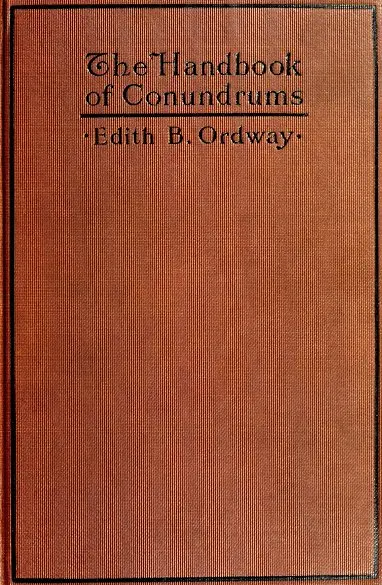
"The Handbook of Conundrums" by Edith B. Ordway is a collection of riddles and witty wordplay written in the early 20th century. The text focuses on various forms of conundrums, puns, and riddles, exploring their history and significance across cultures while also engaging readers to challenge their wits. This work blends humor with an intellectual exercise, making it ideal for lovers of language and playful challenges. At the start of the book, the author introduces the concept of a conundrum as a riddle that typically involves a pun, providing context on their historical and cultural importance. The preface likens the book to a grindstone meant to sharpen the intellect, and the introduction elaborates on the origins of riddles, showcasing their role in ancient societies as markers of wisdom and wit. The ensuing chapters promise a plethora of humorous conundrums categorized into themes like historical, literary, and geographical topics, inviting readers to enjoy the clever interplay of language as they solve each riddle.
Introduction adapted from the source catalogue; source summaries may be automatically generated.
Free to read · English · 32,322 words · No account needed
MAKE TIME FOR A GOOD BOOK
On by default. Untick to stop anonymous reading totals. Each page counts after 10 seconds in view. How this works.
Anonymous counting is on unless you have switched it off.
Why is a miserly uncle with whom you have quarreled like a person
with a short memory? Because he is ever for-getting, and never
for-giving.
Why are worn-out clothes like children without parents? Because they
are left off'uns (orphans).
What is the difference between a milkmaid and a swallow? One skims the milk, the other the water.
Why is a very demure young lady like a tugboat? Because she pays no attention to the swells that follow her.
What smells most in a chemist's shop? The nose.
Who is your greatest friend? Your nose, because it will run for you
till it drops.
Which travels faster, heat or cold? Heat, because you can easily
catch cold.
What did the muffin say to the toasting fork? You're too pointed.
I am forever, yet was never. Eternity.
Which eat more grass, black sheep or white? White, because there are
more of them.
Why is a very amusing man like a very bad shot? Because he keeps the
game alive.
What is the height of folly? Spending your last shilling on a purse.
In what sort of family does the seventh night of the week come on the sixth? In that sort of family where Saturday is a bath night (is Sabbath night).
Why are clouds like coachmen? Because they hold the reins (rains).
On what supposition could a pocket handkerchief be used to build a house? If it became-brick (be cambric).
Why did the young lady return the dumb waiter? Because it didn't
answer.
Why is a schoolboy being flogged like your eye? Because he's a pupil
under the lash.
Why does a blow leave a blue mark? Because blow, when perfect, makes
blew.
When has a man brown hands? When he's tand-'em driving.
Why is the leading horse in a wagon-team like the acceptor of a bill? Because he's the end horse, sir (endorser).
Why is a man marrying a second time like sal volatile? Because it's
re-wiving.
When may a lady be absolutely pronounced to be quite past recovery? When she is speechless, and can only chatter with her teeth.
Why are ladies' eyes like persons separated by the Atlantic Ocean? Because, although they may correspond, they never meet.
What two ages often prove illusory? Mir-age and marri-age.
State the difference between a grocer selling a pound of sugar, and an apothecary's boy with a pestle and mortar. One weighs a pound, the other pounds away.
Why is gritty coffee like the Subway? It may be considered
underground.
When can an Irish servant answer two questions at the same time? When she is asked, "What's o'clock, and where's the cold chicken?" if she replies, "Sure, it's ate."
Your reading position is saved on this browser. Take it to another device with a library code. Reading pages adapt to text, rather than matching a printed edition.
BEHIND THE BOOK
This eBook is for the use of anyone anywhere in the United States and most other parts of the world at no cost and with almost no restrictions whatsoever. You may copy it, give it away or re-use it under the terms of the Project Gutenberg License included with this eBook or online at www.gutenberg.org. If you are not located in the United States, you will have to check the laws of the country where you are located before using this eBook. Read the source licence.
The original source file, including credits and licence, is retained by this library. Request an original-format copy at no charge. Please include the book title and Project Gutenberg identifier #32898.
KEEP YOUR CURIOSITY GOING
Charles G. (Charles Griffith) Ross
Hannah Webster Foster

Emily Lawless
Edwin Hamlin Carr

Charles De Lano Hine
Andrew Ure