
The Writing of News A Handbook with Chapters on Newspaper Correspondence and Copy Reading
Charles G. (Charles Griffith) Ross
THE CLASSIC COLLECTION · 1914
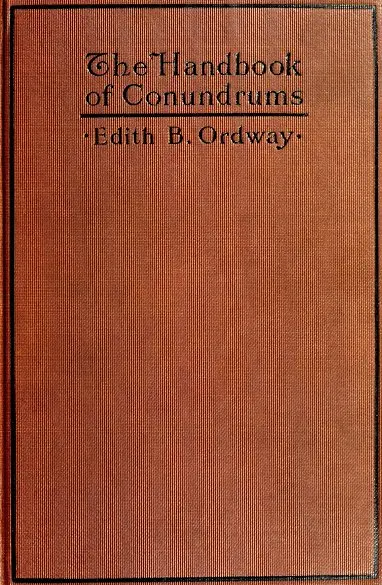
"The Handbook of Conundrums" by Edith B. Ordway is a collection of riddles and witty wordplay written in the early 20th century. The text focuses on various forms of conundrums, puns, and riddles, exploring their history and significance across cultures while also engaging readers to challenge their wits. This work blends humor with an intellectual exercise, making it ideal for lovers of language and playful challenges. At the start of the book, the author introduces the concept of a conundrum as a riddle that typically involves a pun, providing context on their historical and cultural importance. The preface likens the book to a grindstone meant to sharpen the intellect, and the introduction elaborates on the origins of riddles, showcasing their role in ancient societies as markers of wisdom and wit. The ensuing chapters promise a plethora of humorous conundrums categorized into themes like historical, literary, and geographical topics, inviting readers to enjoy the clever interplay of language as they solve each riddle.
Introduction adapted from the source catalogue; source summaries may be automatically generated.
Free to read · English · 32,322 words · No account needed
MAKE TIME FOR A GOOD BOOK
On by default. Untick to stop anonymous reading totals. Each page counts after 10 seconds in view. How this works.
Anonymous counting is on unless you have switched it off.
What is disgusting to all but those who swallow it? Flattery.
Why is a lawyer like an honest man? He is a man of deeds as well as
of words.
Why does a young man study law? To get on.
Why does he continue in the profession? To get honor.
Why does he leave the profession? To get honest.
What is the difference between fog and a falling star? One is a mist on earth, the other is missed in heaven.
Why is the present moment like skim-milk? It's scum (come).
Why is a four-quart measure like a sidesaddle? They both hold a
gal(l)on.
How can you shoot one hundred and twenty hares at one shot? Fire at a
wig.
Name that which, with only one eye put out, has but a nose left.
Noise.
Why are laundresses good navigators? Because they are always crossing the line, and going from pole to pole.
What is that which if you name it even you break it? Silence.
What is that which you can keep even after giving it to somebody
else? Your word.
What is that which the dead and the living do at the same time? Go
round with the world.
What snuff-taker is that whose box gets fuller the more pinches he
takes? The snuffers.
Why are your nose and chin constantly at variance? Because words are continually passing between them.
What is the smallest bridge in the world? The bridge of your nose.
Why is a Jew in a fever like the famous Koh-i-noor diamond? Because
he's a Jew-ill.
Why is an undutiful son like one born deaf? Because your voice is
lost upon him.
What is that which is put on the table and cut, but never eaten? A
pack of cards.
What fashionable game do frogs play at--besides leap-frog? Croaky
(croquet).
What question is that to which you positively must answer yes? What
does y-e-s spell?
What would a pig do if he wished to build himself a habitation? Tie a knot in his tail, and call it a pig's-tie (pig's sty).
If the before-mentioned porker wished to demolish the pig's sty he
had built, what quotation would he make? "I could a tail (tale)
unfold."
What is that which is white, black, and red all over, which shows
some people to be green, and makes others look black and blue? A
newspaper.
Why is a newspaper like an army? Because it has leaders, columns, and
reviews.
What part of a lady's face in January is like a celebrated fur?
Chin-chilly (chinchilla).
Why are suicides invariably successful people in the world? Because they always manage to accomplish their own ends.
Your reading position is saved on this browser. Take it to another device with a library code. Reading pages adapt to text, rather than matching a printed edition.
BEHIND THE BOOK
This eBook is for the use of anyone anywhere in the United States and most other parts of the world at no cost and with almost no restrictions whatsoever. You may copy it, give it away or re-use it under the terms of the Project Gutenberg License included with this eBook or online at www.gutenberg.org. If you are not located in the United States, you will have to check the laws of the country where you are located before using this eBook. Read the source licence.
The original source file, including credits and licence, is retained by this library. Request an original-format copy at no charge. Please include the book title and Project Gutenberg identifier #32898.
KEEP YOUR CURIOSITY GOING
Charles G. (Charles Griffith) Ross
Hannah Webster Foster

Emily Lawless
Edwin Hamlin Carr

Charles De Lano Hine
Andrew Ure