
The Writing of News A Handbook with Chapters on Newspaper Correspondence and Copy Reading
Charles G. (Charles Griffith) Ross
THE CLASSIC COLLECTION · 1914
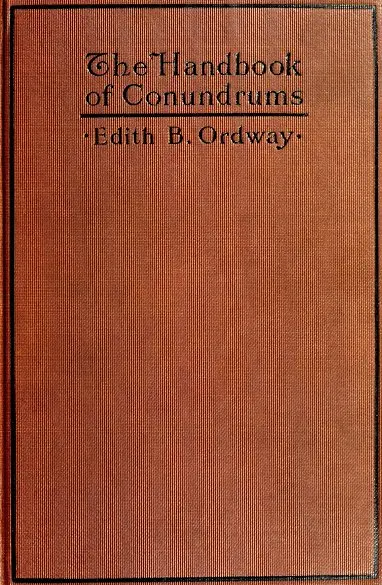
"The Handbook of Conundrums" by Edith B. Ordway is a collection of riddles and witty wordplay written in the early 20th century. The text focuses on various forms of conundrums, puns, and riddles, exploring their history and significance across cultures while also engaging readers to challenge their wits. This work blends humor with an intellectual exercise, making it ideal for lovers of language and playful challenges. At the start of the book, the author introduces the concept of a conundrum as a riddle that typically involves a pun, providing context on their historical and cultural importance. The preface likens the book to a grindstone meant to sharpen the intellect, and the introduction elaborates on the origins of riddles, showcasing their role in ancient societies as markers of wisdom and wit. The ensuing chapters promise a plethora of humorous conundrums categorized into themes like historical, literary, and geographical topics, inviting readers to enjoy the clever interplay of language as they solve each riddle.
Introduction adapted from the source catalogue; source summaries may be automatically generated.
Free to read · English · 32,322 words · No account needed
MAKE TIME FOR A GOOD BOOK
On by default. Untick to stop anonymous reading totals. Each page counts after 10 seconds in view. How this works.
Anonymous counting is on unless you have switched it off.
Why is a straw hat like kissing through the telephone? Because
neither is felt.
Why is your shadow like a false friend? Because it only follows you
in sunshine.
Why is your nose in the middle of your face? Because it is the
scenter.
If a woman asks her blind lover the color of a flower, what would he
say? "I have no i-dea."
When are lawyers circumstances? When they alter cases.
Why is a dog's tail like an expressman? It keeps a-waggin'.
Why are chickens liberal? They give a peck when they take a
grain.
What animals are in the clouds? Rain-deer.
Why is a young lawyer in his office like one of his chickens roosting on his neighbor's fence? He has no business there.
What is the difference between perseverance and obstinacy? One arises from a strong will, the other from a strong won't.
In what color should friendship be kept? In violet.
What is the noblest musical instrument? An upright piano. What the
vilest? A lyre.
How do seamstresses resemble rascals? They cut and run.
Why is a Bostonian's brain like a book of conundrums? Because it is
full of notions.
Why is a fortunate man like a straw in the water? Because he goes on
swimmingly.
Why is the man who falls in the kennel approved of? Because he's
add-mir'd.
Why is an organ an enemy to religion? Because it stands against the
communion.
Why are sharpers like sparrows? Because they feather their nests.
Why is a looking-glass very complaisant? Because it always does as
the company does.
Why is a newspaper like a lame man? Because it generally lies.
Why is a staircase like a back-biter? Because its rail's against you.
Why is a high wind like a dumb man in distress? Because it makes
moving signs.
Why are sheep the most dissipated of animals? They gambol all their youth, live by the turf, the best of them are blacklegs, and they get fleeced at last.
Why is a bald-headed man like a hunting dog? He makes a little hare
go a great way.
Why is a horse that is constantly rid, though never fed, never starved? Because he's never without a bit.
Why is a sleepy servant like a warming pan? Because he's in bed
before his master.
Why is a rich farmer like a man with bad teeth? Because he has a good
many achers.
Why is an apple like a good song? Because it is encored.
Why is an eyelid like the wadding to a gun? Because it covers the
ball.
Why is a smith like a ferryman? Because his business is to work ore.
Your reading position is saved on this browser. Take it to another device with a library code. Reading pages adapt to text, rather than matching a printed edition.
BEHIND THE BOOK
This eBook is for the use of anyone anywhere in the United States and most other parts of the world at no cost and with almost no restrictions whatsoever. You may copy it, give it away or re-use it under the terms of the Project Gutenberg License included with this eBook or online at www.gutenberg.org. If you are not located in the United States, you will have to check the laws of the country where you are located before using this eBook. Read the source licence.
The original source file, including credits and licence, is retained by this library. Request an original-format copy at no charge. Please include the book title and Project Gutenberg identifier #32898.
KEEP YOUR CURIOSITY GOING
Charles G. (Charles Griffith) Ross
Hannah Webster Foster

Emily Lawless
Edwin Hamlin Carr

Charles De Lano Hine
Andrew Ure