
The Writing of News A Handbook with Chapters on Newspaper Correspondence and Copy Reading
Charles G. (Charles Griffith) Ross
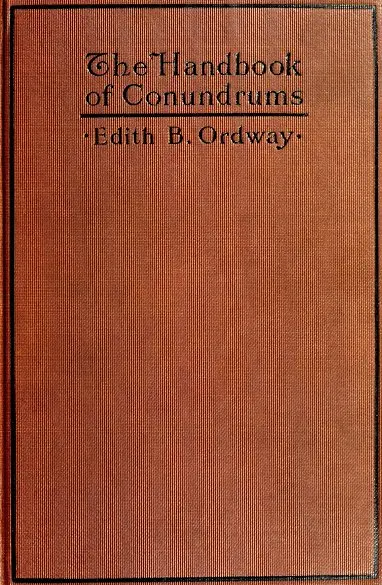
THE CLASSIC COLLECTION · 1914
"The Handbook of Conundrums" by Edith B. Ordway is a collection of riddles and witty wordplay written in the early 20th century. The text focuses on various forms of conundrums, puns, and riddles, exploring their history and significance across cultures while also engaging readers to challenge their wits. This work blends humor with an intellectual exercise, making it ideal for lovers of language and playful challenges. At the start of the book, the author introduces the concept of a conundrum as a riddle that typically involves a pun, providing context on their historical and cultural importance. The preface likens the book to a grindstone meant to sharpen the intellect, and the introduction elaborates on the origins of riddles, showcasing their role in ancient societies as markers of wisdom and wit. The ensuing chapters promise a plethora of humorous conundrums categorized into themes like historical, literary, and geographical topics, inviting readers to enjoy the clever interplay of language as they solve each riddle.
Introduction adapted from the source catalogue; source summaries may be automatically generated.
Free to read · English · 32,322 words · No account needed
MAKE TIME FOR A GOOD BOOK
On by default. Untick to stop anonymous reading totals. Each page counts after 10 seconds in view. How this works.
Anonymous counting is on unless you have switched it off.
How would you express in two letters that you were twice the bulk of your companion? I W (I double you).
What two Christian names read the same both ways? Hannah and Anna.
Why is the Isthmus of Suez like the first U in cucumber? Because it's
between two seas (c's).
What word is there of eight letters which has five of them the same?
Oroonoko.
Why is O the noisiest of all vowels? Because you cannot make a horrid loud noise without it, whilst all the others are inAUdIblE.
What word contains the five vowels in their order? Facetious.
Why is I the luckiest of all the vowels? Because it is in the center of bliss, whilst E is in hEll, and all the others are in pUrgAtOry.
What must all the letters of the alphabet be in order to possess
infinite sagacity? Wise (y's).
Y y u r y y u b i c u r y y for me. Too wise you are, two wise you be; I see you are too wise for me.
What are those things, which, though they appear twice in every day, and twice in every week, yet are only seen twice in a year? Vowels.
What letter in the alphabet is necessary to make a shoe? The last.
What word of six letters admits of five successive elisions,
leaving at each abbreviation a well-known word?
Brandy--brand--bran--ran--an--a.
Name two English words, one of which, being of one syllable only, shall contain more letters than the other of five syllables? Strength--Ideality.
Why is a glass-blower the most likely person to set the alphabet off at a gallop? Because he can make a D-canter.
What word of six letters contains six words besides itself, without transposing a letter? Herein--he--her--here--ere--rein--in.
Is there a word in the English language which contains all the
vowels? Yes, unquestionably.
Why is quizzing like the letter D on horseback? It is deriding (D
riding).
When did "Chicago" begin with a "C" and end with an "e"? Chicago always began with a "C" and end always began with an "e."
There is an English word of more than two letters, of which la is the middle, is the beginning, and is the end, though there is but one "a" and one "l" in the word. What is it? Island, of which "la" is the middle, "is" the beginning, "and" is the end.
What word is there of five letters, that, by taking two away, leaves
but one? Stone.
What word of one syllable, if you take two letters from it, remains a word of two syllables? Plague; ague.
Your reading position is saved on this browser. Take it to another device with a library code. Reading pages adapt to text, rather than matching a printed edition.
BEHIND THE BOOK
This eBook is for the use of anyone anywhere in the United States and most other parts of the world at no cost and with almost no restrictions whatsoever. You may copy it, give it away or re-use it under the terms of the Project Gutenberg License included with this eBook or online at www.gutenberg.org. If you are not located in the United States, you will have to check the laws of the country where you are located before using this eBook. Read the source licence.
The original source file, including credits and licence, is retained by this library. Request an original-format copy at no charge. Please include the book title and Project Gutenberg identifier #32898.
KEEP YOUR CURIOSITY GOING
Charles G. (Charles Griffith) Ross
Hannah Webster Foster

Emily Lawless
Edwin Hamlin Carr

Charles De Lano Hine
Andrew Ure