The unhallowed harvest
Homer Greene
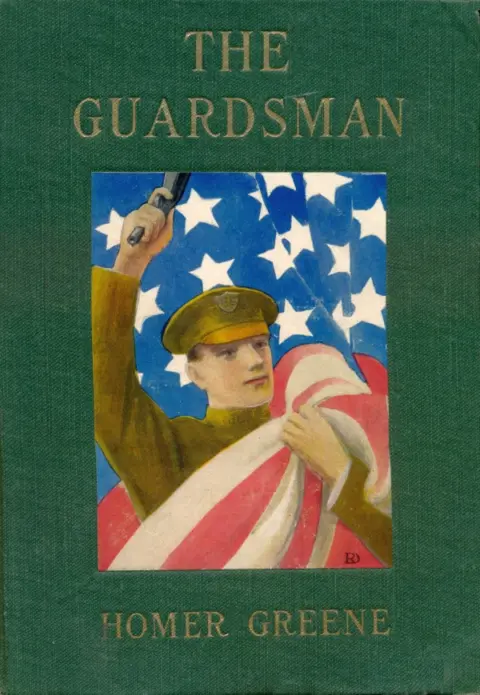
THE CLASSIC COLLECTION · 1919
"The Guardsman" by Homer Greene is a novel written in the early 20th century. The story revolves around the youthful characters in the town of Fairweather as they navigate the mischief of Hallowe'en and face the consequences of their actions. The main characters, Halpert McCormack and Benjamin Barriscale, both come from prominent families and engage in a series of antics that culminate in the theft of a statue from Barriscale's home, which leads to unintended afflictions and moral dilemmas. The opening of the novel introduces readers to the mischief and chaotic spirit of Hallowe'en in 1909, showcasing a group of boys, led by Hal McCormack, who embark on a nighttime escapade that involves removing a cobbler's sign and aiming to place it on the property of Benjamin Barriscale, the wealthy head of the Barriscale Manufacturing Company. However, their adventure escalates when they consider stealing an ornamental marble statue from Barriscale’s fountain, leading to the accidental breaking of the statue later in the story when a rival group encounters it. The narrative sets up a conflict rooted in youthful indiscretion, friendship, and the pursuit of social standing, paving the way for themes of accountability and personal growth as Hal must face the repercussions of their Hallowe'en antics.
Introduction adapted from the source catalogue; source summaries may be automatically generated.
Free to read · English · 71,044 words · No account needed
MAKE TIME FOR A GOOD BOOK
On by default. Untick to stop anonymous reading totals. Each page counts after 10 seconds in view. How this works.
Anonymous counting is on unless you have switched it off.
The young fellow stopped suddenly, faced sharply toward the boy, and laid a hand on his shoulder.
“Look here, Chick!” he exclaimed; “have you found anything?”
“Me? Found anything?” repeated Chick, in apparent surprise.
“Yes; a letter, or anything like that?”
“Why, have you lost one?”
“Chick! Don’t keep me in suspense! If you’ve found my letter, tell me. I’ve worried myself pretty nearly into my grave over it, already.”
“I ast you, have you lost a letter?” Chick was very resolute and
determined.
“Yes,” was the equally resolute reply, “I’ve lost one. Have you found
it?”
They were standing on a quiet street corner, scarcely a block away from the Lewis home. One or two men passed by and spoke to them, but the greetings went unheeded.
“I’ve found a letter,” said Chick; “but how do I know whether it’s yourn or not? Who was it to?”
The young fellow swallowed awkwardly before replying, and grew red in the face. His first impulse was to resent the question as an unwarranted intrusion into his private affairs. But, on second thought, he knew that such an attitude on his part, especially toward Chick, would be extremely poor policy.
“Why,” he exclaimed finally, “it was to a girl by the name of Rachael, and it was signed ‘Alfred.’”
“That’s all right so far,” assented Chick. “But they’s lots o’ Rachaels in the U. S., and the world’s full of Alfreds. Tell me what was in it.”
“Oh, now, look here, Chick! That’s not necessary. Surely I’ve identified the letter sufficiently, and I’m entitled to have it.”
But Chick was obdurate. “No,” he said, “a man can’t be too careful about love-letters. If this here letter should git into the hands o’ the wrong party my goose would be cooked. You got to tell me what was in the letter ’fore I give it up.”
Alfred Lewis looked up the street, then down the street, and then at
Chick.
“Well,” he said finally, “I asked Rachael to marry me.”
“That’s right!” assented the boy. “You sure did. Now, was they any p. s. on the end, or wasn’t they?”
“I believe there was.”
“What was in it?”
“Look here, Chick! Confound you! you’re getting too blamed inquisitive.”
But Chick straightened up as far as his deformed shoulders would permit, and thrust his hands determinedly into his pockets.
“I got to know,” he said.
There was apparently no escape, and the young lover, with scarlet face and stammering tongue, blurted out:
Your reading position is saved on this browser. Take it to another device with a library code. Reading pages adapt to text, rather than matching a printed edition.
Homer Greene
Homer Greene
Homer Greene
Homer Greene
BEHIND THE BOOK
This eBook is for the use of anyone anywhere in the United States and most other parts of the world at no cost and with almost no restrictions whatsoever. You may copy it, give it away or re-use it under the terms of the Project Gutenberg License included with this eBook or online at www.gutenberg.org. If you are not located in the United States, you will have to check the laws of the country where you are located before using this eBook. Read the source licence.
The original source file, including credits and licence, is retained by this library. Request an original-format copy at no charge. Please include the book title and Project Gutenberg identifier #55768.
KEEP YOUR CURIOSITY GOING
Coulson Kernahan

Maurice Baring
Frances Wright
Cécile Tormay

Frederic Jesup Stimson

W. H. P. (William Henry Pope) Jarvis