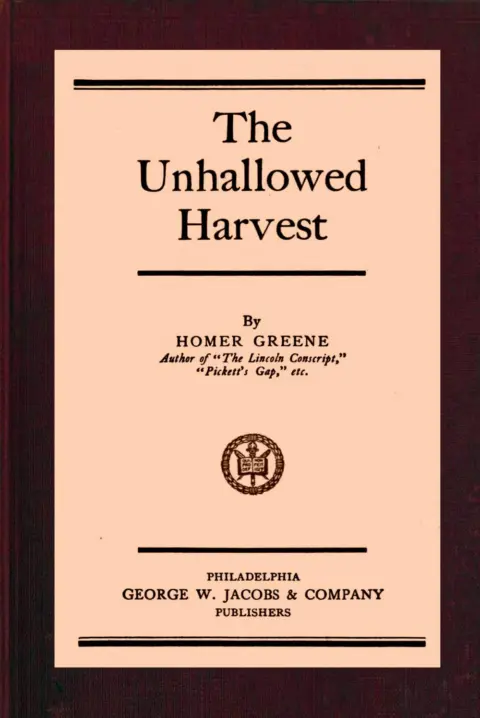
The unhallowed harvest
Homer Greene
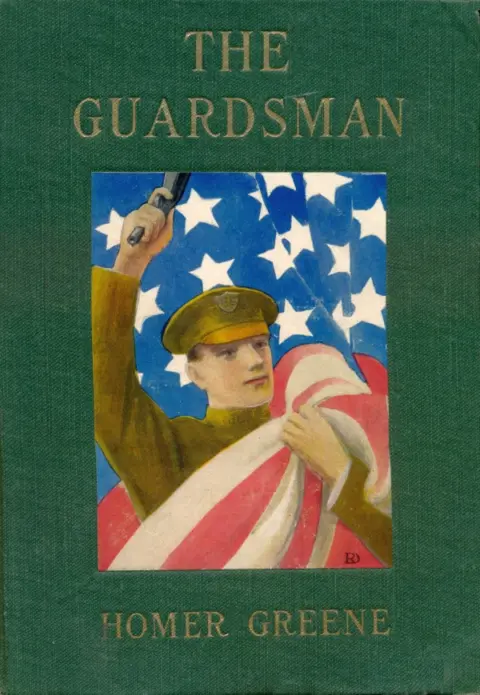
THE CLASSIC COLLECTION · 1919
"The Guardsman" by Homer Greene is a novel written in the early 20th century. The story revolves around the youthful characters in the town of Fairweather as they navigate the mischief of Hallowe'en and face the consequences of their actions. The main characters, Halpert McCormack and Benjamin Barriscale, both come from prominent families and engage in a series of antics that culminate in the theft of a statue from Barriscale's home, which leads to unintended afflictions and moral dilemmas. The opening of the novel introduces readers to the mischief and chaotic spirit of Hallowe'en in 1909, showcasing a group of boys, led by Hal McCormack, who embark on a nighttime escapade that involves removing a cobbler's sign and aiming to place it on the property of Benjamin Barriscale, the wealthy head of the Barriscale Manufacturing Company. However, their adventure escalates when they consider stealing an ornamental marble statue from Barriscale’s fountain, leading to the accidental breaking of the statue later in the story when a rival group encounters it. The narrative sets up a conflict rooted in youthful indiscretion, friendship, and the pursuit of social standing, paving the way for themes of accountability and personal growth as Hal must face the repercussions of their Hallowe'en antics.
Introduction adapted from the source catalogue; source summaries may be automatically generated.
Free to read · English · 71,044 words · No account needed
MAKE TIME FOR A GOOD BOOK
On by default. Untick to stop anonymous reading totals. Each page counts after 10 seconds in view. How this works.
Anonymous counting is on unless you have switched it off.
Chick went on down the street toward the Barriscale plant, but he did not enter it. It was within a quarter of an hour of quitting time anyway; so he hung around in the neighborhood until the men came out, hundreds of them, and, separating into groups, entered the four streets that converged upon the plaza fronting the mills. His quick eye detected young Lewis in the crowd, in company with a fellow employee, and, walking a few rods in the rear, he trailed along after them.
It was not until half a dozen or more blocks had been covered that the two young men separated, and the one whom Chick sought went on alone. He walked rapidly and it was no light task for the boy with the physical handicap to overtake him. But he did overtake him eventually, and, half out of breath, shuffled along beside him.
The young man, seeing who his companion was, made no show, either of pleasure or displeasure. He looked anxious and worried, as though his mind was absorbed in the thought of some impending misfortune.
“Oh, is that you, Chick?” he said quietly. “Going my way?”
“Yes, for a block or two,” wheezed the boy. “Thought you might like to
have company.”
“Sure! Come along! Am I walking a little too fast for you?”
“Oh, I guess I can keep up all right.”
But the young man slowed down in his gait, nevertheless, and made it easier for the boy to keep alongside.
For a little while after that neither of them spoke, Chick because he had not yet recovered sufficient breath, and Lewis because he was not in the mood for talking.
It was Chick who at last broke the silence.
“Lemme see!” said he, “your name’s Alfred, ain’t it? They call you Fred; but your right name’s Alfred, ain’t it?”
“Yes. Why?”
The young man seemed to evince little curiosity, and to ask the
question more as a matter of form than because of a desire to seek
information.
“Oh, nothin’ much,” replied Chick. “Only, if you was, now, writin’ a letter, say to a girl, you’d sign your name Alfred, I s’pose?”
Young Lewis awakened out of his apparent lethargy and glanced down curiously at the boy who was, with some effort, keeping up with him.
“Why, I suppose so,” he said. “What do you want to know for?”
Chick did not reply to the question, but, after a habit he had, he
asked another one instead.
“And if you was writin’ to any girl, you’d most likely be writin’ to a girl name o’ Rachael, I s’pose?”
Your reading position is saved on this browser. Take it to another device with a library code. Reading pages adapt to text, rather than matching a printed edition.
Homer Greene
Homer Greene
Homer Greene
Homer Greene
BEHIND THE BOOK
This eBook is for the use of anyone anywhere in the United States and most other parts of the world at no cost and with almost no restrictions whatsoever. You may copy it, give it away or re-use it under the terms of the Project Gutenberg License included with this eBook or online at www.gutenberg.org. If you are not located in the United States, you will have to check the laws of the country where you are located before using this eBook. Read the source licence.
The original source file, including credits and licence, is retained by this library. Request an original-format copy at no charge. Please include the book title and Project Gutenberg identifier #55768.
KEEP YOUR CURIOSITY GOING
Coulson Kernahan

Maurice Baring
Frances Wright
Cécile Tormay

Frederic Jesup Stimson

W. H. P. (William Henry Pope) Jarvis