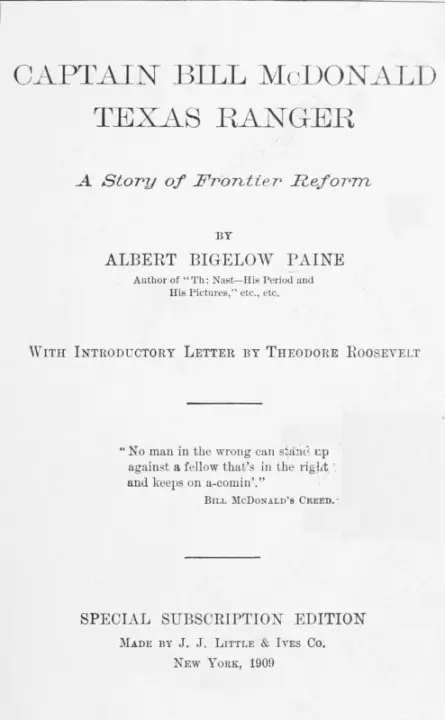
Captain Bill McDonald, Texas Ranger: A Story of Frontier Reform
Albert Bigelow Paine
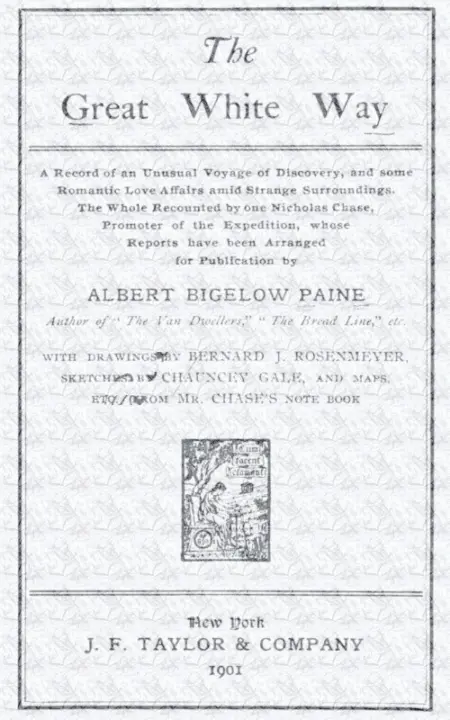
THE CLASSIC COLLECTION · 1901
"The Great White Way" by Albert Bigelow Paine is an adventure novel written in the early 20th century. The story follows Nicholas Chase, a man inspired by generations of sea captains, who embarks on an ambitious expedition to the South Pole, driven by his dreams of discovery and a promise of romantic encounters amid strange surroundings. Along his journey, he is joined by a colorful cast of characters, including Chauncey Gale, a wealthy real estate mogul; his daughter Edith; and a scientific mind named Ferratoni. The opening of the novel introduces us to Nicholas Chase, who, after selling a lackluster business venture, decides to pursue his lifelong dream of exploring the South Pole. His ambition is met with skepticism by scientists who do not share his vision of a warm, habitable land beyond the icy barrier. After grappling with challenges in securing funding and support, Chase ultimately gains the enthusiastic backing of Chauncey Gale and his daughter, setting in motion an adventure filled with anticipation and the promise of discovery. With an eclectic cast and his unyielding idealism, Chase is armed with hope as he prepares to embark on what appears to be an extraordinary journey into the unknown.
Introduction adapted from the source catalogue; source summaries may be automatically generated.
Free to read · English · 70,023 words · No account needed
MAKE TIME FOR A GOOD BOOK
On by default. Untick to stop anonymous reading totals. Each page counts after 10 seconds in view. How this works.
Anonymous counting is on unless you have switched it off.
“Well, here we are,” announced Captain Biffer, as we grouped together on the deck to survey the scene. “And here we’re likely to stay for one while, I’m thinking. This is your warm world—how do you like it?”
“Better than a cold sea,” I said, “when there’s a northeast gale
blowing.”
“How long do we lay up here, Chase?” asked Chauncey Gale. “You’re running this excursion.”
I was secretly uneasy, but I made light of the situation.
“Oh, this is the usual thing. We’ll be here a day or two, perhaps, then the ice will separate again, or a lead form that will let us back to open water. We could hardly be shut in long at this season.”
“I’d invent something to beat this game if I was going to play it regular,” said Gale, then added, “Great place this to lay out an addition. ‘Frozenhurst,’ how’s that for a name?”
“Can we go out on the ice?” asked Edith Gale.
“Of course, if we are careful, and do not go far from the ship,” I said. “We can try our new snow-shoes.”
“I shall make the first Antarctic experiment in wireless communication,”
observed Ferratoni.
“Good time to look for the bake-apple,” suggested Mr. Larkins.
But just here came a sharp protest from Zar.
“Yas, I sh’d say baked apples! Well, I reckon we jes’ ’bout as apt to fin’ baked apples as anything else in dis refrigidous country! Not much, my Miss Edith ain’ gwine out on dat ol’ humpety, bow-back ice-pon’! No, sah!”
Zar’s characterization of the sea’s aspect referred to the huge hummocks and heaved appearance of the ice in places. There were also many bergs, apparently at no great distance, and in spite of the old woman’s strenuous objections, Edith Gale and I planned to visit the nearest of these.
We did so in the afternoon. Numberless penguins, sea-leopards and other species of Antarctic life had gathered curiously about the Billowcrest during the day, and some of these waddled and floundered after us when we set out. We could not make very rapid progress with our new foot-gear, and for a little distance made an interesting spectacle, with our procession of followers trailing out behind. “All hands and the cook” gathered on the deck to enjoy it.
We carried one of Ferratoni’s telephones—a neat, compact little affair, with handles for convenience, and from nearly a mile distant communicated with the inventor, who had ascended to the crow’s-nest for the experiment. It was a successful trial, and we believed it would have been equally so had the distance been much greater.
Your reading position is saved on this browser. Take it to another device with a library code. Reading pages adapt to text, rather than matching a printed edition.
Albert Bigelow Paine
Albert Bigelow Paine
Albert Bigelow Paine
Albert Bigelow Paine
BEHIND THE BOOK
This eBook is for the use of anyone anywhere in the United States and most other parts of the world at no cost and with almost no restrictions whatsoever. You may copy it, give it away or re-use it under the terms of the Project Gutenberg License included with this eBook or online at www.gutenberg.org. If you are not located in the United States, you will have to check the laws of the country where you are located before using this eBook. Read the source licence.
The original source file, including credits and licence, is retained by this library. Request an original-format copy at no charge. Please include the book title and Project Gutenberg identifier #57527.
KEEP YOUR CURIOSITY GOING
Coulson Kernahan

Maurice Baring
Frances Wright
Cécile Tormay

Frederic Jesup Stimson

W. H. P. (William Henry Pope) Jarvis