THE CLASSIC COLLECTION✦The Story of Francis CluddeCLASSIC FREE BOOKS
The Story of Francis Cludde
Stanley John Weyman
THE CLASSIC COLLECTION · 1919
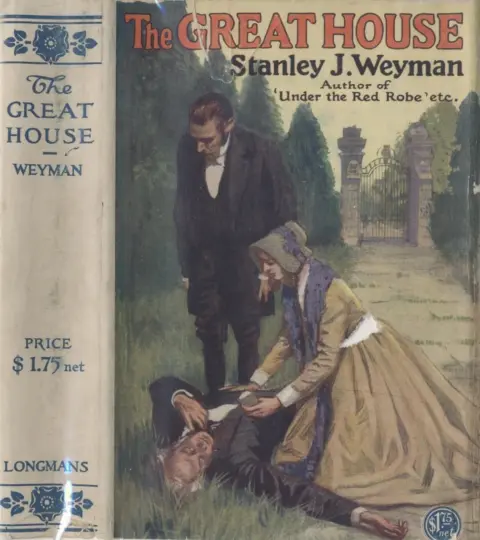
"The Great House" by Stanley John Weyman is a historical novel likely written in the early 20th century. Set primarily in 19th-century France and England, the story begins with Mary Audley, a young woman navigating her precarious situation as the daughter of an artist and a dependent figure in a Polish household. The narrative sheds light on themes of social class, identity, and belonging through her experiences and interactions with the other characters, particularly as she starts to encounter her estranged English relatives. At the start of the narrative, we meet Mary Audley, who spends her 20th birthday in a poverty-stricken dormitory, reflecting on her isolation and yearning for a more fulfilling life. After learning about a potential connection to her uncle in England, she faces a whirlwind of emotions as she prepares to leave France for her new life. During her journey, she receives unexpected kindness from her English cousin, Lord Audley, which influences her perspective on family and belonging. Meanwhile, the backdrop of social and political turmoil sets the stage for further developments in Mary’s interactions with her relatives and her quest for a sense of purpose.
Introduction adapted from the source catalogue; source summaries may be automatically generated.
Free to read · English · 127,315 words · No account needed
MAKE TIME FOR A GOOD BOOK
On by default. Untick to stop anonymous reading totals. Each page counts after 10 seconds in view. How this works.
Anonymous counting is on unless you have switched it off.
The left hand of the hustings was allotted to him, the right hand to Mottisfont, and by a little after eleven both parties had crammed and crushed,
With blustering, bullying, and brow-beating,
A little pummelling and maltreating,
And elbowing, jostling and cajoling,
into their places in front of the platform, the bullies and truncheon-men being posted well to the fore, or craftily ranged where the frontiers met. The bands boomed and blared, the men huzzaed, the air shook, the banners waved, every window that looked out upon the seething mob was white with faces, every ’vantage-point was occupied. It was such a day and such a contest as Riddsley had never seen. The eyes of the country, it was felt, were upon it! Fights took place every five minutes, oaths and bets flew like hail over the heads of the crowd, coarse wit met coarser nicknames, and now and again shrieks varied the hubbub as the huge press of people, gathered from miles round, swayed under the impact of some vicious rush.
“Hurrah! Hurrah! Mottisfont for ever! Basset! Basset and the Big Loaf! Basset! Basset! Hurrah! Mottisfont! Hurrah!”
Then, in a short-lived silence, “Ten to one on Mottisfont! Three cheers for the Duke!” and a roar of laughter.
Or a hundred voices would raise
John Barley-corn, my Joe, John!
When we were first acquaint!
but never got beyond the first two lines, either because they were howled down or they knew no more of the words. The Peelites answered with their mournful,
Child, is thy father dead?
Father is gone!
Why did they tax his bread?
God’s will be done!
or with the quicker,
Oh, landlords’ devil take
Thy own elect I pray!
Who taxed our cake, and took our cake,
And threw our cake away!
On this would ensue a volley of personalities. “What would you be without your starch, Hayward?” “How’s your dad, Farthingale?” “Who whopped his wife last Saturday?” “Hurrah! Hurrah! Who said Potatoes?”
For nearly an hour this went on, the blare of the bands, the uproar, the cheering, the abuse never ceasing. Then the town-crier appeared upon the vacant hustings. He rang his bell for silence and for a moment obtained it. On his heels entered, first the mayor and his assistants, then the candidates, the proposers, the seconders. Each, as he made his appearance, was greeted with a storm of groans, cheers, and cat-calls. Each put on to meet it such a show of ease as he could, some smiling, some affecting ignorance. The candidates and their supporters filed to either side, while the flustered mayor took his stand in the middle with the town clerk at his elbow.
Your reading position is saved on this browser. Take it to another device with a library code. Reading pages adapt to text, rather than matching a printed edition.
Stanley John Weyman
Stanley John Weyman
Stanley John Weyman
Stanley John Weyman
BEHIND THE BOOK
This eBook is for the use of anyone anywhere in the United States and most other parts of the world at no cost and with almost no restrictions whatsoever. You may copy it, give it away or re-use it under the terms of the Project Gutenberg License included with this eBook or online at www.gutenberg.org. If you are not located in the United States, you will have to check the laws of the country where you are located before using this eBook. Read the source licence.
The original source file, including credits and licence, is retained by this library. Request an original-format copy at no charge. Please include the book title and Project Gutenberg identifier #39294.
KEEP YOUR CURIOSITY GOING
Cécile Tormay

Moritz Busch
Coulson Kernahan
John L. Ransom

Maurice Baring
Frances Wright