THE CLASSIC COLLECTION✦The Story of Francis CluddeCLASSIC FREE BOOKS
The Story of Francis Cludde
Stanley John Weyman
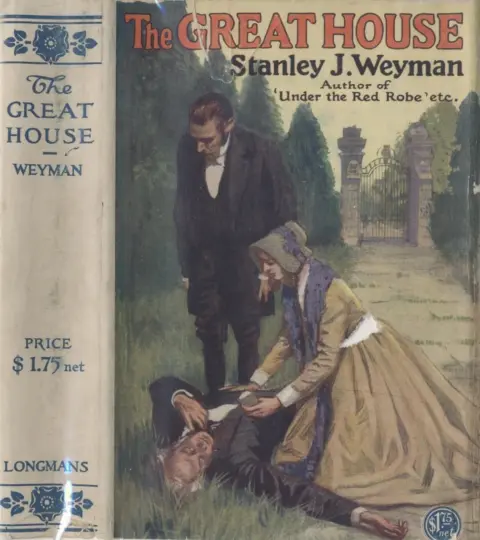
THE CLASSIC COLLECTION · 1919
"The Great House" by Stanley John Weyman is a historical novel likely written in the early 20th century. Set primarily in 19th-century France and England, the story begins with Mary Audley, a young woman navigating her precarious situation as the daughter of an artist and a dependent figure in a Polish household. The narrative sheds light on themes of social class, identity, and belonging through her experiences and interactions with the other characters, particularly as she starts to encounter her estranged English relatives. At the start of the narrative, we meet Mary Audley, who spends her 20th birthday in a poverty-stricken dormitory, reflecting on her isolation and yearning for a more fulfilling life. After learning about a potential connection to her uncle in England, she faces a whirlwind of emotions as she prepares to leave France for her new life. During her journey, she receives unexpected kindness from her English cousin, Lord Audley, which influences her perspective on family and belonging. Meanwhile, the backdrop of social and political turmoil sets the stage for further developments in Mary’s interactions with her relatives and her quest for a sense of purpose.
Introduction adapted from the source catalogue; source summaries may be automatically generated.
Free to read · English · 127,315 words · No account needed
MAKE TIME FOR A GOOD BOOK
On by default. Untick to stop anonymous reading totals. Each page counts after 10 seconds in view. How this works.
Anonymous counting is on unless you have switched it off.
She continued to look back and to wave her handkerchief, until nothing remained but a light or two in a bank of shadow. That was the last she was to see of the land which had been her home for ten years; and chilled and lonely she turned about and did what, had she been an older traveller, she would have done before. She sought the after-cabin. Alas, a glance from the foot of the companion was enough! Every place was taken, every couch occupied, and the air, already close, repelled her. She climbed to the deck again, and was seeking some corner where she could sit, sheltered from the wind and rain, when the captain saw her and fell foul of her.
“Now, young lady,” he said, “no woman’s allowed on deck at night!”
“Oh, but,” she protested, “there’s no room downstairs!”
“Won’t do,” he answered roughly. “Lost a woman overboard once, and as much trouble about her as about all the men, drunk or sober, I’ve ever carried. All women below, all women below, is the order! Besides,” more amicably, as he saw by a ray of lantern-light that she was young and comely, “it’s wet, my dear, and going to be d—d wet, and as dark as Wapping!”
“But I’ve a cloak,” she petitioned, “if I sit quite still, and——”
A tall form loomed up at the captain’s elbow. “This is the lady I am looking for,” the new-comer said. “It will be all right, Captain Jones.”
The captain turned sharply. “Oh, my lord,” he said, “I didn’t know; but with petticoats and a dark night, blest if you know where you are! I’m sure I beg the young lady’s pardon. Quite right, my lord, quite right!” With a rough salute he went forward and the darkness swallowed him.
“Lord Audley?” Mary said. She spoke quietly, but to do so she had to
steady her voice.
“Yes,” he replied. “I knew that you were crossing to-night, and as I had to go over this week I chose this evening. I’ve reserved a cabin for you.”
“Oh, but,” she remonstrated, “I don’t think you should have done that! I don’t know that I can——”
“Afford it?” he said coolly. “Then—as it is a matter of some shillings—your kinsman will presume to pay for it.”
It was a small thing, and she let it pass. “But who told you,” she asked, “that I was crossing to-night?”
“The Princess. You don’t feel, I suppose, that as you are crossing, it was my duty to stay in France?”
“Oh no!” she protested.
Your reading position is saved on this browser. Take it to another device with a library code. Reading pages adapt to text, rather than matching a printed edition.
Stanley John Weyman
Stanley John Weyman
Stanley John Weyman
Stanley John Weyman
BEHIND THE BOOK
This eBook is for the use of anyone anywhere in the United States and most other parts of the world at no cost and with almost no restrictions whatsoever. You may copy it, give it away or re-use it under the terms of the Project Gutenberg License included with this eBook or online at www.gutenberg.org. If you are not located in the United States, you will have to check the laws of the country where you are located before using this eBook. Read the source licence.
The original source file, including credits and licence, is retained by this library. Request an original-format copy at no charge. Please include the book title and Project Gutenberg identifier #39294.
KEEP YOUR CURIOSITY GOING
Cécile Tormay

Moritz Busch
Coulson Kernahan
John L. Ransom

Maurice Baring
Frances Wright