THE CLASSIC COLLECTION✦The Story of Francis CluddeCLASSIC FREE BOOKS
The Story of Francis Cludde
Stanley John Weyman
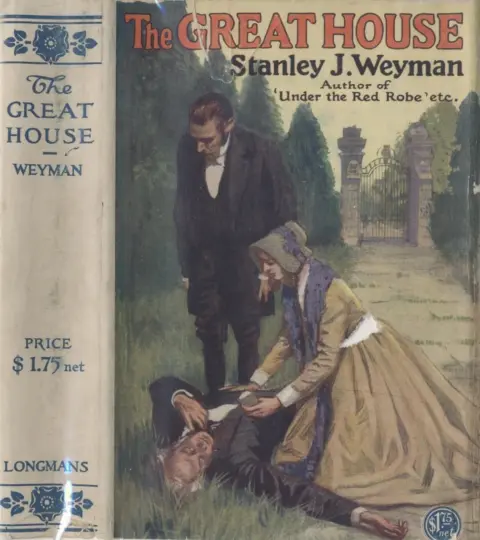
THE CLASSIC COLLECTION · 1919
"The Great House" by Stanley John Weyman is a historical novel likely written in the early 20th century. Set primarily in 19th-century France and England, the story begins with Mary Audley, a young woman navigating her precarious situation as the daughter of an artist and a dependent figure in a Polish household. The narrative sheds light on themes of social class, identity, and belonging through her experiences and interactions with the other characters, particularly as she starts to encounter her estranged English relatives. At the start of the narrative, we meet Mary Audley, who spends her 20th birthday in a poverty-stricken dormitory, reflecting on her isolation and yearning for a more fulfilling life. After learning about a potential connection to her uncle in England, she faces a whirlwind of emotions as she prepares to leave France for her new life. During her journey, she receives unexpected kindness from her English cousin, Lord Audley, which influences her perspective on family and belonging. Meanwhile, the backdrop of social and political turmoil sets the stage for further developments in Mary’s interactions with her relatives and her quest for a sense of purpose.
Introduction adapted from the source catalogue; source summaries may be automatically generated.
Free to read · English · 127,315 words · No account needed
MAKE TIME FOR A GOOD BOOK
On by default. Untick to stop anonymous reading totals. Each page counts after 10 seconds in view. How this works.
Anonymous counting is on unless you have switched it off.
“Very good,” Mary replied, sparkling a little as she looked at him—was not the sun shining? “My uncle is much better this morning. Dr. Pepper says that it was mainly exertion acting on a weak heart. He expects him to be downstairs in a week and to be himself in a fortnight. But he will have to be more careful in future.”
“That is good!”
“He says, too, that if you had not acted so promptly, my uncle must
have died.”
“Well, he was pretty far gone, I must say.”
“So, as he will not thank you himself, you must let me thank you.” And Mary held out the hand she had hitherto kept in her muff. She was determined not to be a prude.
He pressed it discreetly. “I am glad,” he said. “Very glad. Perhaps after this he may think better of me.”
She laughed. “I don’t think that there is a chance of it,” she said.
“No? Well, I suppose it was foolish, but do you know, I did hope that this might bring us together.”
“You may dismiss it,” she answered, smiling.
“Ah!” he said. “Then tell me this. How in the world did he come to be there? Without a hat? Without a coat? And so far from the house?”
Mary hesitated. He had turned, they were walking side by side. “I am not sure that I ought to tell you,” she said. “What I know I gathered from a word that Mr. Audley let fall when he was rambling. He seems to have had some instinct, some feeling that you were there and to have been forced to learn if it was so.”
“But forced? By what?” Lord Audley asked. “I don’t understand.”
“I don’t understand either,” Mary answered.
“He could not know that we were there?”
“But he seems to have known.”
“Strange,” he murmured. “Does he often stray away like that?”
“He does, sometimes,” she admitted reluctantly.
“Ah!” Audley was silent a moment. Then, “Well, I am glad he is better,” he said in the tone of one who dismisses a subject. “Let us talk of something else—ourselves. Are you aware that this is the fourth time that I have come to your rescue?”
“I know that it is the fourth time that you have been very useful,” she admitted. She wished that she had been able to control her color, but though he spoke playfully there was meaning in his voice.
“I, too, have a second sense it seems,” he said, almost purring as he looked at her. “Did you by any chance think of me, when you missed your uncle?”
Your reading position is saved on this browser. Take it to another device with a library code. Reading pages adapt to text, rather than matching a printed edition.
Stanley John Weyman
Stanley John Weyman
Stanley John Weyman
Stanley John Weyman
BEHIND THE BOOK
This eBook is for the use of anyone anywhere in the United States and most other parts of the world at no cost and with almost no restrictions whatsoever. You may copy it, give it away or re-use it under the terms of the Project Gutenberg License included with this eBook or online at www.gutenberg.org. If you are not located in the United States, you will have to check the laws of the country where you are located before using this eBook. Read the source licence.
The original source file, including credits and licence, is retained by this library. Request an original-format copy at no charge. Please include the book title and Project Gutenberg identifier #39294.
KEEP YOUR CURIOSITY GOING
Cécile Tormay

Moritz Busch
Coulson Kernahan
John L. Ransom

Maurice Baring
Frances Wright