THE CLASSIC COLLECTION✦The Story of Francis CluddeCLASSIC FREE BOOKS
The Story of Francis Cludde
Stanley John Weyman
THE CLASSIC COLLECTION · 1919
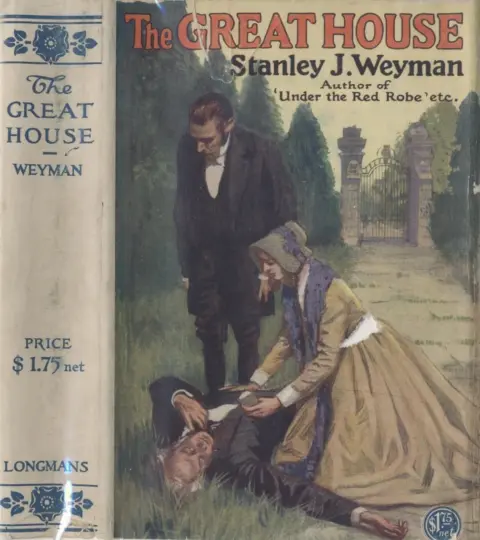
"The Great House" by Stanley John Weyman is a historical novel likely written in the early 20th century. Set primarily in 19th-century France and England, the story begins with Mary Audley, a young woman navigating her precarious situation as the daughter of an artist and a dependent figure in a Polish household. The narrative sheds light on themes of social class, identity, and belonging through her experiences and interactions with the other characters, particularly as she starts to encounter her estranged English relatives. At the start of the narrative, we meet Mary Audley, who spends her 20th birthday in a poverty-stricken dormitory, reflecting on her isolation and yearning for a more fulfilling life. After learning about a potential connection to her uncle in England, she faces a whirlwind of emotions as she prepares to leave France for her new life. During her journey, she receives unexpected kindness from her English cousin, Lord Audley, which influences her perspective on family and belonging. Meanwhile, the backdrop of social and political turmoil sets the stage for further developments in Mary’s interactions with her relatives and her quest for a sense of purpose.
Introduction adapted from the source catalogue; source summaries may be automatically generated.
Free to read · English · 127,315 words · No account needed
MAKE TIME FOR A GOOD BOOK
On by default. Untick to stop anonymous reading totals. Each page counts after 10 seconds in view. How this works.
Anonymous counting is on unless you have switched it off.
“Mr. Peter Audley,” Stubbs replied, “his only brother, would succeed, if he were alive. But it is common ground that he is dead. I knew Mr. Peter, and, if I may say it of an Audley, my lord, a more shiftless, weak, improvident gentleman never lived. And obstinate as the devil! He married into trade, and Mr. John never forgave it—never forgave it, my lord. Never spoke of his brother or to his brother from that time. It was before the Reform Bill,” the lawyer continued with a sigh. “There were no railways then and things were different. Dear, dear, how the world changes! Mr. Peter must have gone abroad ten years ago, but until he was mentioned in the suit I don’t think that I had heard his name ten times in as many years. And he an Audley!”
“He had a child?”
“Only one, a daughter.”
“Would she come in after Mr. John?”
“Yes, my lord, she would—if living.”
“I’ve been talking to her this evening.”
“Ah!” The lawyer was not so simple as he seemed, and for a minute or two he had foreseen the dénouement. “Ah!” he repeated, thoughtfully rubbing his plump calf. “I see, my lord. Mr. Peter Audley’s daughter? Really! And if I may venture to ask, what is she like?”
Audley paused before he answered. Then, “If you have painted the father aright, Stubbs, I should say that she was his opposite in all but his obstinacy. A calm and self-reliant young woman, if I am any judge.”
“And handsome?”
“Yes, with a look of breeding. At the same time she is penniless and dependent, teaching English in a kind of charity school, cheek by jowl with a princess!”
“God bless my soul!” cried the lawyer, astonished at last. “A
princess!”
“Who is a good creature as women go, but as likely as not to send her
adrift to-morrow.”
“Tut-tut-tut!” muttered the other.
“However, I’ll tell you the story,” Audley concluded. And he did so.
When he had done, “Well,” Stubbs exclaimed, “for a coincidence——”
“Ah, there,” the young man broke in, “I fancy, all’s not said. I take it the Princess noted the name, but was too polite to question me. Anyway, the girl is there. She is dependent, friendless; attractive, and well-bred. For a moment it did occur to me—she is John Audley’s heiress—that I might make all safe by——” His voice dropped. His last words were inaudible.
“The chance is so very remote,” said the lawyer, aware that he was on delicate ground, and that the other was rather following out his own thoughts than consulting him.
Your reading position is saved on this browser. Take it to another device with a library code. Reading pages adapt to text, rather than matching a printed edition.
Stanley John Weyman
Stanley John Weyman
Stanley John Weyman
Stanley John Weyman
BEHIND THE BOOK
This eBook is for the use of anyone anywhere in the United States and most other parts of the world at no cost and with almost no restrictions whatsoever. You may copy it, give it away or re-use it under the terms of the Project Gutenberg License included with this eBook or online at www.gutenberg.org. If you are not located in the United States, you will have to check the laws of the country where you are located before using this eBook. Read the source licence.
The original source file, including credits and licence, is retained by this library. Request an original-format copy at no charge. Please include the book title and Project Gutenberg identifier #39294.
KEEP YOUR CURIOSITY GOING
Cécile Tormay

Moritz Busch
Coulson Kernahan
John L. Ransom

Maurice Baring
Frances Wright