THE CLASSIC COLLECTION✦Froth: A NovelCLASSIC FREE BOOKS
Froth: A Novel
Armando Palacio Valdés
THE CLASSIC COLLECTION · 1894
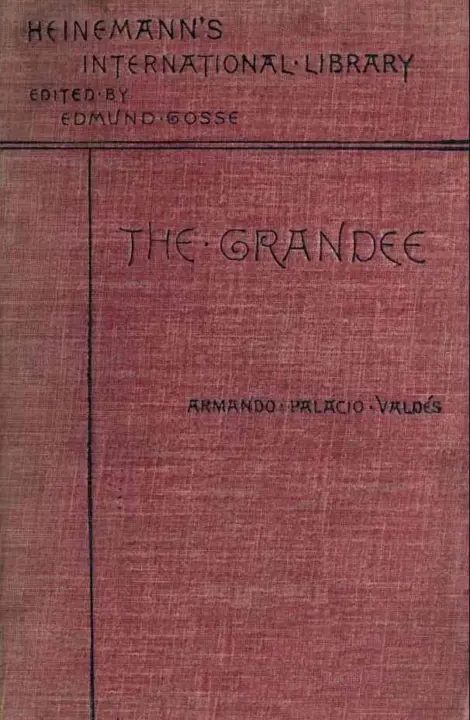
"The Grandee" by Armando Palacio Valdés is a novel written in the late 19th century. The story is set in a provincial city in Spain, focusing on the life and dynamics within a noble household, particularly that of the protagonist Don Pedro Quiñones de Leon, an aging grandee struggling with his sense of dignity in a changing society. The narrative explores themes of societal hierarchy, pride, and personal turmoil against the backdrop of local customs and the intricacies of family relationships. At the start of "The Grandee," the atmospheric setting of Lancia is established through a wintry night, with elements that reflect the town's old-world charm and the quirks of its inhabitants. We meet Don Pedro Quiñones, who navigates the challenges of his aristocratic status despite facing paralysis and the burden of maintaining respectability. His interactions with guests during a social gathering reveal a tapestry of relationships intertwined with humor, social expectations, and unfulfilled desires, setting the stage for deeper explorations of the characters' motivations and conflicts as the story unfolds. The text hints at underlying tensions, notably regarding Don Pedro's strained marriage to Amalia, and foreshadows the complexities and darker themes that will be explored further in the narrative.
Introduction adapted from the source catalogue; source summaries may be automatically generated.
Free to read · English · 95,134 words · No account needed
MAKE TIME FOR A GOOD BOOK
On by default. Untick to stop anonymous reading totals. Each page counts after 10 seconds in view. How this works.
Anonymous counting is on unless you have switched it off.
"And why cooked potatoes? I have as much courage as you, fool! as I showed in the action of Orduna and Unza, and besides, I have six crosses at home."
"You? you?" said the gentleman, unable to resist a smile. "You never served excepting at the mess of the company."
The fury of the brother at hearing this was unbounded. He halloed, he stamped, he thumped the table. Finally he rushed to the door, from the threshold of which he began to apostrophise his friend with excited gestures.
"You say this because you are in your own house! Come out and say it
here! Come out with me!"
The baron looked at him with smiling curiosity.
"Calm yourself, calm yourself, Uncle Diego."
"Come out and fight with me! with sword, pistol, or what you like."
"Very well, man, very well. We will come out and kill each other; but it will only be to please you."
He then went with uncertain steps to the cupboard, and with some difficulty, for it was now completely dark, he put his hands into the press, and feeling about, drew forth two large cavalry swords.
"Take one," he said, handing one to the chaplain.
Fray Diego drew it from its sheath and began to fence with it. Whilst making these experiments Don Francisco regarded him with great satisfaction.
"Well, let us go," said the priest returning the weapon to its sheath.
"Quick, march."
And taking his shovel-hat that was lying on the floor, and concealing the sword under his robes, he passed out of the door. The baron caught up his cap, put on a heavy overcoat and followed him.
"Stop!" he exclaimed, before he had gone four steps. "Don't you think that we have left some liquor behind?"
Fray Diego gave an affirmative grunt. They re-entered the room, and feeling on the floor they came against the jar of gin that was not completely empty. This they poured into the glasses, and drank up all there was. Their next act was to sally into the street. The rough-stoned pavement was wet. A fine rain was falling, but it was so thick that it penetrated clothing as much as a sharp shower. Night had completely closed in; and as, according to the municipal customs, it wanted a good half-hour before the celebrated oil-lamps were lighted, darkness enveloped the rain-driven town. The two heroes, animated by a warlike spirit, perambulated the Calle del Pozo with determination, the cleric before, the noble behind, both muffled up to the eyes, each with the instrument of murder under his arm. They entered the Calle de las Hogueras, passed under the walls of the fortress and out by the road that runs by the old wall of the town. As the water filtered through their clothes, it refreshed their bodies, and partially equilibriated their tempers. Fray Diego became visibly calmer, and the black clouds of depression that oppressed him gradually dispersed, but the baron's haughty, cruel spirit became meanwhile a prey to the morbid conditions of the other. But both facing the prospect of death pursued their intrepid course through the night and rain. They went for some distance by the old wall until they came to the Sarrio road, which they took. They had not proceeded five minutes along it when they heard a groan. They stopped at once, and approaching the side-wall they caught sight of a bundle, which, on coming nearer, they found to be a child.
Your reading position is saved on this browser. Take it to another device with a library code. Reading pages adapt to text, rather than matching a printed edition.
Armando Palacio Valdés
Armando Palacio Valdés
Armando Palacio Valdés
Armando Palacio Valdés
BEHIND THE BOOK
This eBook is for the use of anyone anywhere in the United States and most other parts of the world at no cost and with almost no restrictions whatsoever. You may copy it, give it away or re-use it under the terms of the Project Gutenberg License included with this eBook or online at www.gutenberg.org. If you are not located in the United States, you will have to check the laws of the country where you are located before using this eBook. Read the source licence.
The original source file, including credits and licence, is retained by this library. Request an original-format copy at no charge. Please include the book title and Project Gutenberg identifier #31056.
KEEP YOUR CURIOSITY GOING
Coulson Kernahan

Maurice Baring
Frances Wright
Cécile Tormay

Frederic Jesup Stimson

W. H. P. (William Henry Pope) Jarvis