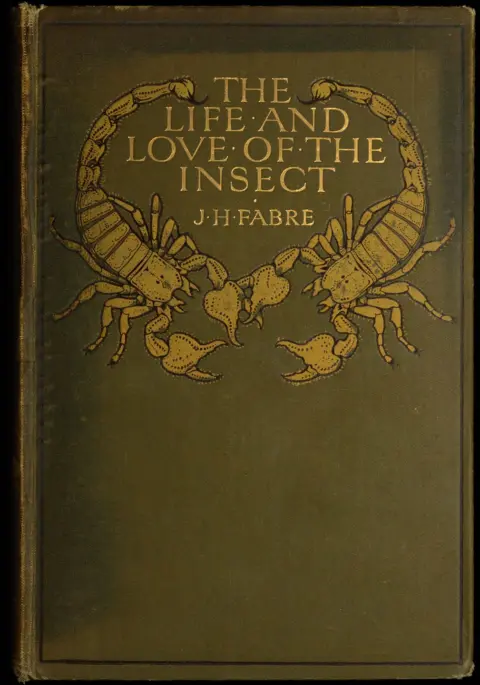
The Life and Love of the Insect
Jean-Henri Fabre
THE CLASSIC COLLECTION · 1919
"The Glow-Worm and Other Beetles" by Jean-Henri Fabre is a scientific publication written in the early 20th century. This work primarily explores the life and behavior of various insects, specifically focusing on beetles and their unique characteristics, with an emphasis on the glow-worm. Fabre’s writing reflects a meticulous approach to entomology, blending detailed observations with poetic descriptions of the insects’ lives and habitats. The opening of the text introduces the glow-worm, notable for its bioluminescent tail, which is celebrated in popular culture and science alike. Fabre details its physical characteristics and fascinating predatory behavior, particularly highlighting the glow-worm's method of incapacitating its prey, the snail, using an anaesthetic bite. With vivid imagery and scientific inquiry, the introduction sets the stage for a deeper exploration of the glow-worm’s life cycle, its evolutionary traits, and the intricate dynamics of its ecological niche. The narrative is rich with observations that blend scientific rigor with a narrative flair, inviting readers into the enchanting world of insects.
Introduction adapted from the source catalogue; source summaries may be automatically generated.
Free to read · English · 100,114 words · No account needed
MAKE TIME FOR A GOOD BOOK
On by default. Untick to stop anonymous reading totals. Each page counts after 10 seconds in view. How this works.
Anonymous counting is on unless you have switched it off.
Calicurgus (see Ringed Calicurgus), 267
Calliphora vomitoria (see Bluebottle), 95
Calosoma sycophanta, 356-357
Camel, 269
Cantharides, 164, 166, 169-170, 290
Canthon bispinus, 261
Capnodis tenebrionis (see Cloudy Buprestis), 381
Capricorn (see also the varieties below), 186-189, 193, 195-199, 203-204, 209, 220, 237, 380, 439
Capricorn of the Cherry-tree (see Cerambyx cerdo), 207-208, 210-211
Capricorn of the Oak (see Capricorn), 209-211
Carabus (see also Golden Carabus, Purple Carabus), 274, 353,
355-357, 363-364, 376
Carrion-beetle (see Silpha), 294
Cat, 307
Cave-bear, 450
Cellar-beetle, 294, 297, 387-388
Cerambyx (see the varieties below), 188, 191, 194, 197, 199, 201,
204, 205, 210, 212, 216
Cerambyx cerdo, 207-208
Cerambyx miles (see Capricorn), 187
Cerceris, 304
Cerocoma (see also Schaeffer's Cerocoma, Schreber's Cerocoma),
160-161, 163, 169-170, 182-183
Cetonia (see also Golden Cetonia, C. floricola), 101, 189, 266,
274, 291, 388
Cetonia aurata (see Golden Cetonia), 101
Cetonia floricola, 291
Chalcid (see also Gall-fly), 428-429
Chalicodoma (see Mason-bee), 136, 179
Chicken, 430
Chinese Carp, 306
Chrysobothrys chrysostigma, 217
Chrysomela (see Golden Apple-beetle), 274, 388
Cicada, 292, 366-368
Clairville, 298, 319, 325
Cleonus, 388
Clerus (see also the varieties below), 33
Clerus alvearius, 33
Clerus apiarius, 33
Cloudy Buprestis, 382, 397, 399
Clythra (see also the varieties below), 451-452, 456, 458-462, 465,
468-471, 473, 475, 477
Clythra longimana, 462, 467
Clythra longipes (Long-legged Clythra), 459, 462, 466, 468-469, 474,
476
Clythra quadripunctata (see Four-spotted Clythra), 459
Clythra sexmaculata (see Six-spotted Clythra), 462
Clythra taxicornis (see Taxicorn Clythra), 460
Clytus (see the varieties below), 218
Clytus arietis, 218
Clytus arvicola, 218
Clytus tropicus, 218
Coccinella (Ladybird), 388
Cockchafer (see also Common Cockchafer, Pine-chafer), 355
Cockroach (see Blackbeetle), 388
Coelioxys, 94, 95
Common Cockchafer, 368
Common Wasp, 71
Condillac, Etienne Bonnot de, Abbe de Mureaux, 185, 194
Confucius, 408
Copris (see also Lunary Copris, Spanish Copris), 237, 243, 258, 262,
266, 269, 289, 310, 347
Cotton-bee (see also Anthidium scapulare), 180, 270
Cow, 243, 269
Crane-fly, 430
Cricket (see also Italian Cricket), 237, 275, 279, 316
Criocephalus ferus, 217
Crioceris (see also the varieties below), 411-414, 418, 420-421, 423-424, 428, 432, 435, 441-442, 444-445, 450
Crioceris campestris (see Field Crioceris), 418
Crioceris duodecimpunctata (see Twelve-spotted Crioceris), 418
Crioceris merdigera (see Lily-beetle), 411
Crioceris paracenthesia, 444
Cryptocephalus (see also the varieties below), 451, 460, 462, 465,
467, 468-469, 471, 477
Cryptocephalus bipunctatus (Two-spotted Cryptocephalus), 460,
467-468, 473
Cryptocephalus ilicis (see Ilex Cryptocephalus), 460
Cyclostome, 8
Your reading position is saved on this browser. Take it to another device with a library code. Reading pages adapt to text, rather than matching a printed edition.
Jean-Henri Fabre
Jean-Henri Fabre
Jean-Henri Fabre
Jean-Henri Fabre
BEHIND THE BOOK
This eBook is for the use of anyone anywhere in the United States and most other parts of the world at no cost and with almost no restrictions whatsoever. You may copy it, give it away or re-use it under the terms of the Project Gutenberg License included with this eBook or online at www.gutenberg.org. If you are not located in the United States, you will have to check the laws of the country where you are located before using this eBook. Read the source licence.
The original source file, including credits and licence, is retained by this library. Request an original-format copy at no charge. Please include the book title and Project Gutenberg identifier #27868.
KEEP YOUR CURIOSITY GOING

John Muir

Asa Gray
Asa Gray

Florence Nightingale
Elizabeth Robins Pennell
Denison Olmsted